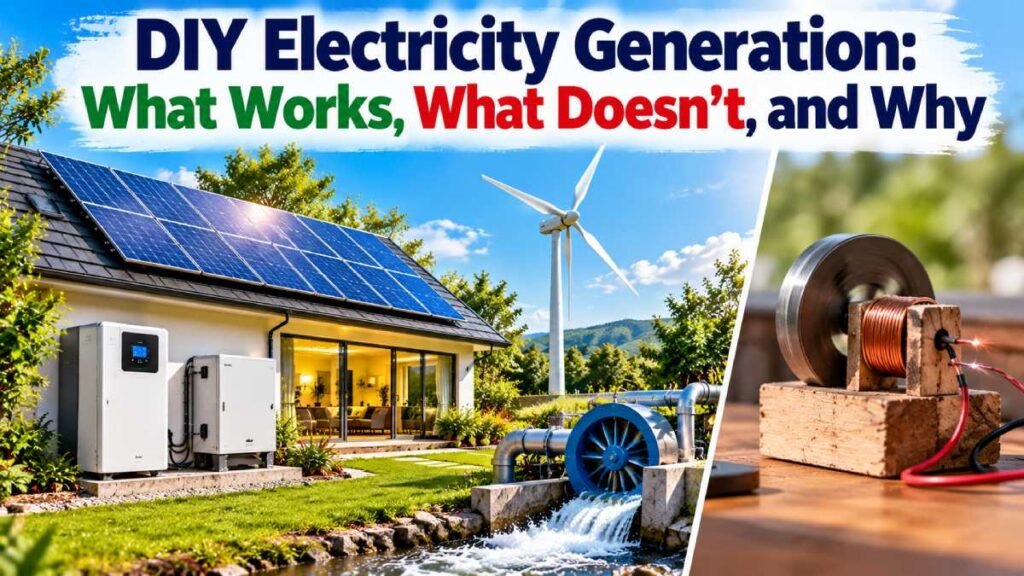
The idea of generating your own electricity sounds appealing.
Instead of depending entirely on the public power grid, you could potentially produce electricity from sunlight, wind, flowing water, mechanical movement, or even a homemade generator. For homeowners dealing with unreliable electricity or rising energy costs, DIY electricity generation can seem like an attractive way to gain more control over their power supply.
But there is an important problem.
Not every DIY electricity idea you see online actually works the way it is advertised.
Some methods are practical and can generate useful amounts of electricity. Others can work under very specific conditions but are unsuitable for most homes. And some popular concepts rely on unrealistic expectations about how much electricity a small device can produce.
Understanding the difference is essential before you spend money on equipment or start building a homemade generator.
In this guide, we’ll look at DIY electricity generation methods that can work, methods that have serious limitations, why some ideas fail, and what you should realistically expect from a home-built electricity system.
What Does DIY Electricity Generation Actually Mean?
DIY electricity generation simply means producing electrical energy yourself rather than relying exclusively on electricity supplied by the grid.
That can include something as straightforward as a small solar panel charging a battery or something considerably more complicated, such as building a generator from mechanical components.
The important point is that electricity generation always involves an energy source.
For example:
Sunlight → Solar panel → Electricity
Wind → Turbine → Generator → Electricity
Moving water → Turbine → Generator → Electricity
Mechanical movement → Generator → Electricity
The generator does not magically create energy.
It converts energy from one form into electrical energy.
That distinction explains why some DIY electricity projects work well while others don’t.
The First Rule: Electricity Cannot Come From Nowhere
Before looking at individual DIY methods, there is one principle you should understand:
A generator needs an energy input.
A solar panel gets its energy from sunlight.
A wind turbine gets its energy from moving air.
A hydroelectric generator gets its energy from moving water.
A bicycle generator gets its energy from the person pedaling.
A fuel generator gets its energy from fuel.
This sounds obvious, but many questionable DIY electricity claims become easier to evaluate once you ask one simple question:
Where is the energy coming from?
If someone claims that a small device can continuously produce large amounts of electricity without an identifiable energy source, that should immediately raise questions.
The issue isn’t whether the device looks sophisticated.
The issue is whether the energy input is sufficient to produce the claimed electrical output.
DIY Electricity Methods That Can Actually Work
1. Solar Power
Solar power is one of the most practical forms of DIY electricity generation available to homeowners.
Solar panels convert sunlight into electrical energy. The electricity can then be used immediately, stored in batteries, or converted into a form suitable for household appliances.
A basic solar system may include:
- Solar panels
- Charge controller
- Battery
- Inverter
- Wiring
- Electrical protection equipment
The advantage is obvious: sunlight is freely available.
Once the equipment has been installed, there is no fuel to purchase every time you generate electricity.
However, solar power has limitations.
Solar panels only generate electricity when there is sufficient sunlight, and their output varies throughout the day. Weather, shading, panel orientation, panel efficiency, and installation conditions can all affect production.
Battery storage also adds cost if you want to use solar-generated electricity at night.
So solar works—but you need to size the system according to your actual electricity requirements.
If you want to understand the different ways homeowners can generate electricity, see our guide to 7 DIY Energy Options for Generating Electricity at Home.
2. Wind Turbines
Wind can also be converted into electricity.
A wind turbine uses moving air to rotate blades. That mechanical rotation drives a generator, producing electricity.
The technology itself is proven.
The challenge is location.
A small wind turbine won’t necessarily produce useful electricity simply because it is installed on a roof or in a backyard.
You need sufficient and reasonably consistent wind.
Buildings, trees, hills, and other obstacles can interfere with airflow and reduce performance.
Wind systems can also require:
- A suitable mounting structure
- Adequate space
- Proper electrical equipment
- Maintenance
- Protection against high winds
- Appropriate local approvals
Therefore, wind generation can work very well in the right environment but may be disappointing in an urban location with poor wind conditions.
3. Micro-Hydroelectric Systems
If you have access to flowing water, micro-hydro can be another effective method of generating electricity.
The basic principle is straightforward.
Moving water turns a turbine, which drives a generator.
Unlike solar, which stops producing electricity when there is insufficient sunlight, a suitable water source can potentially provide a much more consistent energy supply.
But there is a major requirement:
You need an appropriate water source.
A small trickle of water is not necessarily enough.
The amount of usable energy depends on factors such as water flow and the available vertical drop.
That makes micro-hydro extremely location-dependent.
For someone with suitable land and water resources, it can be an excellent option. For the average urban homeowner, it may not be practical at all.
4. Bicycle Generators
This is one DIY electricity project that genuinely works—but its limitations are important.
A bicycle can be connected to a generator so that pedaling produces electricity.
The harder you pedal, the more mechanical energy you put into the system.
That energy can be converted into electrical power.
The problem is scale.
A human being can only produce a limited amount of mechanical power for a limited period.
A bicycle generator might therefore be useful for:
- Charging small batteries
- Demonstrating electricity generation
- Emergency charging
- Educational projects
- Powering very small devices
It is not a realistic replacement for a conventional home electricity system.
The technology works.
The limitation is the amount of energy a human can realistically supply.
5. Hand-Crank Generators
Hand-crank generators operate on the same basic principle.
You provide mechanical energy by turning a handle, and the generator converts that movement into electricity.
These devices can be useful during emergencies because they don’t require:
- Sunlight
- Fuel
- Wind
- Grid electricity
But they also demonstrate an important lesson about DIY electricity:
A method can work without being powerful enough for household use.
A hand-crank generator might provide useful emergency charging for small electronics, but you would not expect it to power an air conditioner, refrigerator, or electric cooker.
DIY Electricity Methods That Can Work—but Have Major Limitations
Not every method belongs in the “works” or “doesn’t work” category.
Some technologies are legitimate but are often presented with unrealistic expectations.
Small Homemade Generators
It is possible to build generators using motors, magnets, coils, and other components.
The underlying electrical principles are real.
Mechanical movement can be converted into electrical energy.
But the output depends on the design, materials, rotational speed, generator efficiency, and most importantly, the energy being supplied to the system.
A homemade generator may produce measurable electricity while still being completely unsuitable for powering a home.
This distinction is important.
Producing electricity is not the same thing as producing enough electricity.
A device producing a few watts may technically be a functioning generator.
But if your refrigerator requires hundreds of watts while running and your air conditioner requires considerably more, the generator’s usefulness for those appliances is limited.
Magnet-Based Generator Projects
Magnet-and-coil projects are popular in the DIY energy world because they can demonstrate electromagnetic generation.
Magnets can certainly play an important role in electrical generators.
But magnets themselves are not an unlimited source of energy.
In a conventional generator, magnets help create the magnetic field required for electromagnetic induction. Something still has to provide the mechanical energy that keeps the generator moving.
This is where many misleading demonstrations can create confusion.
The presence of magnets does not mean a system can produce unlimited electricity without an energy input.
What Usually Doesn’t Work
1. “Free Energy” Machines
One of the biggest warning signs is the promise of a machine that produces unlimited electricity without consuming an equivalent source of energy.
These systems are sometimes described as:
- Free energy generators
- Infinite energy machines
- Over-unity generators
- Self-running generators
- Zero-input power systems
The terminology may vary, but the fundamental claim is similar.
The machine supposedly produces more usable energy than it receives.
That is where you should become extremely skeptical.
A functioning generator can convert energy.
It cannot simply manufacture unlimited energy from nothing.
2. A Generator That Powers Itself Forever
Another common concept involves using the output of a generator to power the same generator indefinitely.
At first glance, this can appear plausible.
For example:
Generator → Electricity → Motor → Generator
The problem is that every real-world system has losses.
There are mechanical losses.
There are electrical losses.
There is resistance.
There is heat.
There is friction.
There are losses in motors, generators, wiring, batteries, and inverters.
Consequently, the system cannot continuously recycle all of its energy with no external input.
You would need an external energy source to keep the system operating.
3. Tiny Devices Claimed to Power Entire Homes
Another warning sign is a small device supposedly capable of replacing a large generator or complete solar system.
Always ask for measurable specifications.
How many watts does it produce?
How long can it produce that output?
What is the energy input?
What happens when you connect a high-power appliance?
A phone charger and an air conditioner have completely different power requirements.
If a product doesn’t clearly explain its output, be cautious about assuming that it can handle major household loads.
Why Some DIY Electricity Projects Fail
There are several reasons a DIY electricity project might not deliver the expected results.
Insufficient Energy Input
This is probably the biggest issue.
A generator can only produce electricity based on the energy available to it.
A small solar panel cannot produce the same amount of electricity as a large solar array.
A weak wind source cannot produce the same output as strong, consistent winds.
A person pedaling a bicycle cannot supply the same energy as a fuel-powered engine.
The input matters.
Incorrect Sizing
Another common problem is using a system that is simply too small.
Imagine purchasing a system capable of producing 300 watts and expecting it to power appliances requiring 2,000 watts.
The technology might work perfectly.
The system is simply undersized.
This is why calculating your energy requirements before buying equipment is so important.
Ignoring Battery Capacity
Some people focus entirely on generation and forget about storage.
Suppose your solar panels generate electricity during the day.
What happens at night?
If you need electricity after sunset, you need either another energy source or sufficient battery storage.
Battery capacity therefore becomes a major part of an off-grid or backup system.
Ignoring Inverter Capacity
The same principle applies to the inverter.
An inverter has a maximum output.
If your appliances require more electricity than the inverter can safely provide, the system may shut down or become overloaded.
You need to consider both the continuous load and the starting surge of certain appliances.
DIY Electricity vs. Reducing Electricity Consumption
There is another approach that is often overlooked.
Instead of trying to generate more electricity immediately, you can reduce how much electricity your home requires.
This can make a smaller generation system much more useful.
For example, replacing inefficient lighting, reducing unnecessary standby consumption, using efficient appliances, and managing high-power devices can reduce your overall demand.
That means a solar or backup system doesn’t have to work as hard.
If reducing consumption is part of your strategy, our guide on how to reduce your electricity bill without buying solar panels covers practical ways to lower energy use without immediately investing in a generation system.
What About DIY Energy Blueprints?
There is also a growing market for DIY energy plans and digital blueprints.
These products typically provide instructions for constructing some type of generator or alternative energy system.
One example is the Energy Revolution System, which is marketed as a DIY, Tesla-inspired electricity project.
The important thing to understand is that a blueprint is not the same thing as a finished generator.
You may still need to purchase components, assemble the system, test it, and determine what its actual output is.
Therefore, anyone considering this type of product should evaluate it based on realistic expectations rather than assuming that a low-cost blueprint automatically provides enough electricity to replace a conventional home power system.
You can read our Energy Revolution System Review before deciding whether this type of DIY approach is worth investigating.
How to Tell Whether a DIY Electricity Idea Is Legitimate
Before spending money on a DIY electricity project, ask these questions.
1. What is the energy source?
Every practical generator needs an energy input.
2. What is the claimed output?
Look for a measurable number, preferably in watts.
3. How long can it maintain that output?
A device producing 1,000 watts for five minutes is very different from one producing 1,000 watts continuously.
4. What appliances can it actually power?
Don’t rely on vague claims such as “powers your home.”
Look at the actual wattage.
5. Does it require batteries?
If so, determine the battery capacity and expected runtime.
6. Does it require an inverter?
If household AC appliances are involved, this may be necessary depending on the system design.
7. What is the total cost?
Include components, batteries, wiring, tools, installation, maintenance, and replacement parts.
8. What happens when the energy source disappears?
Solar doesn’t produce at night.
Wind can stop.
Water flow can change.
Human-powered systems require a person.
A realistic system needs an answer to this question.
The Best DIY Electricity Strategy for Most Homes
For most homeowners, the best approach isn’t to search for one magical generator that does everything.
A better strategy is to build an energy system around your actual requirements.
That might mean:
Step 1: Reduce unnecessary electricity consumption.
Step 2: Identify essential appliances.
Step 3: Calculate their power requirements.
Step 4: Choose an appropriate generation method.
Step 5: Add battery storage if necessary.
Step 6: Use a properly sized inverter where required.
Step 7: Keep a backup option for periods when renewable generation is unavailable.
This approach is less exciting than the promise of an “infinite energy machine,” but it is much more realistic.
Final Verdict: What Works and What Doesn’t?
DIY electricity generation can absolutely work.
Solar panels work.
Wind turbines work under suitable conditions.
Hydroelectric systems work where there is sufficient water flow and elevation.
Mechanical generators work.
Bicycle and hand-crank generators work.
Homemade generators can work.
The important question is not simply whether the technology produces electricity.
The question is:
Does it produce enough usable electricity for what you want to accomplish?
That’s where many DIY energy projects fall short.
A small generator may successfully produce electricity but be incapable of powering major household appliances. A solar panel may work perfectly but produce insufficient electricity for your daily consumption. A wind turbine may function but perform poorly because the location doesn’t have enough wind.
And claims about unlimited, self-sustaining, or “free” electricity should be treated with considerable skepticism.
The most sensible approach is to focus on real energy inputs, measurable electrical output, appropriate system sizing, and your actual household requirements.
If you’re just getting started, don’t try to power your entire house immediately.
Start small.
Determine what you need to power, understand how much electricity those devices consume, and choose a generation method capable of meeting that demand.
That’s how DIY electricity generation becomes a practical project rather than an expensive experiment.
Frequently Asked Questions
Can you really make electricity yourself?
Yes. Electricity can be generated at home using solar panels, wind turbines, flowing water, mechanical generators, and other technologies. The amount you can generate depends on the energy source and equipment.
What is the easiest DIY electricity method?
For many homeowners, small solar systems are among the easiest options because they can generate electricity without moving parts or fuel. However, the best option depends on your location and energy requirements.
Can magnets generate free electricity?
Magnets can be used as part of an electrical generator, but they do not provide unlimited free energy. A generator still requires an external energy source to create continuous mechanical movement.
Can a DIY generator power a refrigerator?
Potentially, yes, but only if the generator and inverter can provide sufficient continuous and starting power. You need to check the refrigerator’s actual electrical requirements.
Can a homemade generator power an entire house?
Some properly designed systems can generate substantial household electricity, but many small DIY generators cannot. The generator’s actual wattage and runtime must be compared with the home’s total electrical demand.
Are DIY electricity blueprints worth it?
It depends on the specific blueprint, its design, your technical ability, the components required, and the amount of electricity the completed system can realistically produce. A blueprint should not automatically be treated as a replacement for a professionally designed household power system.
What is the biggest mistake people make with DIY electricity?
One of the biggest mistakes is confusing “the system produces electricity” with “the system produces enough electricity.” Always calculate the actual electrical load before deciding what type of generator you need.