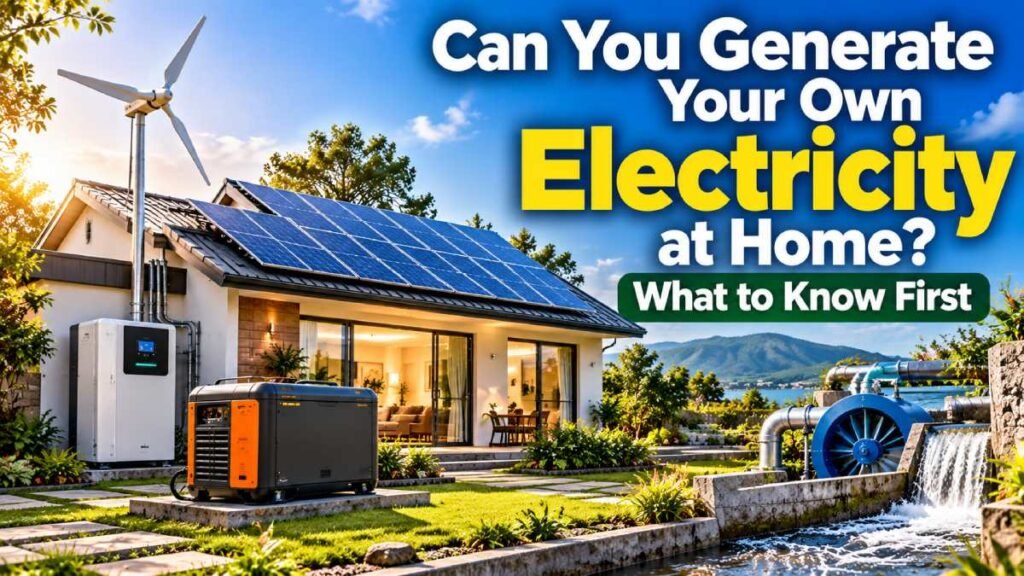
If your electricity bills keep rising or you are tired of depending entirely on the public power grid, you may have wondered: Can you actually generate your own electricity at home?
The short answer is yes.
Home electricity generation is no longer limited to large solar installations or expensive industrial equipment. Depending on your location, budget, available space, and how much electricity you need, there are several ways to generate at least some of your own power.
However, there is an important distinction between generating electricity and generating enough electricity to power an entire home.
A small DIY generator might be useful for powering a few low-wattage devices. Solar panels can generate considerably more electricity, but they require an appropriate installation, batteries if you want backup power, and sufficient sunlight. Other systems can take advantage of wind, water, or mechanical energy where conditions allow.
So, can you generate your own electricity at home?
Yes—but the best approach depends on what you want to power, how much electricity you consume, and how much you are prepared to spend.
In this guide, we will look at the main options, what they can realistically do, the advantages and limitations of each, and what you should know before attempting a DIY electricity project.
Why Generate Your Own Electricity?
There are several reasons homeowners consider producing their own electricity.
The first is obvious: reducing dependence on the grid.
If electricity supply is unreliable in your area, having your own source of power can provide valuable backup. Even if your system cannot power the entire house, being able to keep lights, phones, routers, fans, or other essential devices running can make a significant difference.
The second reason is cost.
Generating some of your own electricity can potentially reduce how much energy you need to purchase from your electricity provider or how frequently you need to rely on fuel-powered generators.
The third reason is independence.
A home energy system gives you more control over where your electricity comes from and how you use it.
That said, generating your own electricity does not automatically mean eliminating your electricity bill. In many cases, the most practical strategy is a hybrid approach where self-generated electricity supplements grid electricity rather than completely replacing it.
How Much Electricity Do You Actually Need?
Before choosing an electricity-generation system, you need to understand your home’s energy consumption.
This is one of the most important steps because different appliances require dramatically different amounts of power.
For example, charging a phone requires very little electricity compared with operating an air conditioner, electric cooker, refrigerator, water heater, or large pumping system.
Consider a typical home containing:
- LED lights
- Smartphones
- Laptop computers
- Wi-Fi router
- Television
- Refrigerator
- Fans
- Washing machine
- Air conditioner
- Electric kettle
- Microwave
- Water pump
A small electricity-generation system might comfortably handle the first few items but struggle with high-powered appliances.
This is why you should not start by asking, “What generator should I build?”
Instead, ask:
“What do I want my system to power?”
That question will make your options much clearer.
1. Solar Power
Solar energy is probably the most practical form of home electricity generation for many homeowners.
Solar panels convert sunlight into electrical energy. The electricity can then be used immediately, stored in batteries, or sent into an appropriate electrical system.
A basic solar setup can include:
- Solar panels
- Charge controller
- Battery bank
- Inverter
- Wiring and protection equipment
The amount of electricity you can generate depends on factors such as panel capacity, sunlight availability, panel orientation, weather, system efficiency, and battery capacity.
Solar is particularly attractive because sunlight is free once the equipment has been installed.
However, solar is not necessarily cheap to install.
The panels themselves are only one part of the system. Batteries, inverters, mounting equipment, wiring, protection devices, and professional installation can significantly increase the total cost.
Solar also has another important limitation: it does not generate the same amount of electricity continuously throughout the day.
That is why battery storage becomes important if you want electricity at night or during periods of low sunlight.
If you are comparing DIY energy concepts with conventional solar, you may also find our detailed comparison useful: Energy Revolution System vs. Solar Panels vs. Water Freedom System vs. Other DIY Energy Alternatives.
2. Wind Power
Wind turbines can also generate electricity at home.
The basic principle is simple: moving air turns turbine blades, which rotate a generator and produce electrical energy.
However, residential wind power is highly dependent on location.
You need enough consistent wind to make the system worthwhile.
Putting a small turbine on a property where the wind is weak or obstructed by buildings, trees, and other structures may produce disappointing results.
Wind turbines can also introduce issues involving:
- Noise
- Installation height
- Structural requirements
- Maintenance
- Local regulations
- Variable electricity production
For someone living in an area with strong, consistent winds and sufficient space, wind power can be useful.
For an average urban homeowner, however, solar is often easier to implement.
3. Micro-Hydroelectric Power
If your property has access to a suitable flowing water source, hydroelectricity can be another possibility.
A micro-hydro system uses moving water to turn a turbine connected to a generator.
Unlike solar and wind, water can potentially provide a much more continuous energy source when the water flow is consistent.
But there is a major catch.
You need the right geographical conditions.
A small stream that barely moves may not provide enough energy to make a practical electricity system.
You also need to consider:
- Water flow
- Elevation difference
- Turbine design
- Environmental considerations
- Installation requirements
- Local regulations
For most homeowners, micro-hydro is therefore a specialized option rather than a general DIY solution.
4. Bicycle or Pedal Generators
You can generate electricity using human mechanical energy.
A stationary bicycle connected to an appropriate generator can convert pedaling into electrical power.
This is an interesting demonstration of how electricity generation works and can produce enough energy for small devices.
However, human-generated electricity has an obvious limitation:
Your body has limited energy output.
Pedaling for a short period might charge a small battery or operate a low-power device, but it is not a realistic way to provide continuous electricity for a normal household.
Still, bicycle generators can be useful for educational projects, emergency situations, demonstrations, or small-scale charging.
5. Hand-Crank Generators
Hand-crank generators work according to a similar principle.
Mechanical movement is converted into electrical energy.
You turn a handle, the internal generator rotates, and electricity is produced.
These devices can be useful during emergencies because they do not require sunlight, fuel, or a functioning power grid.
But once again, the amount of electricity you can generate is relatively small.
They are much better suited to charging small devices or providing emergency power than running household appliances.
6. Small Mechanical Generators
Another possibility is using a mechanical generator driven by a motor, crank, turbine, or another mechanical energy source.
This is where many DIY electricity projects become particularly interesting.
The basic idea is that mechanical movement can be converted into electrical energy through a generator.
Depending on the design, a DIY system might be constructed using relatively accessible components.
However, you should be careful about online claims suggesting that a simple homemade generator can produce unlimited electricity or completely eliminate the need for an external energy source.
Energy cannot be created from nothing.
A generator converts energy from one form into another. The important question is always:
Where is the input energy coming from?
If a device claims to continuously produce large amounts of electricity without a meaningful energy input, you should examine the claim very carefully.
7. DIY Generator Systems and Energy Blueprints
Another category involves DIY electricity projects that provide instructions for building a generator or alternative energy system.
One example is the Energy Revolution System, which is presented as a Tesla-inspired DIY electricity project.
If you are considering this type of system, it is important to understand what you are actually buying.
You are generally buying information, instructions, or a blueprint rather than purchasing a finished whole-house generator.
That means your final costs and results can depend on the components you purchase, your construction ability, the design you follow, and the amount of electrical output you ultimately achieve.
We take a closer look at the system in our Energy Revolution System Review, including what it is supposed to do and what buyers should realistically expect.
Can a DIY Generator Power Your Entire House?
This is where expectations matter.
A DIY generator may be able to produce electricity.
That does not necessarily mean it can power your entire house.
There is a huge difference between generating enough electricity to charge a phone and generating enough electricity to run:
- A refrigerator
- Multiple lights
- Several fans
- An air conditioner
- A water heater
- An electric cooker
- A washing machine
- A television
- Computers
- Water pumps
High-power appliances can consume substantial amounts of electricity.
Therefore, before building or buying any electricity-generation system, determine its expected output in watts and compare that number with the power requirements of your appliances.
For example, if a system produces only a small amount of electricity, you might use it for:
- Phones
- Small LED lights
- Routers
- Small electronics
- Emergency charging
You should not assume that the same system can run an entire home.
Don’t Forget About Batteries
Generating electricity is only part of the equation.
Storage can be just as important.
Solar panels, wind turbines, and other renewable systems can produce electricity when their energy source is available. But your household may need electricity at a different time.
For example, solar panels generate energy during daylight hours while many people consume significant amounts of electricity during the evening.
A battery can bridge that gap.
A typical system might therefore look like:
Energy source → Generator → Charge controller → Battery → Inverter → Appliances
The inverter is particularly important if your appliances require the type of electricity supplied by a conventional household electrical system.
Battery capacity also matters.
A small battery might keep a router and a few lights running for several hours.
A much larger battery system is required for substantial household loads.
The Importance of an Inverter
Many electricity-generation systems produce direct current (DC).
Household appliances may require alternating current (AC).
An inverter converts the electricity into the appropriate form for compatible appliances.
But inverters also have limits.
An inverter might be rated for a particular continuous wattage and a higher short-term surge capacity.
If your appliances collectively demand more power than the inverter can provide, the system may shut down or become overloaded.
This is why choosing an inverter based only on battery capacity is not enough.
You need to consider the total load you intend to operate.
You May Not Need to Generate More Electricity
There is another way to approach the problem.
Instead of immediately trying to generate more electricity, you can first try to use less electricity.
Reducing consumption can lower your energy costs without requiring you to purchase a large generation system.
For example, you could:
- Replace inefficient bulbs with LEDs
- Turn off unused appliances
- Reduce unnecessary standby consumption
- Improve air-conditioning efficiency
- Use energy-efficient appliances
- Avoid running several high-power appliances simultaneously
- Improve insulation where practical
- Monitor your biggest electricity users
We covered this approach in detail in How to Reduce Your Electricity Bill Without Buying Solar Panels.
For some households, reducing consumption first can make a future solar or backup-power system considerably more affordable because you may not need to build a system large enough to handle every appliance simultaneously.
What Is the Cheapest Way to Generate Electricity at Home?
There isn’t one universal answer.
The cheapest option depends on what you need to power.
If your goal is simply to charge a phone during a power outage, a small battery or portable solar charger may be enough.
If you want to operate lights, a router, fans, and other small appliances, a larger battery system may make sense.
If you want to power significant household loads every day, you may need a much larger solar-plus-storage installation or another appropriately sized system.
The cheapest system is therefore not necessarily the one with the lowest purchase price.
It is the one that provides the amount of usable electricity you actually need at a reasonable long-term cost.
How Much Electricity Can You Generate?
This depends entirely on the system.
A small hand-crank generator might produce enough electricity for emergency charging.
A bicycle generator can produce more while someone is actively pedaling.
A small solar panel can generate electricity whenever sufficient sunlight is available.
A properly sized residential solar installation can generate substantially more.
A wind or hydroelectric system can potentially generate significant amounts of electricity under suitable environmental conditions.
The key is to look at measurable output, not marketing language.
Whenever someone claims that a particular device can dramatically reduce or eliminate your electricity costs, ask:
- How many watts does it actually produce?
- For how many hours per day?
- What energy source powers it?
- How much does the complete system cost?
- Does it require batteries?
- What appliances can it realistically operate?
- What maintenance is required?
These questions can help you separate practical technology from exaggerated claims.
Is Generating Your Own Electricity Worth It?
For many homeowners, yes.
But the answer depends on your objective.
If your main goal is backup electricity, a relatively small system may be sufficient.
If your goal is lower electricity bills, improving energy efficiency and adding renewable generation may make sense.
If your goal is complete energy independence, you will need a considerably more sophisticated system involving sufficient generation capacity, storage, appropriate electrical equipment, and careful load management.
You should also consider the upfront cost.
A system that costs a substantial amount of money may take years to recover through electricity savings.
On the other hand, if unreliable electricity is forcing you to spend heavily on fuel-powered generators, batteries, or other backup solutions, an alternative energy system may become more attractive.
A Practical Way to Get Started
If you are serious about generating your own electricity, don’t begin by buying random components.
Start with an energy audit.
Step 1: List Your Appliances
Write down everything you normally use.
Step 2: Identify Power Requirements
Find the wattage of each appliance.
Step 3: Determine Your Priority Loads
Decide which appliances absolutely need to remain operational during an outage.
Step 4: Calculate Your Approximate Daily Consumption
This gives you an idea of how much electricity you actually need.
Step 5: Choose an Appropriate Energy Source
Depending on your location, this might include solar, wind, hydro, mechanical generation, or a combination.
Step 6: Decide Whether You Need Battery Storage
If you need electricity when your generation source is unavailable, storage becomes important.
Step 7: Size the System Correctly
Your generator, inverter, batteries, wiring, and protection equipment should be appropriate for the expected load.
Step 8: Prioritize Safety
Electricity can be dangerous.
High-voltage systems, large battery banks, household wiring, and grid connections should not be treated as casual DIY projects.
If you are connecting a system to household wiring or the public electricity network, use a properly qualified professional.
What About Going Completely Off-Grid?
Going completely off-grid is possible, but it is much more complicated than simply installing a few solar panels.
A genuinely off-grid home needs enough energy generation to meet its average requirements while also dealing with periods when generation is reduced.
For example, a solar-powered home needs to consider cloudy weather and nighttime consumption.
This means an off-grid system generally needs:
- Sufficient generation capacity
- Battery storage
- An appropriate inverter
- Electrical protection
- Backup planning
- Energy-efficient appliances
- Load management
The more electricity your household consumes, the more expensive and complex the system becomes.
For many homeowners, a partial backup system is therefore more practical than attempting complete energy independence.
Final Verdict: Can You Generate Your Own Electricity at Home?
Yes, you absolutely can generate your own electricity at home.
The bigger question is how much electricity you need and which generation method makes sense for your situation.
Solar is one of the most practical options for many homes, particularly where sunlight is plentiful. Wind and micro-hydro can work well in locations with the right environmental conditions. Small mechanical and human-powered generators can provide useful amounts of electricity for specific low-power applications.
DIY generator blueprints can also be interesting for people who want to experiment with alternative energy technology, but you should always evaluate their actual electrical output rather than assuming that a small DIY device can replace a whole-house power system.
The most sensible approach is usually to start with your actual electricity consumption.
Reduce unnecessary consumption first. Identify your essential loads. Then choose a generation and storage system that matches those requirements.
You do not necessarily need to become completely independent from the grid to benefit from generating your own electricity.
Even producing enough power to run your essential devices during outages or reduce your reliance on conventional electricity can make a meaningful difference.
And if you are specifically interested in DIY approaches to producing electricity, our How to Generate Electricity at Home: 7 DIY Energy Options to Know guide is a useful next step.
Frequently Asked Questions
Can I generate electricity at home without solar panels?
Yes. Depending on your location and available resources, electricity can potentially be generated using wind, flowing water, mechanical energy, or human-powered systems. The practical choice depends on how much electricity you need and what energy sources are available.
Can a homemade generator power a house?
Some homemade generators can produce useful electricity, but not every DIY generator can produce enough power for an entire home. You need to compare the generator’s actual output with the combined requirements of your appliances.
Is solar the only practical way to generate electricity at home?
No. Solar is simply one of the most accessible options for many homeowners. Wind, hydroelectric, and other systems can also work under suitable conditions.
Can I eliminate my electricity bill completely?
It is possible for some properties to become largely or completely independent from the grid, but doing so generally requires a properly designed system with sufficient generation and storage capacity. Simply installing a small generator will not necessarily eliminate your electricity bill.
Is building a DIY electricity generator safe?
DIY electrical projects can involve serious risks, particularly when high voltages, large batteries, household wiring, or grid connections are involved. Follow appropriate electrical safety practices and use a qualified professional for dangerous or complex installations.
What should I do before buying a home electricity system?
Start by determining how much electricity you use and which appliances you need to operate. Then compare generation options based on output, installation cost, storage requirements, maintenance, and expected lifespan rather than focusing only on the advertised purchase price.