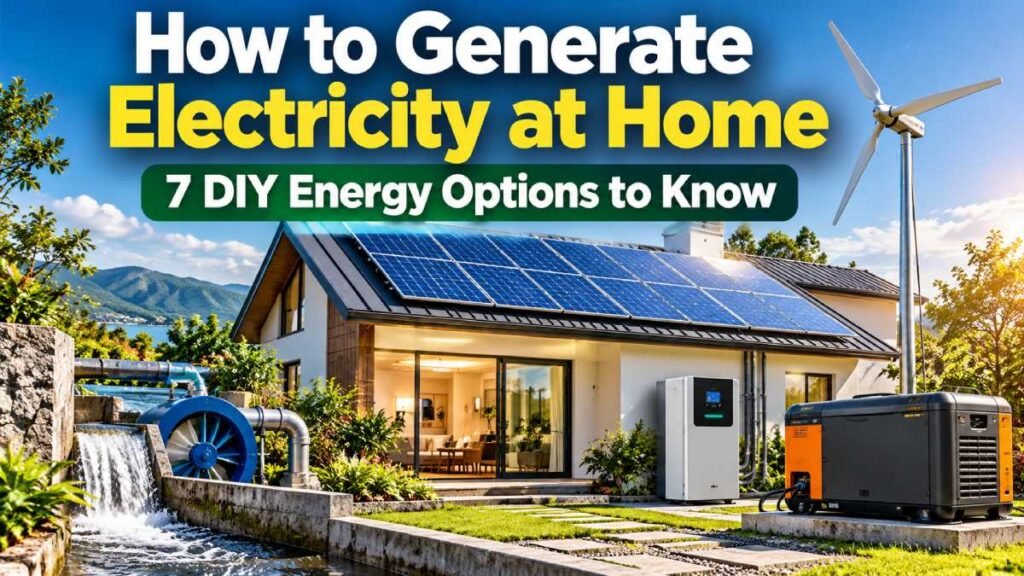
Generating electricity at home may sound complicated, but you don’t necessarily need to build a power plant in your backyard to produce useful energy. From solar panels and small wind turbines to micro-hydro systems and DIY battery backups, there are several ways homeowners can generate or store electricity for everyday use.
For people dealing with unreliable grid power, rising electricity costs, or a desire for greater energy independence, learning how to generate electricity at home can be especially valuable.
The right option depends on where you live, your available space, your budget, local weather conditions, and how much electricity you actually need.
Below are 7 DIY energy options worth knowing, including what each system does, how it works, its advantages and limitations, and where it makes the most sense.
Safety note: Electricity can cause fires, severe injury, or death. DIY projects should be limited to systems and voltages you understand. Have permanent household wiring, grid connections, high-voltage battery systems, and electrical protection equipment installed or inspected by a qualified electrician.
1. Solar Power
Solar energy is probably the most practical starting point for anyone interested in generating electricity at home.
A solar photovoltaic (PV) system converts sunlight directly into electricity using solar panels. The electricity produced can either power appliances immediately, charge batteries for later use, or be connected to a properly designed home electrical system.
A basic off-grid solar setup typically includes:
- Solar panels
- A charge controller
- A battery bank
- An inverter
- Cables and appropriate electrical protection
During daylight hours, the panels generate electricity. The charge controller manages the energy going into the batteries, while the inverter converts stored DC electricity into AC electricity suitable for many household appliances.
What can solar power run?
The answer depends on the size of the system.
A small setup might power LED lights, phones, laptops, routers, fans, and other low-power electronics. A larger system can potentially handle refrigerators, televisions, pumps, freezers, and other household equipment.
The key is calculating your energy requirements before buying equipment.
For example, an appliance consuming 100 watts for five hours uses approximately 500 watt-hours of energy. Add the requirements of all the appliances you want to operate, and you can begin estimating the size of your solar system.
Pros
- Renewable energy source
- Low operating costs after installation
- Relatively scalable
- Quiet
- Suitable for many climates
Cons
- Requires sunlight
- Initial equipment costs can be significant
- Batteries add expense
- Installation requires careful electrical planning
For many homes, solar is the most realistic DIY-friendly electricity-generation option, particularly when starting with a small system and expanding over time.
2. Small Wind Turbines
If you live in an area with consistently strong winds, a small wind turbine can generate electricity at home.
Wind turbines work by converting the kinetic energy of moving air into mechanical rotation. A generator then converts that rotational energy into electrical energy.
A typical small wind system can include:
- Wind turbine
- Charge controller
- Battery bank
- Inverter
- Tower or mounting structure
- Wiring and safety equipment
Unlike solar panels, wind turbines can generate electricity at night, provided sufficient wind is available.
However, that doesn’t mean a wind turbine is automatically better than solar.
The location is extremely important. A turbine placed in an area with weak or turbulent wind may generate very little electricity.
Pros
- Can generate electricity day and night
- Renewable
- Can complement solar
- Useful in windy rural locations
Cons
- Requires adequate wind
- Towers require careful installation
- Moving components require maintenance
- Noise and local regulations can be considerations
A hybrid solar-and-wind system can sometimes provide more consistent renewable generation than relying on either technology alone.
3. Micro-Hydro Power
If your property has access to a suitable flowing stream or water source with sufficient elevation change, micro-hydro power can be one of the most consistent forms of small-scale renewable electricity.
Instead of relying on sunlight or wind, a micro-hydro system uses moving water to turn a turbine.
The basic principle is straightforward: water flows downhill through a controlled system, spins a turbine, and the turbine drives a generator.
The amount of electricity you can generate depends heavily on two factors:
Water flow + vertical drop (head).
A small stream with a large elevation difference may potentially produce useful electricity, while a larger but very slow-moving body of water may not be practical.
Pros
- Can operate continuously
- Doesn’t depend on sunshine
- Potentially high reliability
- Excellent for suitable rural properties
Cons
- Requires an appropriate water source
- Installation can be technically challenging
- Environmental considerations may apply
- Not practical for most urban homes
For the right property, however, micro-hydro can be remarkably effective because water can provide a more continuous energy source than intermittent solar or wind.
4. Bicycle Generator
If you’re interested in learning how electricity generation works rather than powering an entire home, a bicycle generator is an interesting DIY project.
The concept is simple.
A bicycle wheel is connected to a generator or alternator. When you pedal, mechanical energy from your body is converted into electrical energy.
The electricity can then be used to power small devices or charge a battery, depending on the generator and electrical setup.
A bicycle generator isn’t a realistic replacement for the electricity grid. Human beings simply cannot produce enough sustained mechanical power to run a typical household for long periods.
But it’s an excellent educational project.
It demonstrates an important principle behind many electricity-generation technologies:
Mechanical energy → generator → electrical energy.
Pros
- Relatively inexpensive
- Educational
- Doesn’t require sunlight or wind
- Can demonstrate basic electrical-generation principles
Cons
- Human power is limited
- Not practical for household electricity
- Requires physical effort
- Output depends on the generator and rider
It’s best viewed as an educational or emergency project rather than a serious whole-house power system.
5. DIY Backup Battery System
Strictly speaking, a battery doesn’t generate electricity. It stores electricity generated elsewhere.
However, building a properly designed battery backup system can dramatically improve household energy independence.
A battery system can store energy from solar panels or another source and provide electricity when the primary power source isn’t available.
A typical system might include:
- Deep-cycle battery or suitable battery bank
- Battery management system where required
- Inverter
- Appropriate fuses and disconnects
- Charging equipment
- Battery enclosure and ventilation appropriate to the battery chemistry
Modern lithium-based batteries can provide substantial energy storage in a relatively compact package, although they require proper equipment and protection.
Why battery storage matters
Imagine your solar panels generate more electricity during the afternoon than your household needs.
Instead of wasting that excess energy, a battery system can store it.
Later, you can use the stored energy when the sun goes down or when grid power fails.
This makes batteries particularly useful in areas where electricity interruptions are common.
Pros
- Provides backup power
- Works well with solar
- Can shift energy use to later periods
- Scalable
Cons
- Batteries can be expensive
- Battery lifespan is limited
- Incorrect installation can be dangerous
- Inverters and protection equipment add complexity
For anyone building a home energy system, storage is often just as important as generation.
6. Pedal, Hand-Crank and Small Generator Systems
Another category of DIY electricity projects involves converting mechanical movement into electricity using small generators.
Hand-crank generators, pedal generators, and small engine-driven generators all use the same basic concept: mechanical movement turns a generator, producing electrical energy.
These systems can be useful for emergency situations.
For example, a small hand-crank generator may provide enough electricity for certain low-power emergency devices. A pedal generator can be used to demonstrate energy conversion or provide limited charging capability.
The important distinction is between producing electricity and producing useful amounts of electricity.
Generating enough electricity to illuminate an LED is relatively easy. Generating enough electricity to run an air conditioner, refrigerator, water heater, or electric cooker is a completely different challenge.
That’s why energy calculations should always come before building a system.
7. DIY Energy Generator Systems
The final option is a broad category covering various DIY electricity-generator projects designed to provide an alternative source of household power.
These systems can range from relatively simple generator projects to more sophisticated designs involving batteries, inverters, motors, generators, and renewable-energy components.
If you’re researching one of these systems, it’s important to distinguish between a legitimate energy-generation system and claims that appear to promise unlimited or “free” electricity without an adequate energy source.
Electricity doesn’t appear from nowhere.
Every functioning generator must obtain energy from somewhere, whether that energy comes from sunlight, moving water, wind, fuel, chemical reactions, or mechanical work.
If you’re specifically interested in a Tesla-inspired DIY generator approach, you can read our Energy Revolution System review to see what the system claims to offer, how its approach works, and what to consider before deciding whether it’s appropriate for your needs.
The biggest question to ask with any DIY generator system is simple:
Where does the input energy come from?
If you can answer that question clearly, you can begin evaluating whether the system is technically plausible and useful for your particular situation.
Which DIY Electricity Option Is Best?
There isn’t one answer for every household.
Your location and electricity requirements should determine which technology makes sense.
| Energy option | Best suited for | Main limitation |
|---|---|---|
| Solar | Most homes | Depends on sunlight |
| Wind | Windy properties | Requires suitable wind |
| Micro-hydro | Properties with flowing water | Location-dependent |
| Bicycle generator | Educational projects | Very limited output |
| Battery backup | Power outages | Doesn’t generate electricity |
| Hand/pedal generators | Emergency/low-power use | Human power is limited |
| DIY generator systems | Experimental or alternative power projects | Quality varies significantly |
For most homeowners, solar plus battery storage is one of the most practical combinations.
Solar handles electricity generation while batteries handle storage. Together, they can provide power during both sunny and non-sunny periods.
A wind turbine may make sense as an additional source if your location has reliable wind. Micro-hydro can be even more attractive if you have access to an appropriate water source.
How Much Electricity Do You Actually Need?
Before building anything, calculate your household’s electricity consumption.
Start by listing the appliances you want to power.
For each appliance, find its wattage and estimate how many hours per day it operates.
For example:
100-watt appliance × 5 hours = 500 watt-hours
Do this for every appliance.
You might discover that your essential electricity needs are much smaller than your total household consumption.
For example, during a power outage, you may only need:
- Lights
- Phone chargers
- Internet router
- Laptop
- Fan
- Refrigerator
You may not need to power an electric oven, water heater, air conditioner, washing machine, and every other appliance simultaneously.
This distinction can dramatically reduce the size and cost of an alternative energy system.
Don’t Ignore Energy Efficiency
One of the easiest ways to generate more usable electricity is to reduce how much electricity you need.
Replacing inefficient bulbs with LEDs, choosing efficient appliances, improving insulation where appropriate, and eliminating unnecessary standby consumption can reduce your energy requirements.
Consider two homes.
Home A needs 15 kWh of electricity every day.
Home B needs 7 kWh because it uses efficient appliances and manages its energy consumption carefully.
Home B doesn’t necessarily need a larger generator. It needs a smaller amount of electricity in the first place.
Energy efficiency can therefore be considered the “first power plant” in a home.
Safety Comes Before DIY Electricity
Electricity projects shouldn’t be approached like ordinary DIY woodworking or painting projects.
Improper wiring, overloaded circuits, incorrectly sized cables, damaged batteries, poor grounding, and unsuitable inverters can create serious hazards.
Never assume that a low-cost component is safe simply because it is being sold online.
Pay particular attention to:
- Electrical insulation
- Correct cable sizing
- Fuses and circuit breakers
- Grounding
- Battery protection
- Ventilation
- Moisture protection
- Overcurrent protection
- Inverter specifications
- Local electrical regulations
For systems that connect to household wiring or the utility grid, professional installation is strongly recommended.
Final Thoughts
Learning how to generate electricity at home can open the door to greater energy independence and provide valuable backup during power interruptions.
The seven options covered here range from highly practical technologies such as solar panels and battery storage to more specialized solutions such as wind turbines and micro-hydro systems, along with educational projects such as bicycle and hand-crank generators.
The best approach isn’t necessarily the most complicated one.
Start by determining how much electricity you actually need. Then consider the energy resources available at your property.
If you have abundant sunlight, solar may be the obvious starting point. If you have reliable wind, a small turbine could complement solar. If you’re fortunate enough to have suitable flowing water, micro-hydro may be worth investigating.
And if you’re exploring alternative DIY generator designs, evaluate them based on their actual energy source, electrical principles, expected output, cost, and safety—not simply the marketing claims.
The goal isn’t to build the most impressive-looking energy system.
The goal is to build a system that reliably produces or stores the amount of electricity your home actually needs.