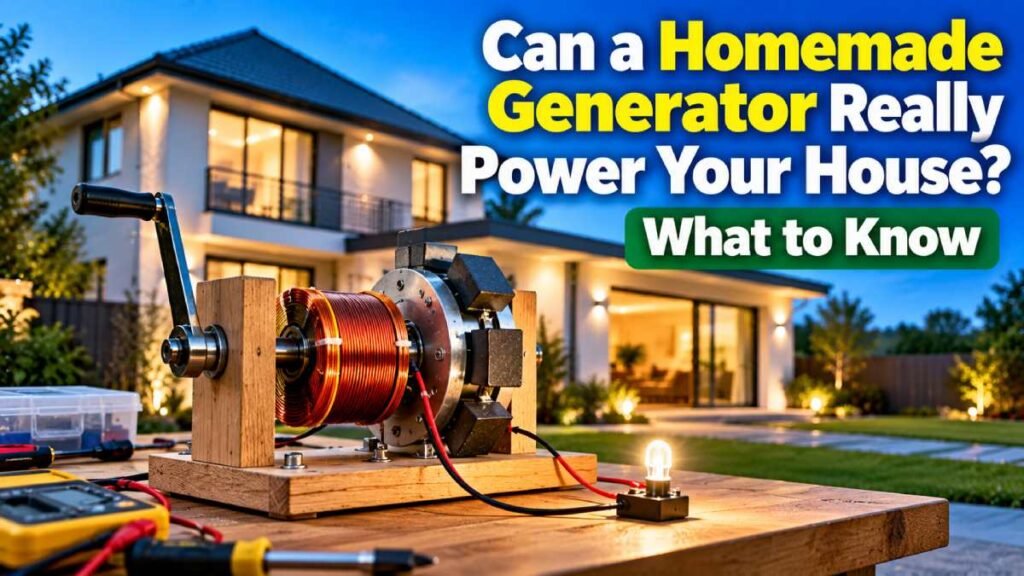
The idea of building your own generator at home sounds appealing.
Instead of buying an expensive conventional generator or installing a large solar system, you might be wondering whether you can build something yourself that produces enough electricity to keep your household running.
The short answer is: sometimes—but usually not in the way people imagine.
A homemade generator can potentially produce useful electricity for certain low-power applications. Depending on the design, it may be able to run lights, charge phones, power small electronics, or provide electricity for other modest loads.
But powering an entire house is a completely different challenge.
A typical home may contain refrigerators, freezers, water pumps, fans, televisions, computers, washing machines, electric cookers, air conditioners, and other appliances. Running several of these simultaneously requires substantially more electrical capacity than a small homemade generator can normally provide.
So before building one, it’s important to understand what homemade generators can realistically do, where their limitations begin, and what you would need if your goal is genuine whole-home backup power.
What Counts as a Homemade Generator?
A homemade generator is essentially a system that you assemble yourself to produce electrical power rather than purchasing a complete commercial generator.
The design can vary considerably.
Some DIY projects use mechanical movement to turn a generator or alternator. Others experiment with electromagnetic induction, coils, magnets, motors, turbines, or other components.
The specific technology matters because different designs produce very different amounts of usable electricity.
A small educational generator might demonstrate the principles of electricity generation while producing enough power for a tiny load.
A more substantial DIY system could potentially provide considerably more output.
The important point is that “homemade generator” doesn’t automatically mean “whole-house generator.”
The amount of electricity produced depends on the actual design, components, energy input, efficiency, and electrical output of the finished system.
How Much Electricity Does a House Actually Need?
This is the first question you should answer before deciding whether a homemade generator is practical.
Your house doesn’t consume one fixed amount of electricity.
Consumption changes depending on which appliances are operating.
For example, charging a smartphone requires very little power compared with running an air conditioner.
A few LED bulbs may consume relatively little electricity, while an electric water heater or cooking appliance can require considerably more.
Your household’s electrical demand might include:
- LED lights
- Phones and tablets
- Wi-Fi router
- Television
- Laptop
- Refrigerator
- Freezer
- Fans
- Water pump
- Washing machine
- Air conditioner
- Microwave
- Electric cooker
- Water heater
If you only want to keep a few essential devices operational, your backup requirement may be relatively modest.
If you want to operate almost everything normally during an outage, your generator needs to be substantially larger.
This is why a homemade generator that successfully powers a light bulb doesn’t necessarily have any practical ability to power an entire home.
The Difference Between Watts and Watt-Hours
Understanding two basic electrical concepts can help explain the problem.
Watts measure power.
Watt-hours measure energy used over time.
Suppose an appliance requires 100 watts while operating.
Running it for one hour would require approximately 100 watt-hours of energy.
Running it for five hours would require approximately 500 watt-hours.
Now imagine several appliances operating simultaneously.
If you have five devices requiring 100 watts each, your system needs to supply approximately 500 watts while they’re running.
That’s before considering startup requirements, losses, and additional appliances.
This is why determining your home’s electrical demand is more important than simply asking whether a generator “produces electricity.”
The real question is:
How much usable electricity can it continuously deliver, and for how long?
Starting Power Can Be a Major Problem
Another issue people sometimes overlook is that certain appliances can require more power when they start.
Motors and compressors are common examples.
A refrigerator may use relatively modest power while operating, but its compressor can require additional starting power.
The same general issue can occur with:
- Freezers
- Water pumps
- Air conditioners
- Some power tools
- Certain compressors
A generator that appears large enough based solely on an appliance’s normal operating consumption may struggle when that appliance starts.
This is one reason commercial generators provide specifications for both continuous and starting or surge capacity.
A homemade system needs to be evaluated in the same practical way.
Can a Homemade Generator Power Lights?
This is one of the more realistic applications.
Lighting can be relatively easy to support when you use efficient LED bulbs.
If your goal is simply to maintain basic lighting during a blackout, you don’t necessarily need a large power source.
A properly designed low-power system may be capable of handling a few lights, depending on its actual output.
This is very different from trying to power an entire house.
For many DIY energy projects, small loads are where the concept makes the most practical sense.
What About Phones and Small Electronics?
Small electronics are another reasonable application.
Phone chargers, USB devices, routers, small LED lights, and some other low-power electronics generally require much less electricity than household appliances with motors or heating elements.
A DIY generator or small backup power system may therefore be useful for maintaining communication and basic connectivity during an outage.
This can be valuable even if the system can’t run your refrigerator or air conditioner.
In an emergency, having enough electricity for phones and internet equipment can make a significant difference.
Can It Run a Refrigerator?
Possibly—but don’t assume that every homemade generator can.
A refrigerator is a more demanding load than a phone charger or LED light because it contains a compressor.
The generator must have sufficient capacity to handle both the refrigerator’s normal operating requirements and its startup demand.
You also need enough energy to keep it running for the required period.
If your primary objective is protecting food during a blackout, reliability becomes particularly important.
A system that works occasionally under ideal conditions isn’t necessarily a dependable refrigerator backup.
For that reason, you should test the actual generator and determine its measured output before relying on it for critical appliances.
Can It Run an Air Conditioner?
This is where many DIY generator claims become unrealistic.
Air conditioners can require substantial electrical power, particularly during compressor startup.
A small homemade generator designed for lights and electronics is unlikely to be appropriate for powering an air conditioner.
To operate an air conditioner reliably, the system would need sufficient continuous output, adequate surge capacity, appropriate voltage and frequency, and enough energy input to sustain operation.
At that point, you’re no longer dealing with a simple hobby project.
You’re approaching the requirements of a serious power-generation system.
If cooling during outages is essential, a properly sized commercial generator, solar-plus-battery installation, or another professionally designed system is generally a more realistic option.
Why “Free Energy” Claims Need Extra Caution
The internet contains many homemade generator projects that promise extraordinary results.
Some claim to produce electricity with very little input. Others use language suggesting that a device can generate large quantities of electricity essentially for free.
This is where you need to slow down.
A generator doesn’t create energy from nothing.
Electrical energy has to come from somewhere.
The input might be mechanical energy, fuel, sunlight, moving water, stored battery energy, or another energy source.
Even systems based on electromagnetic induction still require an energy input to produce electrical output.
If someone claims that a small homemade device can continuously power a large home without a meaningful energy source, you should ask for independent measurements and carefully examine how the system actually works.
What About Tesla-Inspired DIY Generators?
Some DIY energy projects are inspired by concepts associated with Nikola Tesla, electromagnetic induction, coils, resonant circuits, and related electrical principles.
These concepts can be legitimate areas of electrical engineering.
The problem occurs when legitimate terminology is used to make a system appear capable of producing far more energy than it actually can.
For example, a Tesla-inspired coil project may demonstrate interesting electrical principles without being capable of replacing a conventional household generator.
The important distinction is between demonstrating a principle and providing enough reliable electrical power for a home.
If you’re interested in this type of project, our Energy Revolution System review examines one DIY energy blueprint and its intended applications.
What Would You Need to Power an Entire House?
A whole-home power system needs more than simply a device that produces electricity.
You need to consider several components and requirements.
Adequate generation capacity
The generator must be capable of producing enough electricity to meet your home’s maximum expected load.
Stable electrical output
Your appliances require electricity within appropriate voltage and frequency ranges.
Unstable power can damage sensitive electronics and create safety problems.
Surge capacity
The system needs to handle appliances that require additional power during startup.
Energy storage or continuous fuel
If the generator doesn’t operate continuously, you’ll need another way to store or supply energy.
Electrical protection
Proper fuses, breakers, grounding, wiring, and other safety equipment are essential.
Safe connection to the house
Connecting a backup source to household circuits requires appropriate equipment and installation.
A homemade device that simply produces electricity isn’t automatically a complete home backup system.
Why Batteries Can Change the Equation
One interesting approach is to separate electricity generation from electricity delivery.
Instead of requiring your homemade generator to power every appliance instantly, you could potentially use it to charge a battery system, provided the generator’s output and the charging system are appropriately designed.
The battery can then supply electricity to selected loads through an inverter.
This creates a system with several separate stages:
Energy source → generator → battery → inverter → household loads
Each stage introduces its own efficiency losses and technical requirements.
But this architecture can make it easier to manage intermittent or relatively low-output generation.
It also illustrates why building a practical backup system is more complicated than simply connecting a homemade generator to a wall outlet.
Why You Shouldn’t Connect a Homemade Generator Directly to Your House
This is one of the most important safety points.
Never improvise a connection between a homemade generator and your home’s electrical wiring.
Improper connections can create dangerous backfeeding conditions, potentially sending electricity into circuits that were not designed for it.
There are also risks involving:
- Electrical shock
- Fire
- Equipment damage
- Improper grounding
- Overloaded wiring
- Unstable voltage
- Damage to appliances
- Danger to utility workers
If you want a generator or alternative power source connected to household circuits, use the appropriate transfer equipment and have the installation handled by a qualified professional.
A Homemade Generator May Be Better as a Supplement
You don’t necessarily need your homemade generator to replace your existing power system.
It can instead serve a smaller purpose.
For example, you could use a DIY system for:
- Experimentation
- Learning about electricity generation
- Low-power lighting
- Small electronics
- Battery charging
- Educational projects
- Supplementary emergency power
Meanwhile, a conventional generator or solar-battery system could handle larger household loads.
This can be a much more realistic way to incorporate DIY energy technology into your home.
Homemade Generator vs Commercial Generator
A commercial generator generally has several advantages that are difficult to reproduce with a basic DIY project.
Commercial systems are designed with known electrical specifications and safety requirements.
They are typically rated for specific continuous and surge outputs.
Replacement parts and maintenance procedures may also be easier to obtain.
A homemade generator can be cheaper and more educational, but you assume responsibility for the design, construction, testing, and safety of the system.
That doesn’t make DIY inherently bad.
It simply means the two options serve different purposes.
If your family’s electricity supply depends on the system working every time, reliability should carry considerable weight in your decision.
What About Solar Instead?
If your ultimate objective is reducing dependence on the electricity grid, solar may provide a more scalable path than trying to build a homemade generator capable of powering your entire house.
A solar system can be designed around specific household loads.
You can start relatively small and expand later.
For example, a system might initially provide power for:
- Lights
- Phones
- Internet
- Fans
- Refrigeration
As your needs grow, additional solar generation and battery capacity can be added where the system architecture allows it.
This doesn’t mean solar is automatically cheaper.
A properly sized system can require a significant investment.
But it provides a more predictable pathway toward greater energy independence.
How to Determine Whether Your DIY Generator Is Enough
If you’ve already built a homemade generator—or are considering building one—don’t judge its capability by simply observing whether an appliance turns on.
Measure it.
You want to know its:
- Continuous power output
- Peak or surge output
- Voltage
- Frequency
- Current
- Runtime
- Energy input
- Efficiency under load
You should also test it under controlled conditions.
Start with small loads before attempting anything more demanding.
If the system’s electrical output is unstable, don’t connect sensitive household electronics to it.
And if you don’t have the knowledge or equipment necessary to test the system safely, seek professional assistance.
So, Can a Homemade Generator Really Power Your House?
It can, in theory, if it has been engineered to produce enough stable electrical power for the household’s actual demand.
But that’s an important qualification.
A small DIY generator capable of producing electricity is not necessarily capable of powering an entire home.
There is a major difference between:
“It produces electricity.”
and
“It can reliably power my house.”
The second claim requires much more.
You need sufficient output, stable electrical characteristics, adequate energy supply, surge capacity, proper wiring, protection equipment, and safe integration with the home’s electrical system.
For most small DIY projects, the realistic application is therefore low-power backup or experimentation, not complete household electricity replacement.
The Bottom Line
Building a homemade generator can be an interesting and potentially useful project.
It can teach you how electricity generation works, provide power for small devices, and potentially become one component of a broader backup strategy.
But you shouldn’t assume that a homemade generator can automatically replace a commercial generator or a properly designed solar system.
If your goal is to keep a few lights and small electronics operating, a modest DIY solution may be worth exploring.
If your goal is to power refrigerators, pumps, air conditioners, cooking appliances, and most of your household during an outage, you’ll need a substantially more capable system.
The smartest approach is to start with your actual electricity requirements rather than the generator itself.
Know how much power your home needs, understand what the homemade system can genuinely produce, and never sacrifice electrical safety for the promise of cheap or “free” electricity.