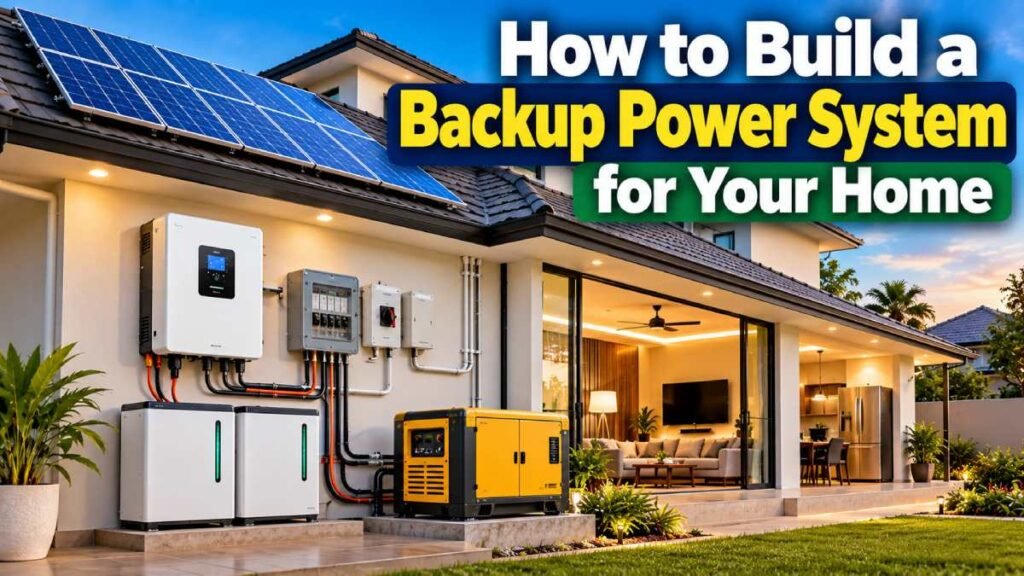
Power outages can turn ordinary household tasks into major inconveniences.
The lights go out. Your refrigerator stops running. Your Wi-Fi disappears. Phones need charging. Fans and air conditioners stop working. If the outage lasts for several hours—or even days—you may quickly realize how dependent your household is on electricity.
That is why having a backup power system can be so valuable.
But building one doesn’t necessarily mean spending a huge amount of money on a complete off-grid solar installation. A backup system can be as simple as a battery and inverter for essential appliances, or as sophisticated as a solar-and-battery system capable of powering most of your home.
The key is to build the system around what you actually need during an outage.
You don’t necessarily need to power everything.
You need to make sure the things that matter most keep working.
What Is a Home Backup Power System?
A home backup power system provides electricity when your normal power source is unavailable.
Depending on the system, it may use:
- Batteries
- Solar panels
- An inverter
- A fuel generator
- A portable power station
- A combination of several technologies
A basic battery backup system works like this:
Battery → Inverter → Household appliances
A solar backup system adds another component:
Solar panels → Charge controller/inverter → Battery → Household appliances
A hybrid system may also include the electricity grid or a conventional generator.
The objective is not necessarily to become completely independent from the grid.
Instead, the goal is to make sure you have electricity when you need it most.
Start by Deciding What You Need to Keep Running
Before buying equipment, make a list of your essential appliances.
For example, during a power outage, you may want to keep:
- Refrigerator
- LED lights
- Fans
- Wi-Fi router
- Smartphones
- Laptop
- Television
- Security equipment
- Medical or other essential devices
You may decide that other appliances can remain switched off until normal electricity returns.
This is one of the easiest ways to reduce the size and cost of your backup system.
You don’t need a generator capable of powering your entire house if your actual priority is keeping a refrigerator, lights, fans, and internet connection running.
Calculate the Power Requirements
Once you’ve identified your essential appliances, determine how much power they require.
Appliances normally have a wattage rating listed on a label or specification sheet.
For example, you might have:
- LED lights: 10–20 watts each
- Router: 10–20 watts
- Laptop: 50–100 watts
- Fan: 50–100 watts
- Television: 50–150 watts
- Refrigerator: variable, depending on the model and operating cycle
These numbers are only examples. Always check your actual appliance ratings.
Add together the appliances you expect to operate simultaneously.
This gives you an estimate of your peak operating load.
That number is important when selecting your inverter or generator.
Understand Continuous Power and Surge Power
One of the easiest mistakes to make when buying backup equipment is looking only at continuous power.
Some appliances require significantly more electricity when they start.
Refrigerators, freezers, pumps, compressors, and certain motors can have a startup surge.
For example, a refrigerator may use relatively modest electricity once running but require considerably more power for a brief period when its compressor starts.
Your inverter or generator therefore needs to accommodate both:
- Normal operating power
- Startup or surge power
Ignoring this can result in an apparently powerful system that struggles whenever a motor-driven appliance starts.
Choose the Type of Backup System
There are several approaches you can take.
Battery and Inverter System
A battery-and-inverter setup is one of the simplest backup systems.
The battery stores electricity, while the inverter converts it into usable AC electricity for compatible household appliances.
This type of system can be useful when you need silent backup power for several hours.
The main limitation is battery capacity.
Once the battery is depleted, the system needs to be recharged.
Solar and Battery System
Adding solar panels allows you to recharge the batteries using sunlight.
This can significantly improve the usefulness of your backup system because you are no longer completely dependent on grid electricity for recharging.
During daylight hours:
Solar panels → Appliances + Battery
At night or during an outage:
Battery → Inverter → Appliances
The amount of backup electricity available depends on the size of both the solar array and battery bank.
Fuel Generator
A petrol or diesel generator can provide substantial amounts of electricity and can run for as long as fuel is available.
Generators can be useful for high-power appliances and longer outages.
However, they come with disadvantages including:
- Fuel costs
- Noise
- Exhaust fumes
- Maintenance
- Manual refueling
- Storage requirements
A generator should never be operated in an enclosed or poorly ventilated space because of the risk of dangerous exhaust gases.
Hybrid Backup System
A hybrid approach combines multiple sources.
For example:
Solar + Batteries + Grid + Generator
Solar can provide electricity when available.
Batteries can provide silent backup.
The grid can supply electricity when it is available.
A fuel generator can serve as an emergency backup during prolonged periods of poor solar production or unusually high demand.
For some households, this provides the greatest flexibility.
How Large Should Your Battery Be?
Battery capacity is one of the most important parts of your backup system.
A battery isn’t simply about how much power you can draw at one moment.
It is also about how long the system can keep your appliances running.
For example, a small battery might be sufficient for:
- Several LED lights
- A router
- Phone charging
- A laptop
for several hours.
But if you add a refrigerator, multiple fans, television, and other appliances, you’ll need considerably more storage.
The more electricity you consume during the outage, the larger your battery needs to be.
Don’t Forget Battery Usable Capacity
A battery’s advertised capacity isn’t necessarily the same amount of energy you should expect to use continuously.
Battery chemistry, depth of discharge, temperature, age, and system efficiency can all affect usable capacity.
This is why you shouldn’t size your system based solely on the number printed on a battery.
You need to consider how much energy the system can realistically deliver under your intended operating conditions.
Choosing the Right Inverter
The inverter is another critical component.
Its job is to convert DC electricity from the battery into AC electricity that compatible household appliances can use.
When choosing an inverter, look at:
- Continuous output rating
- Surge rating
- Input voltage
- Efficiency
- Protection features
- Compatibility with your battery system
- Compatibility with your intended appliances
If your essential appliances require a combined 1,500 watts while operating, choosing an inverter rated below that level would obviously be problematic.
You also need to account for appliances that have high starting demands.
Decide How Long You Need Backup Power
Another important question is:
How many hours of backup electricity do you actually need?
Your answer could be:
- 2 hours
- 4 hours
- 8 hours
- Overnight
- 24 hours
- Several days
A system designed for two hours of emergency lighting is very different from a system designed to keep a refrigerator, fans, router, and other appliances operating for several days.
Don’t automatically build the largest possible system.
Estimate your realistic outage requirements first.
Solar Can Extend Your Backup Time
If you live somewhere with good sunlight, solar panels can be extremely useful for extending battery runtime.
Imagine your battery becomes partially depleted during the night.
During the following day, solar panels can generate electricity and replenish the battery while also supplying your household’s daytime loads.
This creates a cycle where the battery isn’t completely dependent on grid electricity for charging.
However, solar production varies.
Cloudy weather, rain, shading, panel orientation, and other conditions can reduce generation.
Therefore, a solar backup system should be designed with realistic production assumptions rather than the maximum theoretical output printed on the panel.
Should You Include an Emergency Generator?
For households that experience long outages, a backup generator can provide an additional layer of protection.
You might not need to run it every day.
Instead, you could reserve it for situations such as:
- Several days without reliable grid electricity
- Extended periods of poor weather
- Very high household demand
- Low battery levels
- Emergency situations
This can make a hybrid backup system considerably more resilient.
What About DIY Backup Power Projects?
DIY electricity projects can sometimes provide useful low-power backup electricity.
For example, some DIY systems are designed around electromagnetic or generator concepts and can be used for small loads.
However, beginners should be careful not to confuse a DIY project with a whole-home backup system.
The Energy Revolution System review is a useful example.
The system is presented as a downloadable DIY blueprint rather than a finished generator. Its realistic use is focused on low-wattage applications such as lighting and charging small electronics, rather than replacing a conventional generator or powering major household appliances.
That distinction is important.
A DIY project may be interesting and useful for a specific purpose without being capable of handling the electrical demands of an entire home.
Create an Essential-Loads Circuit
One practical strategy is to identify a group of appliances that you want your backup system to prioritize.
For example, you could design your backup system around:
Refrigerator + router + lights + fans + phone charging
rather than:
Every appliance in the house.
This makes the system easier and often cheaper to size.
If your backup system is connected to household wiring, however, the installation should be handled appropriately by a qualified electrician.
Never improvise a connection between a homemade power source and your home’s electrical wiring.
What Should You Not Connect to a Small Backup System?
Small systems are generally not suitable for high-power appliances unless they have been specifically sized for them.
These can include:
- Electric ovens
- Electric cookers
- Large air conditioners
- Electric water heaters
- Clothes dryers
- Large pumps
- High-powered heating appliances
These devices can consume substantial amounts of electricity.
If you want to operate them during outages, you’ll need to size the generator, inverter, batteries, and wiring accordingly.
Make Your Backup System More Efficient
You can make a smaller backup system last longer simply by reducing unnecessary electricity consumption.
During an outage:
- Turn off unused lights.
- Unplug unnecessary electronics.
- Avoid running multiple high-power appliances simultaneously.
- Use efficient LED lighting.
- Use fans strategically.
- Avoid opening the refrigerator unnecessarily.
- Charge devices when electricity is available.
- Monitor battery levels.
Energy efficiency isn’t just about reducing your electricity bill.
It can directly increase the amount of time your backup system can keep essential appliances running.
Safety Comes First
Backup electricity systems can be dangerous when incorrectly installed.
Batteries can store significant amounts of energy.
Inverters can produce high voltages.
Generators produce exhaust gases.
Household electrical wiring can cause electric shock, fires, or equipment damage if improperly connected.
Keep these basic principles in mind:
Never Run a Fuel Generator Indoors
Generators produce carbon monoxide and other exhaust gases.
Operate them outdoors in a suitable location away from doors, windows, and ventilation openings.
Don’t Connect a Generator Directly to Household Wiring
Improper backfeeding can create serious hazards for both your household and utility workers.
Use an appropriate transfer mechanism installed by a qualified electrician.
Protect Batteries and Wiring
Use appropriate fuses, breakers, cables, connectors, and enclosures.
Don’t Experiment With High Voltage
If you’re not trained to work with household electrical systems, don’t attempt complex wiring yourself.
A professional installation can be far cheaper than dealing with an electrical fire or damaged appliances.
How Much Will a Backup Power System Cost?
There is no single price.
Your cost depends on:
- Required power output
- Battery capacity
- Solar panel capacity
- Inverter size
- Battery chemistry
- Generator size
- Installation
- Wiring
- Safety equipment
- Maintenance requirements
A small system designed to keep phones, lights, and a router running can cost dramatically less than a whole-home solar-and-battery installation.
This is another reason to determine your actual requirements before shopping.
The Best Backup System Is the One You Actually Need
It is easy to become overwhelmed by specifications.
Watts.
Kilowatt-hours.
Amp-hours.
Inverter ratings.
Battery chemistry.
Solar panel ratings.
Surge capacity.
But the underlying decision is relatively simple.
Ask yourself:
What do I need to keep running when the electricity goes off?
Then determine:
How much power do those appliances require?
Then:
How long do I need them to run?
Once you have those answers, you can begin selecting the appropriate equipment.
Final Verdict
Building a backup power system for your home doesn’t have to mean trying to reproduce the entire electricity grid on your property.
Start small and build around your actual needs.
Identify your essential appliances.
Calculate their power requirements.
Determine your desired backup runtime.
Choose an appropriate battery, inverter, solar system, generator, or combination of technologies.
And most importantly, don’t buy a system simply because it claims to provide “home power.”
Look at the actual output.
A small DIY electricity project can be useful for lights and charging devices. A battery-and-inverter system can provide several hours of backup. A properly designed solar-and-battery installation can potentially provide much greater independence.
The right choice depends entirely on your household’s electricity requirements.
The goal isn’t to build the biggest backup system possible. It’s to build a reliable system that keeps the things you need running when the grid doesn’t.
Frequently Asked Questions
What is the easiest backup power system for a home?
For basic backup needs, a battery-powered inverter or portable power station can be relatively simple. If you need longer-term backup, adding solar panels or another charging source can make the system more useful.
How do I know what size inverter I need?
Add the wattage of the appliances you expect to operate simultaneously and account for the startup surge of appliances such as refrigerators, pumps, and other motor-driven equipment.
How many batteries do I need for backup power?
It depends on your electricity consumption and how long you want the system to operate. Calculate the energy requirements of your essential appliances and size your storage accordingly.
Can solar panels work as backup power?
Yes, but solar panels alone don’t necessarily provide electricity when the sun isn’t available. A battery is generally needed if you want stored electricity for nighttime or outage use.
Can a DIY generator power my entire house?
Some professionally designed generator systems can power an entire home, but many small DIY electricity projects are intended only for low-power applications. Always check the actual output before connecting appliances.
Should I buy a generator or solar battery system?
That depends on your priorities. Generators can provide substantial power for extended periods when fuel is available, while battery systems are quieter and can be paired with solar for renewable recharging. A hybrid system can combine the advantages of both.