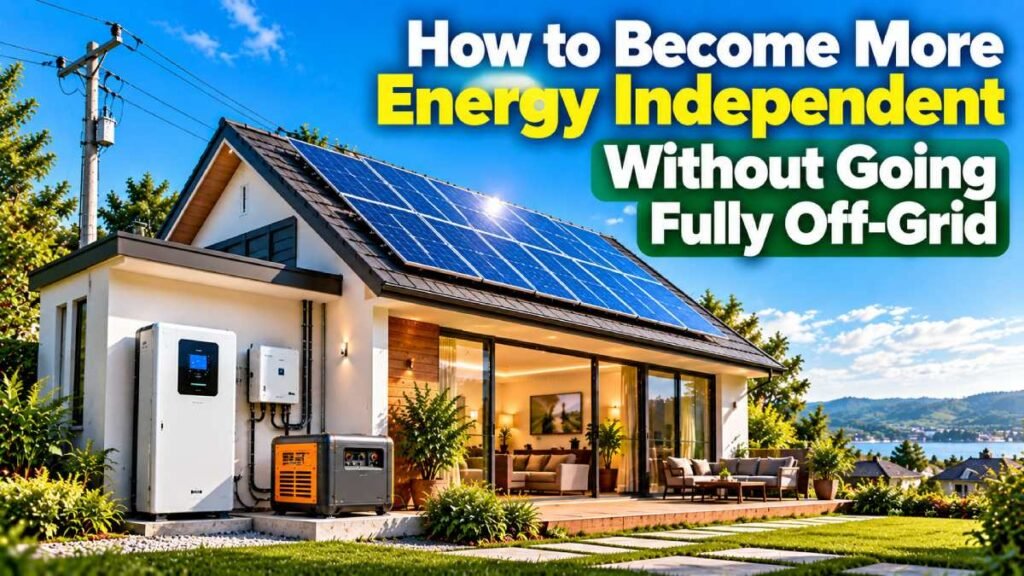
You don’t have to disconnect from the electricity grid completely to become more energy independent.
For many households, going fully off-grid is expensive, complicated, and unnecessary. A better approach can be to gradually reduce how much you depend on the grid while keeping it available as a backup.
This approach gives you many of the benefits of energy independence without requiring you to build an entirely self-sufficient power system.
You can start small, reduce your electricity consumption, add backup power, generate some of your own electricity, and eventually build a system that keeps essential appliances running even when grid electricity isn’t available.
The key is to focus on reducing dependence rather than eliminating the grid completely.
What Energy Independence Actually Means
Energy independence doesn’t necessarily mean producing every watt of electricity your home consumes.
Instead, it means having greater control over where your energy comes from and how much you depend on a single source.
A partially energy-independent home might:
- Use less electricity from the grid
- Generate some electricity through solar
- Store electricity in batteries
- Have backup power available during outages
- Reduce unnecessary energy consumption
- Use efficient appliances
- Maintain access to the grid when additional power is needed
This can be much more achievable than attempting to disconnect completely.
For example, instead of designing a solar system large enough to power every appliance in your home 24 hours a day, you could build a smaller system specifically for essential loads.
That might include lighting, refrigeration, internet equipment, fans, phones, computers, and other important devices.
Start by Reducing How Much Electricity You Need
The easiest electricity to replace is the electricity you don’t use.
Before spending money on solar panels, batteries, generators, or other equipment, look for ways to reduce your household’s energy consumption.
This can make every future investment smaller and more affordable.
Replace inefficient lighting
LED bulbs generally use considerably less electricity than traditional incandescent bulbs while providing the same basic lighting function.
If your home has many lights operating for several hours each day, replacing inefficient bulbs can reduce your overall electricity demand.
It also means your backup system won’t have to work as hard during power outages.
Pay attention to standby consumption
Some devices continue drawing electricity even when you’re not actively using them.
Televisions, computers, entertainment systems, chargers, networking equipment, and other electronics can contribute to household consumption when left connected unnecessarily.
You don’t have to obsess over every device.
Simply identifying the equipment that remains powered continuously can reveal opportunities to reduce unnecessary consumption.
Use efficient appliances where practical
When replacing an old appliance, energy efficiency should be one of the factors you consider.
An efficient refrigerator, freezer, fan, air conditioner, or washing machine can reduce the amount of electricity your home requires over its useful life.
This becomes particularly important if you’re planning to rely partly on solar and batteries.
Lower consumption means you may need fewer panels and less battery capacity to achieve the same level of backup.
Don’t Try to Power Everything
One of the biggest mistakes people make when planning energy independence is trying to make their backup system capable of running the entire house.
That can become expensive very quickly.
Instead, separate your home’s electrical loads into two categories:
Essential loads are the appliances and devices you genuinely need during an outage.
Non-essential loads are things you can live without temporarily.
Your essential loads might include:
- Refrigerator
- Freezer
- Lights
- Internet router
- Phones
- Computers
- Fans
- Security equipment
- Water pump
Non-essential loads might include:
- Electric ovens
- Large water heaters
- Heavy workshop equipment
- High-power entertainment systems
- Certain air conditioners
- Other appliances that consume substantial amounts of electricity
Once you make this distinction, you may discover that achieving meaningful energy independence doesn’t require an enormous system.
Build a Backup Power Layer
You don’t need to become energy independent overnight.
A backup power system can be your first step.
Depending on your requirements and budget, this could involve a generator, battery backup, solar system, or another appropriate power solution.
The purpose is simple:
Keep essential equipment running when the grid isn’t available.
This doesn’t eliminate your dependence on the grid.
It simply makes grid interruptions less disruptive.
And that’s an important distinction.
You can still use grid electricity when it is available while having another source ready when it isn’t.
Add Solar Gradually
Solar power is one of the most practical ways to increase energy independence without immediately going completely off-grid.
You don’t necessarily have to install a massive solar system from the beginning.
You can start with a system designed around your most important loads.
For example, a smaller installation might initially support:
- Lighting
- Phones
- Internet equipment
- Computers
- Fans
- Refrigeration
As your budget allows, you can expand the system by adding more panels, additional battery capacity, or a larger inverter.
This gradual approach can make the transition easier to manage financially.
Batteries Are What Make Backup Solar Useful
Solar panels generate electricity when there is sunlight.
But your household also needs electricity after sunset and during periods when solar production is insufficient.
That’s where battery storage becomes important.
A battery allows electricity generated earlier to be stored and used later.
The amount of battery capacity you need depends on your electricity consumption and how long you want your essential appliances to operate without grid power or additional generation.
For example, someone who only wants several hours of backup will have different requirements from someone who wants to operate essential appliances throughout the night.
This is why simply asking how many solar panels you need isn’t enough.
You also need to consider how much energy you need to store.
Use the Grid as a Backup Instead of Treating It as the Enemy
Energy independence doesn’t require abandoning the grid.
In fact, keeping a grid connection can make a partially independent energy system much easier to manage.
When solar production is insufficient or your batteries are depleted, the grid can provide additional electricity.
When the grid is unavailable, your backup system can take over essential loads.
This creates a hybrid model:
Grid + solar + battery + backup power.
For many households, that may be more practical than trying to create a completely independent energy system.
Consider a Generator as a Secondary Backup
Solar and batteries can dramatically reduce your dependence on fuel-powered generators, but there are situations where having a generator available still makes sense.
Extended periods of poor solar production, unusually high electricity demand, or prolonged outages can put additional pressure on a battery system.
A generator can serve as an additional layer of protection.
Instead of running it every time the electricity goes out, you can reserve it for situations where your primary backup system isn’t sufficient.
This can reduce fuel consumption while still giving you an emergency fallback.
Small DIY Systems Can Play a Supporting Role
DIY energy projects can also be part of a broader energy-independence strategy, provided their capabilities are understood realistically.
A small DIY system may be useful for experimenting with electricity generation or supporting low-power devices.
For example, you might use a small system for lighting or charging certain electronics rather than attempting to power an entire household.
The Energy Revolution System review is worth reading if you’re considering this type of approach and want to understand what a DIY energy blueprint can realistically provide.
The important point is that DIY solutions should complement your energy strategy rather than automatically be treated as replacements for properly sized solar, batteries, or generators.
Monitor Your Electricity Consumption
You can’t effectively reduce your dependence on electricity if you don’t know where your electricity is going.
Start by examining your household’s major energy consumers.
Some appliances may use relatively little electricity individually but operate for many hours.
Others may consume large amounts of power but only operate occasionally.
Understanding this difference can help you prioritize.
You may discover that reducing one major energy load has a bigger impact than making dozens of tiny changes elsewhere.
Monitoring also becomes useful when designing a solar or battery system because your actual consumption gives you a better starting point for determining how much backup capacity you need.
Think in Terms of Energy Resilience
Instead of asking:
“How do I get completely off the grid?”
Ask:
“How do I make my home resilient when the grid isn’t available?”
That’s a much more practical objective.
A resilient home can continue operating essential systems even when electricity supply is interrupted.
It might have:
- Solar generation
- Battery storage
- Backup generation
- Efficient appliances
- Reduced electricity consumption
- Multiple ways to obtain power
- A prioritized list of essential electrical loads
The goal isn’t necessarily to eliminate the grid.
It’s to make sure your household isn’t completely dependent on it.
Don’t Oversize Your System Without a Reason
More solar panels and larger batteries aren’t automatically better.
Oversizing can dramatically increase the cost of your system without providing meaningful benefits if your electricity requirements are modest.
Start with your actual consumption.
Then determine:
- Which appliances must remain operational.
- How much electricity they consume.
- How many hours they need to operate.
- How much solar energy you can realistically generate.
- How much battery storage you need.
- Whether you need a generator as additional backup.
This approach gives you a system designed around your needs rather than a collection of expensive components.
Build Your System in Stages
One of the easiest ways to become more energy independent is to treat the process as a series of upgrades.
Stage one: Reduce consumption
Improve efficiency and eliminate unnecessary electricity use.
Stage two: Protect essential loads
Create a backup system capable of keeping critical devices operational during outages.
Stage three: Add solar generation
Begin producing some of your own electricity instead of purchasing all of it from the grid.
Stage four: Add battery storage
Store excess energy for use when solar production isn’t available.
Stage five: Add additional backup
Keep a generator or another suitable backup source available for unusually long outages or periods of high demand.
Stage six: Expand when necessary
If your energy needs increase, expand the system rather than replacing everything unnecessarily.
This staged approach can spread the cost over time.
How Much Energy Independence Do You Really Need?
There is no universal target.
For one household, being able to keep the refrigerator, lights, internet, and phones running during a blackout may be enough.
Another household may want enough capacity to operate most appliances without the grid.
You could think of energy independence as a spectrum.
At one end, you’re completely dependent on the grid.
Further along, you have basic backup power.
Then you add solar.
Then battery storage.
Eventually, you may reach a point where the grid becomes a secondary source rather than your primary source of electricity.
You don’t necessarily have to reach 100%.
Even moving from heavy dependence to partial independence can make a meaningful difference.
The Financial Side Matters
Energy independence is not just an engineering decision.
It’s also a financial one.
Before investing in equipment, consider:
- The initial purchase cost
- Installation costs
- Maintenance
- Battery replacement
- Fuel costs
- Electricity savings
- Expected equipment lifespan
- Your household’s future energy needs
A system that saves money over time can be attractive.
But a system that costs far more than necessary may take much longer to justify financially.
Don’t buy equipment simply because it promises energy independence.
Buy it because it solves a specific energy problem for your household.
Safety Should Always Come First
Electricity systems can be dangerous when improperly installed.
Solar panels, batteries, generators, inverters, household wiring, and electrical protection equipment all need to be installed and configured correctly.
Never attempt to connect an independent power source directly to household wiring without the appropriate equipment and professional guidance.
Fuel-powered generators must also be operated outdoors in a properly ventilated location because of carbon monoxide risks.
If you’re unsure about electrical installation, work with a qualified electrician rather than experimenting with your home’s main electrical system.
Saving money on installation isn’t worth creating a fire, shock, or carbon monoxide hazard.
The Bottom Line
Becoming more energy independent doesn’t mean you have to abandon the electricity grid.
For most households, a gradual approach makes more sense.
Start by reducing unnecessary electricity consumption. Identify the appliances that truly matter during outages. Add backup power for those essential loads. Introduce solar when it makes financial sense, then add battery storage as your needs and budget allow.
You can even keep a generator as a secondary emergency option.
The result is a home that isn’t completely dependent on a single source of electricity.
That’s the real advantage of partial energy independence.
You don’t have to produce every watt yourself.
You simply need enough control over your energy supply that a grid outage doesn’t bring your household to a complete standstill.
The goal isn’t necessarily to live off-grid. It’s to make the grid optional when you need it to be.