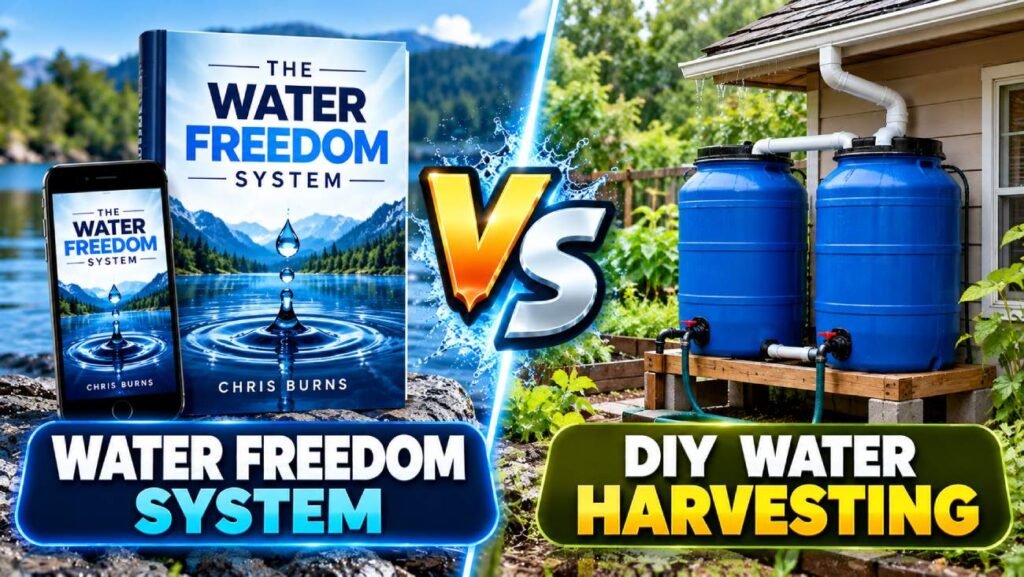
Water Freedom System is a $39.69 digital guide that shows you how to build a home atmospheric water generator, a machine that pulls moisture out of the air. DIY water harvesting means collecting water from natural sources yourself, mostly rain from a roof, plus dew and fog in special conditions.
They are not really rivals. They solve different problems. Rainwater harvesting gives you far more water for far less money, but only when it rains. Water Freedom System gives you a trickle on demand, but only if your air is humid and you have power.
- If you get regular rain: start with rain harvesting. It is cheaper and moves much more water.
- If you want water that does not depend on rain: Water Freedom System is the dry-day backup. It costs about $39.69 for the guide plus roughly $270 in parts.
- If you live in a very dry or cold place: neither will do much. Look at stored water, a well or a filter instead.
- Best overall plan: use both as layers. Rain tank first, air-water second, stored water as the base.
- Risk is low. The guide has a 60-day money-back guarantee through ClickBank.
👉 Try Water Freedom System for $39.69, 60-Day Refund
Table of Contents
- Side-by-Side Snapshot
- What Each Option Actually Is
- The Water Math: Rain vs Air
- The Dry-Spell Test: How Big a Tank Do You Need?
- Every DIY Harvesting Method Compared
- Which Method Fits Your Climate?
- The Three-Layer Water Plan
- What You Get Inside Water Freedom System
- What We Liked and What We Did Not
- Safety and Legal Rules for Both
- How to Try It Without Wasting Money
- FAQ
- Final Verdict
Side-by-Side Snapshot
| Factor | Water Freedom System | DIY Water Harvesting |
|---|---|---|
| What it is | Guide to build an air-to-water generator | Collecting rain, dew or fog |
| Water source | Humidity in the air | Rain, dew, fog |
| Upfront cost | $39.69 guide, about $270 parts | About $50 to $500+ for rain systems |
| Needs power | Yes | No, for most methods |
| Works when it is dry | Yes, if the air is humid | No, rain stops when the sky does |
| Volume | Small and steady | Large but irregular |
| Refund | 60 days on the guide | Not applicable |
What Each Option Actually Is
What is Water Freedom System?
Water Freedom System is a downloadable guide by Chris Burns that teaches you to build a small atmospheric water generator (AWG) from hardware-store parts. An AWG works like a dehumidifier. A fan pulls air across a cold coil, moisture condenses into water, and a filter cleans it for drinking.
The sales page says Chris is a farmer from Fresno, California who built it during a drought. We could not verify that story. The science behind the build is real, though. You can read the full breakdown in our Water Freedom System review.
What is DIY water harvesting?
DIY water harvesting is any way of collecting water from natural sources on your own property, without a purchased treatment plant. The most common version is rainwater from a roof, run through a gutter into a barrel or tank. Less common versions use dew collectors, fog nets and solar stills.
The main point most articles miss: these are different tools. One makes water from air using electricity. The other catches water that nature already delivers for free.
The Water Math: Rain vs Air
This is the comparison nobody shows you, and it settles most of the debate.
How much water can a roof catch?
One inch of rain on one square foot of roof gives 0.623 gallons. The formula is roof area (sq ft) x rainfall (inches) x 0.623. So a 1,000 square foot roof catches about 623 gallons from a single inch of rain, before losses.
Here is what a 1,500 square foot roof can collect over a year, assuming 80% of the water actually reaches your tank:
| Annual rainfall | Gallons per year | Average gallons per day |
|---|---|---|
| 10 inches (dry) | About 7,500 | About 20 |
| 20 inches | About 15,000 | About 41 |
| 30 inches | About 22,400 | About 61 |
| 45 inches (wet) | About 33,600 | About 92 |
Those are averages. Rain does not fall evenly, so you only get that daily figure if your tank is big enough to hold the wet days for the dry ones. More on that in the next section.
How much electricity would the same water cost with an AWG?
Published research puts efficient commercial AWGs at roughly 0.2 to 1.3 kWh per liter. A one-year field study in a hot, humid climate averaged 2.25 kWh per liter.
Now compare one inch of rain on a 1,000 square foot roof, which is about 2,358 liters:
| Source | Water | Electricity needed |
|---|---|---|
| Rain on a 1,000 sq ft roof | 623 gallons | Almost none |
| AWG, best case (0.35 kWh/L) | 623 gallons | About 825 kWh |
| AWG, field average (2.25 kWh/L) | 623 gallons | About 5,300 kWh |
An average US home uses roughly 30 kWh a day. So making 623 gallons from air would take about a month of your whole house’s electricity, even in the best case. One rain shower does the same job for free.
That is why we do not recommend Water Freedom System as a money saver or as a rain substitute. Its job is different. It makes a small amount of water when nothing else will. If you want to understand your power side, see how much electricity the average home really uses.
👉 Get the Water Freedom System Blueprint + 4 Free Bonuses
The Dry-Spell Test: How Big a Tank Do You Need?
The real weakness of rain harvesting is not the yearly total. It is the gap between storms. A tank that is empty on day 12 of a dry spell does you no good, no matter how wet the year was.
Run this quick test:
- Find the longest stretch your area usually goes without meaningful rain, in days.
- Multiply by your daily need. For drinking only, emergency planners suggest at least one gallon per person per day.
- That number is the storage you need to cover the gap.
| Household size | 14 dry days (drinking only) | 30 dry days (drinking only) |
|---|---|---|
| 2 people | 28 gallons | 60 gallons |
| 4 people | 56 gallons | 120 gallons |
| 6 people | 84 gallons | 180 gallons |
Drinking is the easy part. Cooking, washing and flushing use far more. Many households use roughly 80 gallons per person per day indoors, so covering a whole house from rain alone takes serious storage.
This is where an AWG earns its place. A build that makes a few gallons on a humid day will not run a house. It can stretch a drinking-water supply through the days when the tank is low. That is exactly the gap rain cannot fill.
Every DIY Harvesting Method Compared
| Method | Typical output | Cost | Needs power? |
|---|---|---|---|
| Roof rain catchment | 0.623 gal per sq ft per inch of rain | About $50 to $500+ | No |
| Dew collector | Up to about 1 liter per m2 per night | Low | No |
| Fog net | Around 2 to 5 liters per m2 per fog day, up to 10 | About $1,000 to $1,500 for a 40 m2 net | No |
| Air-water generator (WFS-type) | A few gallons on a good day | About $310 total | Yes |
| Solar still | Small, mainly for purifying water | Low | No |
Why dew and fog rarely replace rain at home
- Dew is energy limited. Radiative dew collectors are capped at roughly 1 liter per square meter per night, because the sky can only cool a surface so much.
- Fog nets need fog and wind. Dew and humid air alone are not enough. Nets work in coastal and mountain places, and a 40 square meter net averages about 200 liters a day, but strong wind can wreck cheap builds.
- Solar stills are slow. They are better for cleaning questionable water than for producing volume. This is our editorial view, so check any yield claim you see.
For most homeowners the real choice is rain barrels versus an AWG, with the other methods as extras for special places.
Which Method Fits Your Climate?
| Your climate | Best main method | Where Water Freedom System fits |
|---|---|---|
| Wet, regular rain | Rain catchment | Optional backup for dry spells |
| Humid, little rain (coastal, tropical dry season) | Air-water plus storage | Strong fit |
| Foggy, windy highlands | Fog nets | Secondary |
| Moderate rain and moderate humidity | Rain catchment | Good backup layer |
| Dry or desert | Stored water, well, filter | Poor fit |
| Cold winters | Rain in warm months, storage | Weak in winter |
A simple way to check: look at your local humidity and your yearly rainfall. If humidity is above roughly 50% and rain is scarce, an AWG makes sense. If rain is steady, a tank and gutters will beat it on every number except independence from weather.
AWG output drops sharply when the air is cool, roughly below 65°F (18°C), and when humidity falls under about 40%. Builders in Florida report good results. Builders in dry states often report almost nothing. Both facts come up in the forum threads we read.
The Three-Layer Water Plan
Preparedness planners think in layers, and so should you. Here is how the pieces fit:
- Layer 1, stored water. Sealed containers of drinking water. Costs little and works instantly.
- Layer 2, rain harvesting. Gutters and tanks. Produces volume whenever it rains.
- Layer 3, an air-water generator. The slow, steady layer that keeps producing after the tank runs low, as long as you have power and humid air.
Each layer covers a different failure. Stored water covers the first days. Rain covers the weeks. The AWG covers the long gaps. If you want the power side, our guides on building a backup power system for your home and off-grid electricity for beginners help, and our comparison of the Energy Revolution System, solar panels and Water Freedom System shows how they compare.
Most people already have layer 1 or can get it for a few dollars. Layer 2 depends on your roof and your local rules. Layer 3 is the one that usually needs a plan, and a $39.69 guide is a cheap way to learn what it takes.
👉 See Today’s Water Freedom System Price
What You Get Inside Water Freedom System
- Step-by-step build instructions written for beginners
- A materials list with where to source each part (about $270 in total)
- Blueprints and diagrams for each stage
- A multi-stage filtration section, including sediment and activated carbon
- Maintenance and troubleshooting tips for when output drops
- A scaling guide to expand the system
- 4 free bonus guides: bartering, blackout survival, home defense and a greenhouse guide
It arrives as a digital download, so you can open it on a phone, tablet or computer right after checkout. That also makes it easy to read the whole thing before spending anything on parts.
What We Liked and What We Did Not
What we liked
- It fills the gap rain leaves. It is the only option here that works on a dry, humid day.
- The science is real. Condensation is how dehumidifiers and commercial AWGs work.
- The filtration section matters. Condensed air water is not safe by default, and the guide covers it.
- The scaling guide gives you a path to a bigger build later.
- Low risk. About $39 with a 60-day refund, versus $1,500 or more for a commercial AWG.
- It teaches the skill, so you can fix and adjust your own system.
What we did not
- The “20 to 60 gallons a day” claim is not realistic for a home build, as the power math shows.
- It needs electricity. It is not a power-free source like a rain barrel.
- Parts cost about $270 on top of the guide.
- No independent lab test of output has been published.
- Possible upsells after checkout. The core guide is complete without them.
To be fair, big claims and upsells are common across ClickBank products. ClickBank screens its vendors, and in our experience most complaints come from mismatched expectations, such as buying in a dry climate, rather than from anyone being cheated.
Safety and Legal Rules for Both
Is rainwater safe to drink?
Not without treatment. The CDC warns that rainwater can carry bacteria, parasites, viruses and chemicals, for example from bird droppings on a roof. Use a first-flush diverter, a covered tank, filtration and disinfection, and test the water before drinking it.
Is air-made water safe to drink?
Only if you filter it and keep the tank clean. Condensed water can pick up dust and microbes, and standing water breeds bacteria. Do not drink water from a regular dehumidifier, since those units are not built for drinking.
Is rainwater collection legal?
In most places, yes, but rules vary. Some states cap how much you can store or limit use to non-drinking purposes, and a few require specific filtration for potable use. Check your state or county before you build, since these laws have changed in recent years.
Building an AWG at home is generally not restricted in the same way, but you should still check local building and electrical rules for any wiring you do.
How to Try It Without Wasting Money
Your 60-day guarantee refunds the guide, not the parts. If you spend $270 on hardware and then find your climate is too dry, you can get the $39.69 back but not the hardware money. So order of operations matters:
- Check your humidity and rainfall first, using the tables above.
- Buy and download the guide. It is about $39.69.
- Read the whole guide and the parts list before you buy a single part.
- Price the parts in your area and check your power cost.
- Decide inside 60 days. If it does not fit, request a refund through ClickBank.
Done this way, the most you can lose is a little time. If it fits, you build with confidence. Compare this with spending $1,500 or more on a commercial unit without being able to try it first.
👉 Start Water Freedom System Risk-Free
Pricing, refund and support
- Price: $39.69 one-time (marketed against a $149 regular price), instant digital access
- Refund: 60-day money-back guarantee through ClickBank. Buying through an affiliate link does not affect your refund rights.
- ClickBank billing and refunds: 1-800-390-6035
- Product support: chris@waterfreedomsystem.com (listed in third-party coverage, so confirm it in your receipt email)
If you are weighing it against a similar guide, see our Water Freedom System vs Smart Water Box comparison, our Smart Water Box review and our Joseph’s Well review.
FAQ: Water Freedom System vs DIY Water Harvesting
Is Water Freedom System better than rainwater harvesting?
No, they do different jobs. Rainwater harvesting moves far more water for far less money when it rains. Water Freedom System makes a small, steady amount of water on dry days if you have humid air and power. Many people use both.
Which makes more water, an AWG or a rain barrel?
Rain, by a wide margin. One inch of rain on a 1,000 square foot roof gives about 623 gallons. Making that much from air would take roughly 825 kWh at best, so a home AWG produces only a few gallons a day.
Does Water Freedom System really make 20 to 60 gallons a day?
Not at home scale. The electricity needed for those numbers would exceed a typical household’s whole daily use. Treat the gallon claims as marketing and plan for a few gallons on a good, humid day.
Is Water Freedom System legit?
Yes. It is a real guide sold through ClickBank with a 60-day refund. The main criticism is its optimistic output claim, not fraud.
Which costs less to set up?
Rain barrels usually cost less, starting around $50 for a basic setup. Water Freedom System is about $39.69 plus roughly $270 in parts.
Does it work in a dry climate?
Poorly. AWG output drops sharply below about 40% humidity and in cool air. A dry region is better served by stored water, a well or a good filter.
Do I need electricity for each option?
Rain barrels, dew collectors and fog nets do not need power. Water Freedom System does, because the fan and cooling run on electricity. You can pair it with solar if you want it off-grid.
Can I drink collected rainwater?
Only after treatment. Rainwater can carry microbes and chemicals, so use filtration and disinfection and test it before drinking.
Is rainwater collection legal where I live?
Usually, but some states limit storage or drinking use. Check your state and county rules before you build.
How much water do I need per person?
Emergency planners suggest at least one gallon per person per day for drinking. Whole-household use is far higher, often around 80 gallons per person per day.
Can I use dew collectors or fog nets at home?
Dew collectors are limited to about 1 liter per square meter per night. Fog nets need regular fog and wind, so they suit coastal and mountain areas more than ordinary neighborhoods.
Does the refund cover my parts?
No. It covers the $39.69 guide only. Read the guide and price the parts before you spend on hardware.
Can I get a refund if I buy through your link?
Yes. ClickBank handles the refund, and who referred you does not matter.
Are there upsells?
Possibly. You may see extra offers after checkout, and you can decline them. The core guide is complete on its own.
Can I just use a regular dehumidifier instead?
The physics is the same, but regular dehumidifier water is not meant for drinking. The filtration and build steps in the guide are the point.
Final Verdict
If you get regular rain, start with rain harvesting. It is the cheapest, biggest source of water you can build. If you want a layer that keeps working when the rain stops, Water Freedom System is a low-risk way to learn how to add one.
Ignore the giant gallon numbers on the sales page. What you are buying is the know-how to make clean water from air when other sources fail. At $39.69 with a 60-day refund, you can read the entire guide, check your climate, price the parts and walk away if it does not fit.
The buyers who regret it are the ones who expected a free, high-volume water supply or bought in a dry climate. If you are in a humid area and want a backup layer, it is an easy call.
👉 Get Water Freedom System Now, Refundable for 60 Days
Further Reading
- Water Freedom System Review: our full breakdown of the guide, bonuses and complaints.
- Water Freedom System vs Smart Water Box: how the two DIY air-water guides compare on cost and build.
- Energy Revolution System Review: a DIY power guide if you want to run an AWG off the grid.
- Generator vs Solar vs DIY Power: how to pick a backup power source for your water setup.
Disclaimer: This article is for information only and is not engineering, legal or medical advice. Water output depends on humidity, temperature, rainfall, build quality and maintenance, and results vary. Always treat and test collected or home-made water before drinking it, and check local laws before building. This post contains affiliate links, and prices and offers can change.