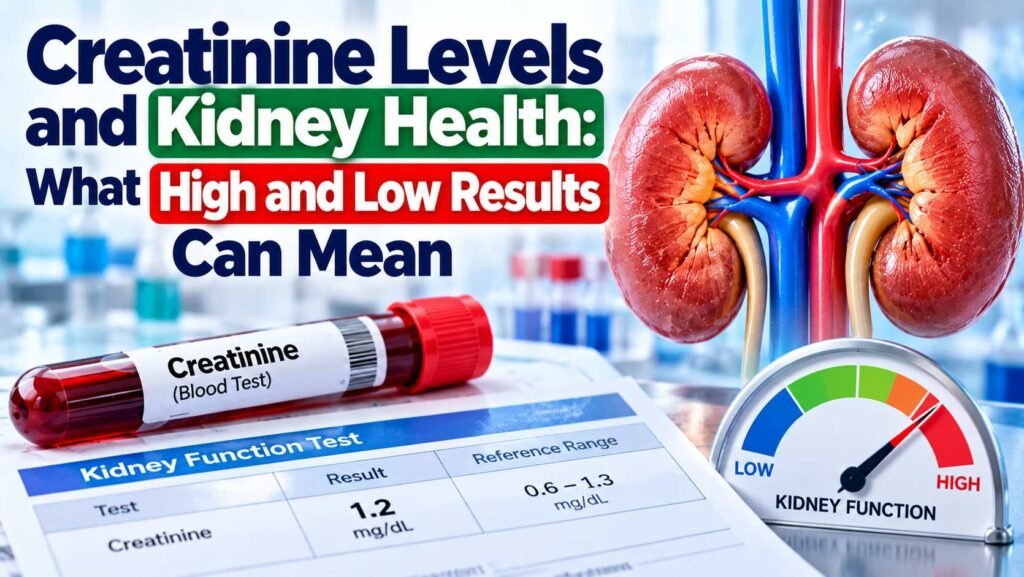
Creatinine is one of the most commonly discussed numbers on a kidney blood test.
If your creatinine level is high, you may immediately wonder whether your kidneys are failing. If it is low, you might assume that everything is fine.
But creatinine results are not quite that simple.
Creatinine is a waste product produced largely from normal muscle metabolism and processed out of the blood by the kidneys. When kidney filtration decreases, creatinine can build up in the bloodstream. However, your creatinine level can also be influenced by factors such as muscle mass, diet, certain medications, exercise, and other health conditions.
That’s why doctors generally don’t interpret creatinine in isolation.
Instead, creatinine is often used to calculate estimated glomerular filtration rate (eGFR), which provides a more useful estimate of kidney filtration.
So what does a high or low creatinine result actually mean?
Let’s break it down.
What Is Creatinine?
Creatinine is a waste product that comes from the normal breakdown of muscle tissue and the metabolism of protein.
Your muscles continuously produce creatinine as part of their normal activity. The kidneys then filter creatinine from the blood and remove it through urine.
Because the kidneys are responsible for removing creatinine, measuring the amount in your blood can provide useful information about how well they are functioning.
In general, when kidney filtration decreases, blood creatinine can increase.
But there’s an important catch.
Creatinine is not a direct measurement of kidney function.
A person’s result can vary based on factors unrelated to kidney damage.
For example, someone with a larger amount of muscle may naturally have a higher creatinine level than someone with very little muscle.
That means the same creatinine number can have different implications for different people.
What Is a Normal Creatinine Level?
There isn’t one universal creatinine number that is considered normal for everyone.
Reference ranges can vary between laboratories, and creatinine can also differ according to factors such as age, sex, body size, and muscle mass.
For that reason, it’s better to look at your laboratory’s reference range rather than comparing your number with someone else’s.
Your doctor may also consider your previous results.
For example, a creatinine level that has remained relatively stable over time can mean something very different from a result that has suddenly increased.
The trend can be extremely important.
What Does a High Creatinine Level Mean?
A high blood creatinine level can mean that your kidneys aren’t filtering waste as efficiently as they normally should.
When kidney filtration decreases, less creatinine is removed from the blood, causing the blood level to rise.
High creatinine can occur with:
- Chronic kidney disease
- Acute kidney injury
- Dehydration
- Certain medications
- High muscle mass
- Recent intense exercise
- Eating a large amount of cooked meat
- Use of creatine supplements
- Certain other medical conditions
Therefore, a high creatinine result doesn’t automatically mean you have chronic kidney disease.
Your healthcare professional needs to consider the result alongside your symptoms, medical history, previous laboratory results, eGFR, urine testing, medications, and other relevant factors.
Can Dehydration Raise Creatinine?
Yes.
When you’re dehydrated, changes in your body’s fluid balance can affect blood test results, including creatinine.
This is one reason a single elevated result shouldn’t automatically be interpreted as evidence of permanent kidney damage.
If your healthcare professional suspects that dehydration or another temporary factor contributed to the result, they may recommend repeating the test or performing additional tests.
However, you shouldn’t assume that every elevated creatinine result is simply dehydration.
A persistently elevated result deserves proper medical evaluation.
Can Exercise Affect Creatinine?
Intense exercise can temporarily influence creatinine levels.
This is particularly relevant for people with significant muscle mass or those who have recently performed strenuous exercise.
Muscle tissue produces creatinine, so a person who is very muscular can have a higher baseline creatinine than someone with substantially less muscle.
The National Kidney Foundation also notes that high-intensity exercise and high muscle mass can affect creatinine results.
This is one reason doctors don’t interpret the number without considering the person behind the test.
Can Diet Affect Creatinine?
Diet can also influence creatinine.
Eating a large amount of cooked meat shortly before testing can temporarily increase creatinine levels.
Creatine supplements can also affect creatinine measurements.
This doesn’t necessarily mean that the kidneys are damaged.
If you regularly use creatine supplements, follow a particular diet, or recently consumed a large amount of meat, it’s worth telling your healthcare professional so that the result can be interpreted appropriately.
What Does a Low Creatinine Level Mean?
A low creatinine level is generally not interpreted in the same way as a high creatinine level.
Lower creatinine can occur in people with relatively low muscle mass.
It can also be associated with factors such as:
- Low muscle mass
- Muscle wasting
- Certain chronic illnesses
- Pregnancy
- A vegetarian or vegan diet
- Severe liver disease
Again, context matters.
A low creatinine result doesn’t automatically mean that your kidneys are unusually healthy.
In fact, because creatinine production depends partly on muscle mass, someone with very little muscle may produce less creatinine and therefore have a lower blood creatinine level even when kidney function isn’t perfect.
That’s another reason why kidney health shouldn’t be judged from creatinine alone.
Why eGFR Is Often More Useful
One of the most important numbers to look at alongside creatinine is eGFR, or estimated glomerular filtration rate.
eGFR estimates how effectively your kidneys are filtering waste from your blood.
It’s calculated using information that includes your creatinine level and other factors.
Because creatinine can vary between people, eGFR provides additional context that a creatinine number by itself cannot provide.
Generally, a higher eGFR indicates better kidney filtration.
An eGFR below 60 that persists for three months or longer can indicate chronic kidney disease, while an eGFR below 15 is associated with kidney failure. However, healthcare professionals interpret eGFR together with other evidence rather than using one isolated result to diagnose CKD.
Creatinine and eGFR Don’t Tell the Whole Story
Even eGFR isn’t the only number that matters.
Another important kidney-health measurement is the urine albumin-to-creatinine ratio, commonly called uACR.
This test looks for albumin, a type of protein, leaking into the urine.
Healthy kidneys generally keep albumin in the bloodstream rather than allowing significant amounts to pass into the urine.
A uACR result of 30 mg/g or more can indicate albuminuria and may be a sign of kidney damage.
This means two people could have similar creatinine levels but have different overall kidney-health profiles.
That’s why a proper kidney assessment can involve several measurements rather than one number.
What If Your Creatinine Suddenly Increases?
A sudden increase deserves attention.
A rapid change can sometimes occur with acute kidney injury, which is different from chronic kidney disease.
Acute kidney injury can happen for several reasons, including severe dehydration, certain medications, infections, obstruction of the urinary tract, or other acute medical problems.
The significance of a change depends on your previous creatinine level, how quickly it changed, your symptoms, and what else is happening medically.
Don’t try to diagnose the cause yourself from the number alone.
If your doctor tells you that your creatinine has increased significantly, ask what may have caused the change and whether the test needs to be repeated.
What If Your Creatinine Is High but Your eGFR Looks Okay?
This can happen.
Creatinine is affected by factors other than kidney filtration.
For example, someone with substantial muscle mass or recent intense exercise may have a higher creatinine level without having the same degree of kidney impairment that the number might initially suggest.
Certain medications and dietary factors can also influence creatinine.
That’s why healthcare professionals may look at the creatinine trend, calculate eGFR, review medications, consider muscle mass and diet, and order additional tests when appropriate.
The important lesson is:
Don’t diagnose kidney disease from creatinine alone.
What If Your Creatinine Is Normal?
A creatinine result within the laboratory’s reference range is reassuring, but it doesn’t necessarily prove that your kidneys are completely healthy.
Some people can have kidney disease without a dramatically elevated creatinine level.
That’s partly because creatinine production varies between individuals.
Early kidney disease can also have few or no obvious symptoms, which is why kidney assessment may include eGFR and urine albumin testing rather than relying on symptoms or creatinine alone.
This is particularly important for people who have risk factors such as diabetes, high blood pressure, cardiovascular disease, or a family history of kidney disease.
What Can Cause Kidney Function to Decline?
Kidney function can be affected by many different conditions and circumstances.
Some of the important risk factors include:
- Diabetes
- High blood pressure
- Cardiovascular disease
- Certain kidney diseases
- Family history of kidney disease
- Some medications
- Previous kidney injury
- Older age
- Certain infections or inflammatory conditions
Diabetes and high blood pressure are especially important because they are major contributors to chronic kidney disease.
If you’re concerned about protecting your kidneys, understanding these risk factors is just as important as understanding your creatinine result.
For more practical strategies, see our guide to 10 Habits to Improve Your Kidney Health in 2026.
How Can You Support Healthy Kidney Function?
There isn’t one food, supplement, or “kidney detox” that guarantees healthy kidney function.
Instead, kidney health is generally connected to managing the factors that can damage the kidneys over time.
That includes:
Manage blood pressure
High blood pressure can damage blood vessels in the kidneys over time.
Keeping blood pressure within the range recommended by your healthcare professional is an important part of protecting kidney health.
Manage blood sugar
If you have diabetes or elevated blood sugar, managing it appropriately is important because prolonged high blood sugar can damage the kidney’s filtering structures.
Be thoughtful about medications
Some medicines can affect kidney function, particularly in certain circumstances.
Don’t stop prescribed medication on your own, but tell your healthcare professional about everything you’re taking, including over-the-counter medicines and supplements.
Avoid unnecessary extreme diets
A healthy diet can support overall health, but people with established kidney disease may have specific dietary requirements.
Protein, sodium, potassium, phosphorus, and fluid intake may need to be considered according to your individual kidney function and laboratory results.
Maintain appropriate physical activity
Regular physical activity can support cardiovascular and metabolic health, both of which are important for kidney health.
For more everyday strategies, you can also read our guide to 5 Ways to Prevent Chronic Kidney Disease.
When Should You Be Concerned About a Creatinine Result?
A creatinine result deserves more attention when it is:
- Significantly outside your laboratory’s reference range
- Increasing compared with previous results
- Accompanied by a declining eGFR
- Associated with abnormal urine albumin levels
- Accompanied by concerning symptoms
- Found in someone with significant kidney-disease risk factors
A single abnormal number doesn’t necessarily tell the entire story.
Your healthcare professional may repeat the test, compare it with previous results, calculate eGFR, check your urine, review medications, and investigate possible causes.
What Symptoms Can Occur With Kidney Problems?
Early kidney disease can be difficult to recognize because it may cause few or no noticeable symptoms.
As kidney function becomes more impaired, some people may experience:
- Swelling in the legs, ankles, feet, or around the eyes
- Changes in urination
- Persistent fatigue
- Nausea
- Loss of appetite
- Muscle cramps
- Itching
- Changes in concentration
- Shortness of breath in more advanced disease
However, these symptoms aren’t specific to kidney disease.
For a broader look at symptoms that may warrant attention, see our article on 5 Signs of Poor Kidney Health You Shouldn’t Ignore.
If symptoms are severe, sudden, or concerning, medical evaluation is more appropriate than trying to determine the cause from an online article.
What Should You Ask Your Doctor About Your Creatinine?
If you’ve recently received a creatinine result, don’t be afraid to ask specific questions.
Useful questions include:
- What is my creatinine level?
- How does it compare with my previous results?
- What is my eGFR?
- Has my eGFR changed?
- Should I have a urine albumin-to-creatinine ratio?
- Could my medications affect the result?
- Could my diet or exercise have affected the test?
- Should the test be repeated?
- Do I have any risk factors for chronic kidney disease?
- Do I need to see a kidney specialist?
These questions can help you understand the result instead of simply reacting to whether the number is labeled “high” or “low.”
What About the Chronic Kidney Disease Solution?
If you’ve been researching creatinine because you’re concerned about chronic kidney disease, you may also come across lifestyle programs designed to support kidney health.
The Chronic Kidney Disease Solution review looks specifically at what the program contains, its lifestyle-based approach, the evidence behind its recommendations, its limitations, pricing, and refund policy.
It’s important to keep the distinction clear: a lifestyle education program isn’t a substitute for kidney testing, diagnosis, medication, or medical care.
If you already have CKD, your dietary and lifestyle needs may depend on your stage of disease, medications, blood and urine results, and other health conditions.
The Bottom Line
Creatinine is an important kidney-health marker, but it isn’t a standalone diagnosis.
High creatinine can indicate reduced kidney filtration, but it can also be influenced by factors such as muscle mass, exercise, diet, supplements, medications, and dehydration.
Low creatinine can occur with low muscle mass and other conditions and doesn’t automatically mean your kidneys are functioning exceptionally well.
The more useful question is not simply, “Is my creatinine high or low?”
It’s:
“What does my creatinine mean in the context of my eGFR, urine tests, previous results, and overall health?”
That’s why doctors often consider creatinine alongside eGFR and urine albumin measurements when evaluating kidney health.
If your creatinine result is abnormal or has changed significantly, discuss it with a healthcare professional rather than trying to interpret the number on its own.
And if you’re concerned about protecting your kidneys over the long term, focus on the bigger picture: managing blood pressure and blood sugar, following appropriate lifestyle habits, taking medications as directed, and getting recommended kidney testing when you’re at risk.
Your creatinine number is a clue.
It’s the complete kidney-health picture that tells the real story.
Frequently Asked Questions
Is high creatinine always a sign of kidney disease?
No. High creatinine can occur for reasons unrelated to chronic kidney disease, including high muscle mass, recent intense exercise, certain medications, creatine supplements, and dietary factors. It should be interpreted alongside other information such as eGFR and urine testing.
What does a low creatinine level mean?
Low creatinine can be associated with low muscle mass, pregnancy, vegetarian or vegan diets, muscle wasting, and certain medical conditions. It doesn’t automatically indicate unusually good kidney function.
What creatinine level indicates kidney failure?
There isn’t a single creatinine number that can diagnose kidney failure for everyone. Kidney function is better assessed using eGFR and other clinical information. An eGFR below 15 is generally considered a marker of kidney failure.
Is creatinine or eGFR more important?
They serve different purposes. Creatinine is a blood measurement that is used, along with other factors, to calculate eGFR. eGFR generally provides a more useful estimate of kidney filtration than creatinine alone.
Can creatinine levels return to normal?
Sometimes. If an elevated creatinine level is caused by a temporary or reversible factor, it may decrease when that factor is corrected. However, the outcome depends on the underlying cause, so an abnormal result should be evaluated rather than assumed to be temporary.
Can you have kidney disease with normal creatinine?
Yes. Creatinine can appear normal in some people with kidney disease, particularly because creatinine levels vary according to factors such as muscle mass. That’s one reason healthcare professionals also consider eGFR and urine albumin testing.
Medical Disclaimer: This article is for informational and educational purposes only and is not a diagnosis or substitute for professional medical advice. If you have an abnormal creatinine, eGFR, or urine test result—or symptoms that concern you—speak with a qualified healthcare professional. Do not stop or change prescribed medication based on information in this article.