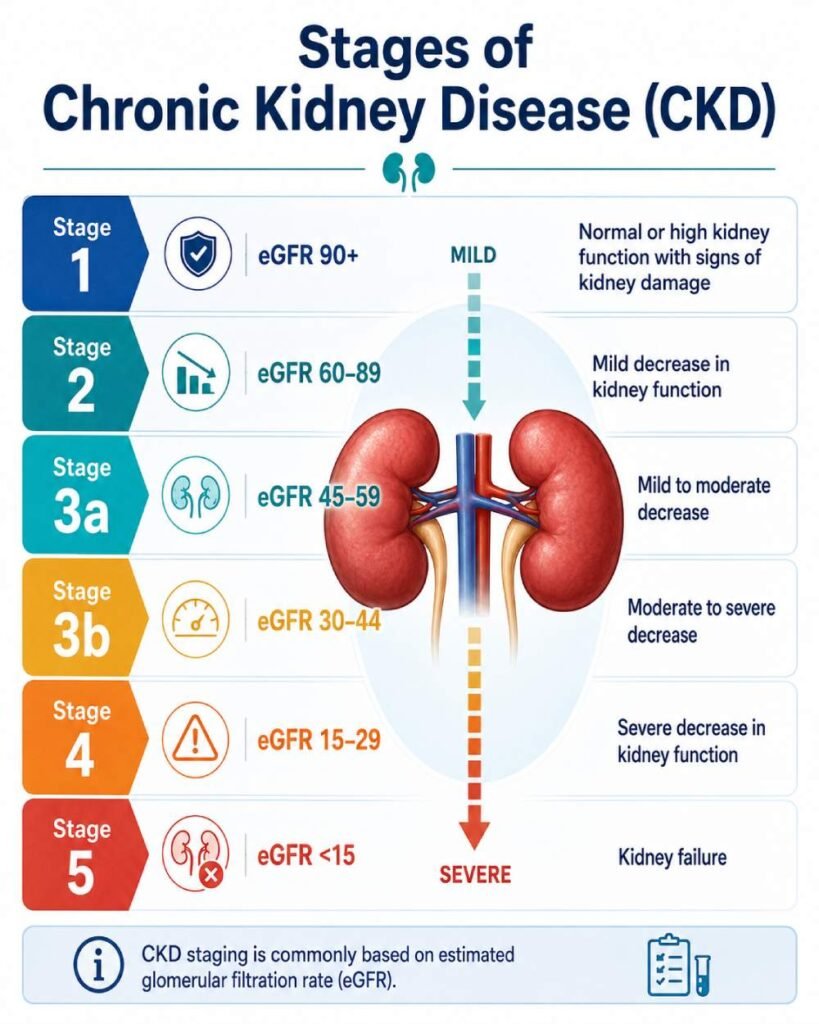
Chronic kidney disease (CKD) is diagnosed and tracked using a staging system built around two numbers: eGFR (estimated glomerular filtration rate) and uACR (urine albumin-to-creatinine ratio). Together, these two tests tell you and your doctor how well your kidneys are filtering waste and whether there’s damage showing up in your urine. This guide walks through what each stage means, what symptoms tend to show up (or don’t), and what typically happens next at each point along the way.
This article is for general education only. It is not medical advice and can’t tell you what stage you are in — only a doctor, using your own lab results, can do that. If you have concerns about your kidney function, please talk to a physician or nephrologist
What Is Chronic Kidney Disease?
Chronic kidney disease means your kidneys have been damaged or have lost function gradually, over a period of three months or longer. “Chronic” is the key word — it distinguishes CKD from acute kidney injury, which comes on suddenly and can sometimes be reversed. CKD, by contrast, is usually a slow, progressive process, though the speed of progression varies a lot from person to person.
Your kidneys filter waste and excess fluid out of your blood, help regulate blood pressure, balance electrolytes, and support red blood cell production. As kidney function declines, all of these jobs get harder for the body to do, which is why CKD is linked to a wide range of downstream problems, including cardiovascular disease.
An estimated 37 million adults in the United States may have CKD, and close to 90% of them don’t know it — largely because early-stage CKD rarely causes noticeable symptoms.
How CKD Is Staged: eGFR and uACR
Doctors use the KDIGO (Kidney Disease: Improving Global Outcomes) framework to stage CKD, and it relies on two separate blood and urine tests:
- eGFR (estimated glomerular filtration rate) — a blood test based on creatinine (sometimes combined with cystatin C) that estimates how much blood your kidneys filter per minute. A healthy eGFR is generally 90 or above.
- uACR (urine albumin-to-creatinine ratio) — a urine test that checks for albumin, a protein that shouldn’t normally be in urine in meaningful amounts. Its presence signals damage to the kidney’s filtering units.
CKD stage is labeled with a “G” number for GFR (G1 through G5) and an “A” number for albuminuria (A1 through A3). A diagnosis of CKD generally requires either an eGFR under 60, or a uACR above 30 mg/g, confirmed on repeat testing at least 90 days apart — this repeat testing is what separates “chronic” from a temporary dip caused by dehydration, illness, or another short-term factor.
Stage 1 CKD: Kidney Damage With Normal Function
eGFR: 90 or above
In stage 1, kidney function itself is still normal or near-normal, but there’s evidence of kidney damage — usually protein in the urine (elevated uACR), structural abnormalities seen on imaging, or changes found on a biopsy. Because filtration is still working well, stage 1 CKD almost never causes symptoms. It’s typically found incidentally, through routine bloodwork or urine testing, often in people with diabetes or high blood pressure who are being screened because they’re at elevated risk.
This is the stage where intervention has the most leverage — addressing the underlying cause (diabetes, hypertension, or another driver) can sometimes stop damage from progressing further.
Stage 2 CKD: Mild Loss of Function
eGFR: 60–89
Stage 2 still falls in a range some clinicians would consider mildly reduced, but combined with other evidence of kidney damage (like albuminuria), it counts as CKD. Like stage 1, this stage is usually symptom-free. Some people may notice nothing at all; others might have subtle signs like slightly more fatigue than usual, though this is easy to miss or attribute to something else entirely.
Regular monitoring becomes more important here, along with managing whatever underlying condition (diabetes, high blood pressure, obesity, or a family history of kidney disease) is contributing to the decline.
Stage 3 CKD: Moderate Loss of Function
eGFR: 30–59, split into two sub-stages:
- Stage 3a: eGFR 45–59
- Stage 3b: eGFR 30–44
This is often the point where CKD starts to become noticeable, both to patients and on routine labs. Symptoms can start to appear, including:
- Fatigue
- Swelling in the hands, feet, or ankles (edema)
- Changes in urination frequency
- Back pain in the kidney area
- High blood pressure that’s harder to control
Stage 3 is also when complications tied to reduced kidney function — like anemia and early bone mineral disturbances — become more common, since the kidneys play a role in producing the hormone that stimulates red blood cell production and in regulating calcium and phosphorus. This is generally when care becomes more structured, often with a referral to a nephrologist (kidney specialist), closer monitoring of blood pressure and blood sugar, and more frequent lab work.
Stage 4 CKD: Severe Loss of Function
eGFR: 15–29
At stage 4, kidney function is significantly impaired, and symptoms are typically more pronounced:
- Fatigue and weakness
- Swelling in the legs, ankles, or around the eyes
- Nausea
- Loss of appetite
- Muscle cramps, especially at night
- Difficulty concentrating
- Changes in urination (foamy urine, or urinating more or less than usual)
This stage typically involves close nephrology care and active preparation for what comes next if function continues to decline — including education about dialysis options (in-center hemodialysis, home hemodialysis, or peritoneal dialysis) and evaluation for a kidney transplant, since transplant workups and waitlists take time. Managing related complications — anemia, bone and mineral disorders, and cardiovascular risk — becomes a central part of care at this stage.
Stage 5 CKD: Kidney Failure
eGFR: below 15 (or already on dialysis)
Stage 5 is also called end-stage kidney disease (ESKD) or kidney failure. At this point, the kidneys are working at less than 15% of normal capacity, which is not enough to sustain the body without medical intervention. Symptoms are usually significant and may include:
- Urinating less often, or not at all
- Persistent fatigue
- Swelling throughout the body
- Shortness of breath
- Nausea and vomiting
- Loss of appetite and unintended weight loss
- Confusion or trouble concentrating
People at this stage need dialysis or a kidney transplant to survive. Stage 5 also carries the highest risk of cardiovascular complications of any CKD stage, so ongoing monitoring for heart-related issues is a standard part of care, alongside dialysis or transplant planning.
Who Is at Risk for CKD?
CKD can develop at any age, but certain factors raise the risk substantially:
- Diabetes — the leading cause of CKD worldwide
- High blood pressure — the second leading cause, and both a cause and a consequence of CKD
- Family history of kidney disease
- Cardiovascular disease
- Obesity
- Older age
- Certain autoimmune or genetic conditions (such as lupus or polycystic kidney disease)
- Recurrent kidney infections or kidney stones
Because early CKD often has no symptoms, people in these higher-risk groups are typically advised to get periodic eGFR and uACR testing, even when they feel fine.
What Can Slow CKD Progression
CKD isn’t automatically a one-way path to kidney failure — how fast it progresses depends heavily on the underlying cause and how well related conditions are managed. Research consistently points to a few factors that make the biggest difference:
- Blood pressure control — even modestly elevated systolic blood pressure has been associated with faster eGFR decline in CKD patients, making this one of the most actionable levers available.
- Blood sugar management in people with diabetes
- Reducing albuminuria through appropriate medication, often with drug classes that also protect the heart
- Avoiding nephrotoxic substances, including certain over-the-counter pain medications used regularly over long periods
- Not smoking, which is linked to faster kidney function decline and can also limit eligibility for treatments like transplant
- Regular, appropriate physical activity, as approved by a treating physician
None of this replaces medical care — the right approach depends entirely on what’s driving an individual’s kidney disease, which only a treating physician can determine from full lab work and history.
Frequently Asked Questions
What is a normal eGFR?
A normal eGFR is generally 90 or above. However, eGFR alone doesn’t diagnose CKD — it needs to be considered alongside uACR and confirmed with repeat testing, since a single low reading can reflect a temporary issue rather than chronic disease.
Can CKD be reversed?
Generally, kidney damage from CKD is not reversible, since damaged nephrons (the kidney’s filtering units) don’t regenerate. However, progression can often be slowed significantly, and in early stages, addressing the underlying cause can sometimes stabilize function for a long time.
What’s the difference between CKD and kidney failure?
Kidney failure (stage 5 CKD, or end-stage kidney disease) is the most advanced stage of CKD, where eGFR drops below 15 and the kidneys can no longer function well enough to sustain the body without dialysis or a transplant. Stages 1 through 4 involve varying degrees of reduced function that fall short of failure.
How often should CKD be monitored?
Monitoring frequency depends on stage and risk category — people with lower risk may be tested annually, while those in more advanced stages or with faster-progressing disease are typically monitored more often. This should be determined by a treating physician based on individual lab trends.
Does CKD always progress to dialysis?
No. Many people with early-stage CKD never progress to kidney failure, especially when the underlying cause is well controlled. Progression varies significantly based on the cause of kidney damage, how well related conditions like diabetes and hypertension are managed, and individual factors.
What tests confirm a CKD diagnosis?
A blood test for eGFR and a urine test for uACR (albumin-to-creatinine ratio) are the two core tests. A CKD diagnosis generally requires abnormal results on one or both tests, confirmed by repeat testing at least three months apart.
Is CKD painful?
Most CKD, especially in earlier stages, does not cause pain. When symptoms occur, they’re more commonly fatigue, swelling, or changes in urination rather than pain. Flank or back pain can occur with certain underlying causes, like kidney stones or polycystic kidney disease, but pain isn’t a typical marker of CKD stage itself.
Related Reading
Blood pressure control is one of the most consistently cited factors in slowing kidney function decline, so if you’re looking at ways to support healthy blood pressure, our roundup of blood pressure supplements for 2026 may be a useful starting point for a conversation with your doctor — though supplements are not a substitute for prescribed treatment in anyone managing CKD.
Disclaimer: This article is for informational purposes only and does not constitute medical advice. Chronic kidney disease is a serious medical condition that must be diagnosed, staged, and managed by a qualified healthcare provider based on individual lab results and health history. If you have symptoms of kidney disease or risk factors such as diabetes or high blood pressure, please consult a physician or nephrologist.