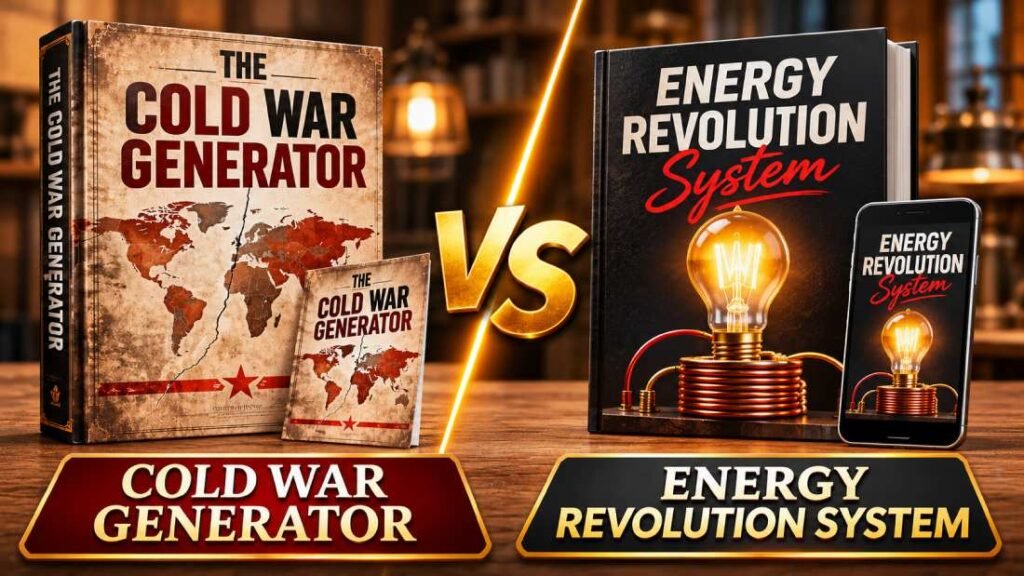
Quick verdict: Cold War Generator and Energy Revolution System are both digital DIY blueprints, not finished generators. You pay about $39 for a guide, then buy coils, magnets and parts yourself. Energy Revolution System is the better first pick for beginners because it comes with more published detail (schematics, video tutorials and bonuses). Cold War Generator is worth a look if you like its compact, magnet-and-coil approach and want a simple, low-cost experiment.
- Best for: hobbyists, tinkerers and curious homeowners who want a low-cost weekend project and a bit of backup power knowledge.
- Not for: anyone expecting to cancel their electric bill, run a whole house or get a certified plug-and-play generator.
- Price: about $39 each, plus roughly $60 to $210 in parts depending on the build.
- Risk: both advertise a 60-day money-back guarantee through ClickBank, so you can test the guide before you commit to a big parts bill.
👉 Try Energy Revolution System Risk-Free for 60 Days
👉 Get Cold War Generator With a 60-Day Refund
Table of Contents
- Side-by-Side Summary
- What Each Product Is
- How They Claim to Work
- The Reality Check: What Can a Small DIY Device Power?
- Real Total Cost
- The 60-Day Test Plan
- Safety and Legal Basics
- Pros and Cons
- Which One Fits You
- Better Ways to Cut Your Power Bill
- Refunds and Buying Direct
- FAQ
- Final Verdict
Side-by-Side Summary
| Feature | Cold War Generator | Energy Revolution System |
|---|---|---|
| Format | Digital DIY blueprint | Digital guide with schematics and videos |
| Concept | Magnets and coils | Tesla-inspired bifilar pancake coil |
| Price | About $39.69 (listed down from $69) | About $39 (listed down from $149) |
| Parts you buy | Yes, not included | Yes, not included |
| Refund | 60 days | 60 days |
| Skill level | Beginner to intermediate | Beginner friendly |
Prices and bundles change, so check the live checkout page before you decide.
What Each Product Is
What is Cold War Generator?
Cold War Generator is a downloadable DIY blueprint with instructions, diagrams and a materials list for building a small home power device. It is not a factory-built generator. The sales page presents it as a compact, silent, fuel-free build. It also carries its own disclaimer calling the project an experiment that has not been technically assessed or produced at scale. That honesty is worth noting.
What is Energy Revolution System?
Energy Revolution System is a digital guide that shows how to build a small supplemental generator inspired by Nikola Tesla’s coil work. Published descriptions mention a PDF guide, wiring schematics, video tutorials and bonus guides. The creator is listed in several reviews as Michael Garnett. You buy the parts yourself.
The key point: neither one ships a device to your door. You are buying knowledge and a plan. That is why the price is low and why the refund matters.
How They Claim to Work
Both products build around the same basic idea: copper coils and magnets arranged to produce a small electrical output. Cold War Generator’s pitch says the device captures ambient electromagnetic energy. Energy Revolution System leans on Tesla-style coil design and electromagnetic induction.
Here is the honest science. Electromagnetic induction is real. It is how every power plant and alternator works. But induction needs something moving or changing, like a spinning shaft, a changing current or a battery feeding the circuit. No coil and magnet setup can create energy from nothing. Any real output has to come from somewhere, so the smart move is to find out exactly where during your build. I show you how in the test plan below.
That does not make these projects worthless. Building one teaches you real things about wiring, coils, voltage and safe testing. If you treat it as an electronics project with a refund safety net, it can be a fun and educational use of $39.
The Reality Check: What Can a Small DIY Device Power?
This is the part most reviews skip. Before you buy, know how little power a small build usually delivers and how much a home uses. The average US home uses roughly 29 kWh a day. A continuous 50 watt output adds up to 1.2 kWh a day.
| Output | Energy per day | Share of a typical home |
|---|---|---|
| 10 watts | 0.24 kWh | Under 1% |
| 50 watts | 1.2 kWh | About 4% |
| 200 watts | 4.8 kWh | About 16% |
At around $0.17 per kWh, even a steady 50 watts saves roughly $6 a month. That is real money for a hobby build, but it will not wipe out a $200 bill.
| Device | Typical power draw | Realistic for a small DIY unit? |
|---|---|---|
| Phone charger | 5 to 20 watts | Yes |
| LED bulb | 8 to 12 watts | Yes |
| Laptop | 50 to 100 watts | Maybe |
| Fridge (running) | 100 to 200 watts | Unlikely |
| Air conditioner | 1,000 to 3,500 watts | No |
The honest takeaway: think of these as small-scale projects that might run lights, chargers or small electronics. Anyone telling you a $39 blueprint will run your whole house is overselling it. I would rather you know that now and still try it for the right reasons.
For a wider look at what actually works at home, read my guide on DIY electricity generation: what works, what doesn’t and why.
Real Total Cost
The sticker price is only the start. Here is a fair way to budget.
| Cost item | Cold War Generator | Energy Revolution System |
|---|---|---|
| Blueprint | About $39.69 | About $39 |
| Parts | Marketing says under about $108 | Reviews cite about $63 to $210 |
| Tools and meter | $20 to $40 if you have none | $20 to $40 if you have none |
| Realistic total | About $60 to $190 | About $120 to $290 |
Parts figures come from marketing and review pages, so treat them as estimates. Smart tip: read the full guide and parts list inside the refund window before you buy parts. If the plan does not make sense to you, request your refund and keep your parts money.
👉 See Energy Revolution System’s Current Price and Bonuses
The 60-Day Test Plan
This plan is the most useful thing in this article. It lets you judge either product with real numbers instead of marketing, inside the refund window.
- Days 1 to 7: Read the whole guide. Check the parts list against local prices. Ask yourself if you can do each step safely.
- Days 8 to 25: Build the low-power version first. Keep it small and away from your home wiring.
- Days 26 to 35: Test with a multimeter. Measure voltage and current across a small load, such as a 5 watt LED bulb. Multiply volts by amps to get watts.
- Days 36 to 45: Check the input side too. If the circuit is fed by a battery or capacitor, track how fast it drains. Output must be compared with input.
- Days 46 to 55: Run it for 24 hours with a steady load. Write down readings every few hours.
- By day 55: If you did not reach the output the guide describes, contact support and request a refund. Do not wait until day 60.
Why this works: numbers settle arguments. If your meter shows steady useful power, great. If not, you still learned a lot and you get your money back.
Safety and Legal Basics
- Never connect a homemade device to your main house wiring. Backfeeding power can injure utility workers and violates local code almost everywhere. Use a licensed electrician for any home connection.
- Use insulated tools, safety glasses and proper fuses. Strong magnets can pinch fingers and damage electronics and pacemakers.
- Do not leave a test build running unattended. Coils and batteries can overheat.
- Keep it to small loads like lights and chargers until you have measured the real output.
- Check local rules before building anything that stores or produces power at home.
For a safer path to home backup power, see my guide on how to build a backup power system for your home.
Pros and Cons
Cold War Generator
What people like:
- Low one-time price with a 60-day money-back guarantee
- Clear instructions, diagrams and a materials list in one download
- Compact build that fits on a workbench
- The sales page openly calls it an experiment, which is refreshing
- Good for learning about coils, magnets and basic electronics
What people do not like (and how to handle it):
- Not certified or independently tested. Treat it as a hobby project and test with a meter.
- Output varies by build. Start small and scale up only after you have real readings.
- You buy the parts yourself. Read the guide first, then order parts.
Energy Revolution System
What people like:
- Beginner friendly with schematics and video tutorials
- Low price, with bonus guides mentioned in several reviews
- Same 60-day money-back guarantee through ClickBank
- Teaches wiring and coil basics, which are useful skills
- Positioned honestly by many reviewers as a supplemental project
What people do not like (and how to handle it):
- Parts cost can climb past the guide price. Budget before you shop.
- Upsells are offered after checkout. The base guide stands alone, so you can skip them.
- Expectations get inflated online. Use the test plan and judge by your own measurements.
Which One Fits You
| Your situation | Better pick | Why |
|---|---|---|
| First DIY power project | Energy Revolution System | Videos and schematics help |
| Want a compact bench build | Cold War Generator | Small footprint |
| Want bonus material | Energy Revolution System | Bonus guides mentioned |
| Strict on budget | Either | Both about $39, parts vary |
| Need reliable home backup | Neither | Buy a certified unit |
Who should avoid both: people who need dependable power for medical equipment, refrigeration or heating, anyone uncomfortable working with wiring, and anyone expecting a guaranteed drop in their power bill.
I also compared the Energy Revolution System against another popular blueprint in my Energy Revolution System vs Power Grid Generator article, and Cold War Generator against another DIY plan in Cold War Generator vs Moray Generator.
👉 Check Cold War Generator’s Current Offer and Refund Terms
Better Ways to Cut Your Power Bill
If your real goal is a smaller electric bill or reliable backup power, these usually give a bigger return than any blueprint:
- Cut waste first. Standby loads, old appliances and heating or cooling habits often cost more than people think. See my 15 practical ways to cut energy costs.
- Know your number. My guide on how much electricity the average home really uses helps you size any backup plan.
- Compare real options. Read generator vs solar vs DIY power before spending big.
- Use a blueprint as a side project, not your main plan.
Refunds and Buying Direct
Both products advertise a 60-day money-back guarantee, processed through ClickBank. That matches the standard on most ClickBank and Digistore24 offers.
- Order from the official page, not a reseller, so your refund rights stay intact.
- Save your receipt email and order ID.
- Request your refund through the contact details on your receipt. If the seller is slow, ClickBank’s customer support can step in.
- Buying through an affiliate link does not affect your refund.
- Skip the optional upsells if you only want the base guide, and read what you are agreeing to at checkout.
👉 Start Energy Revolution System Today, 60-Day Money-Back Guarantee
Frequently Asked Questions
Which is better, Cold War Generator or Energy Revolution System?
For most beginners, Energy Revolution System, because it lists schematics, video tutorials and bonuses. Cold War Generator is a good option if you prefer its compact magnet-and-coil approach.
Are these real generators?
No. Both are digital blueprints. You build the device yourself from parts you buy.
Can they power a whole house?
No. Even their own supporters describe them as small, supplemental projects. A typical home needs thousands of times more power than a small DIY build.
Is Cold War Generator a scam?
It is a real digital product with a 60-day refund guarantee, but its big claims are unproven. Its sales page itself calls it an experiment. Judge it by your own measurements.
Is Energy Revolution System legit?
It is a real downloadable guide sold through ClickBank with a 60-day refund. It is legit as a DIY project guide, not as a guaranteed way to erase your power bill.
How much do they cost?
About $39 each for the guide. Parts add roughly $60 to $210 depending on the build.
How long does it take to build one?
Most descriptions say a weekend to a couple of weeks, depending on your skill and how fast you get parts.
Do I need experience?
Basic tool skills help. Both are described as beginner friendly, but wiring needs care.
Can I get a refund if I already ordered parts?
The refund covers the blueprint, not the parts you bought. That is why I suggest reading the guide before buying parts.
Can I connect it to my home’s electrical panel?
Not without a licensed electrician and local approval. Backfeeding is dangerous and usually illegal.
Are there upsells?
Energy Revolution System offers optional upgrades after checkout. The base guide works on its own.
Can I use either one off-grid?
Only for small loads like lights and chargers, and only after you have measured real output.
What is a safer way to get backup power?
A certified portable power station, a small solar kit with a battery or a standby generator installed properly.
Final Verdict
Pick Energy Revolution System if you want the most beginner-friendly guide and the more detailed package. Pick Cold War Generator if the compact, experimental approach appeals to you. Either way, go in as a builder, not as someone expecting to cancel their power bill. Use the test plan, keep the loads small and use the 60-day guarantee if the numbers do not impress you. Done that way, a $39 guide is a low-risk way to learn something real.
👉 Try Energy Revolution System Risk-Free
👉 Try Cold War Generator Risk-Free
Keep Reading
- Cold War Generator review: my full look at this blueprint on its own.
- Energy Revolution System reviews and complaints: what buyers say and what to watch for.
- Can a homemade generator really power your house? A practical reality check.
Disclaimer: This article is for information only. DIY electrical projects carry risk of shock, fire and injury, and neither product is certified or independently tested. Never connect a homemade device to your home wiring without a licensed electrician. Results vary, and prices and terms change, so confirm everything on the official websites. Affiliate disclosure: if you buy through links on this page, I may earn a commission at no extra cost to you. I keep reviews honest because it protects your money and my reputation.