When the electricity goes out, having a backup power system can make the difference between a minor inconvenience and a major disruption.
But there is no single backup solution that works for every household.
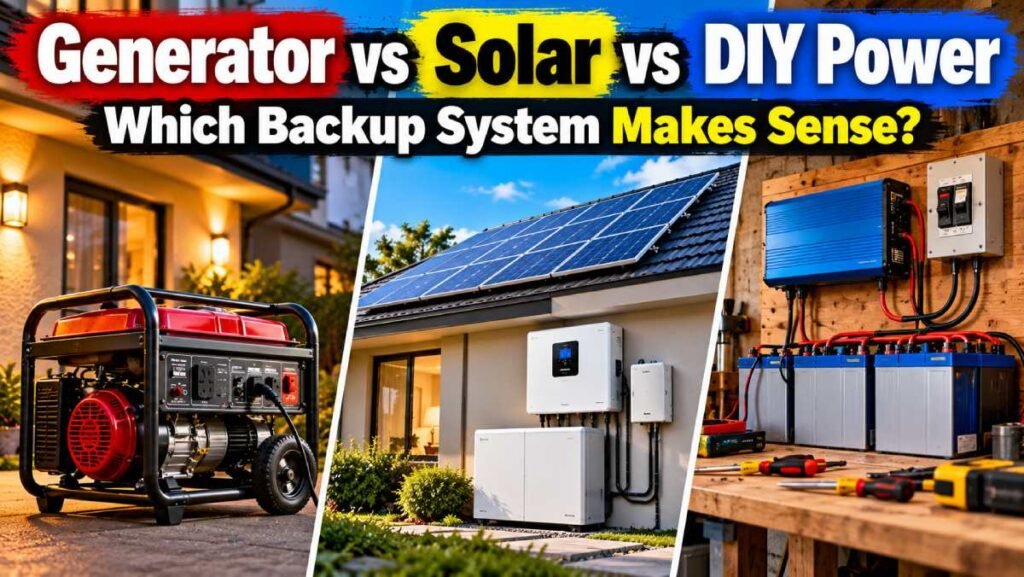
A portable generator may be affordable and powerful, but it needs fuel and produces noise and exhaust. Solar power can provide cleaner, quieter electricity, but a properly sized system can require a significant upfront investment. DIY power solutions can cost much less and may be useful for small devices, but they generally cannot replace a conventional generator or whole-home solar system.
So which one actually makes sense?
The answer depends on how much electricity you need, how long outages typically last, your budget, and whether you want emergency backup, lower electricity costs, or greater energy independence.
Let’s compare generators, solar systems, and DIY power solutions so you can decide which approach fits your home.
Start With What You Actually Need to Power
Before comparing technologies, make a list of the appliances and devices you want to keep running during an outage.
There is a huge difference between keeping a phone charged and powering an entire house.
For example, your backup requirements might include:
- Phones and tablets
- Wi-Fi routers
- LED lights
- Fans
- Televisions
- Laptops
- Refrigerators
- Freezers
- Water pumps
- Washing machines
- Air conditioners
The more appliances you want to operate simultaneously, the larger and more expensive your backup system will need to be.
A small DIY electricity project might be perfectly adequate for lights and phone charging. It would be a completely different story if your goal is to keep a refrigerator, freezer, water pump, and air conditioner running during a prolonged outage.
This is why choosing a backup system based purely on purchase price can be misleading.
The cheapest system isn’t necessarily the cheapest system for your actual electricity needs.
How Portable Generators Compare
Traditional fuel-powered generators remain one of the most practical backup options for households that need substantial power during outages.
Their biggest advantage is straightforward: power output.
A properly sized generator can operate appliances that small battery systems and DIY projects cannot handle.
Why generators remain popular
Generators have several advantages:
- They can produce substantial amounts of electricity.
- They can run for extended periods as long as fuel is available.
- Many models can power refrigerators, freezers, pumps, televisions, fans, and other appliances.
- Portable models can be moved when necessary.
- They don’t depend on sunlight.
- They can provide backup power immediately when properly set up.
For households experiencing frequent or unpredictable blackouts, this can be extremely useful.
The disadvantages of generators
The biggest drawback is the ongoing operating cost.
You have to buy fuel, store it safely, maintain the generator, and deal with oil changes and other servicing requirements.
Generators can also be noisy, particularly inexpensive models.
There is also the issue of exhaust emissions. A fuel-powered generator should never be operated inside a house, garage, enclosed balcony, or another poorly ventilated area because of the risk of carbon monoxide poisoning.
And if fuel becomes expensive or difficult to obtain, your backup system becomes much less convenient.
Who should consider a generator?
A generator makes the most sense when your priority is reliable, relatively high-output emergency electricity.
It’s particularly useful if you need to run appliances rather than simply charge small electronics.
What Solar Power Brings to the Table
Solar power approaches the problem differently.
Instead of producing electricity by burning fuel, a solar system uses photovoltaic panels to convert sunlight into electricity.
When combined with batteries and an appropriate inverter, a solar installation can provide backup electricity during outages without requiring fuel.
The major advantage of solar
The biggest benefit is that once the system has been installed, sunlight is essentially your energy source.
You don’t have to keep buying petrol or diesel every time the grid goes down.
Solar systems are also quiet compared with conventional generators.
A properly designed system can potentially provide electricity for:
- Lighting
- Fans
- Refrigeration
- Electronics
- Internet equipment
- Water pumps
- Computers
- Other household appliances
The exact capacity depends on the size of the panels, inverter, batteries, and the appliances being powered.
Solar isn’t automatically cheap
The main problem is the upfront investment.
A small solar setup may be relatively affordable, but a system capable of powering a large home for extended periods can become considerably more expensive.
Batteries are particularly important.
Solar panels can generate electricity during daylight hours, but if you want power at night or during cloudy periods, you need an appropriate storage solution or another backup source.
That means you aren’t simply buying solar panels.
You may need:
- Solar panels
- An inverter
- Batteries
- Charge controllers or integrated electronics
- Mounting equipment
- Wiring
- Protection equipment
- Installation
The larger your energy requirements, the more substantial the system becomes.
Who should consider solar?
Solar makes the most sense if your goal extends beyond emergency backup.
If you want to reduce your dependence on the grid, reduce fuel consumption, and potentially use renewable energy over many years, solar becomes much more attractive.
Where DIY Power Solutions Fit
DIY power solutions occupy a very different part of the market.
Instead of buying a finished generator or installing a professional solar system, you’re building or assembling something yourself.
One example is the Energy Revolution System, which is sold as a digital blueprint rather than a physical generator. The guide focuses on building a small Tesla-inspired coil-based system using separately sourced components.
You can read our Energy Revolution System review to see what the system actually provides and what its realistic limitations are.
The important thing is to understand what DIY power is—and what it isn’t.
DIY doesn’t mean unlimited electricity
A DIY power project may be useful for low-power applications such as:
- LED lighting
- Phone charging
- Small electronics
- USB devices
- Small fans
- Educational experiments
But that doesn’t mean a DIY project can replace a conventional generator or a properly sized solar installation.
High-power appliances require substantially more electrical capacity.
A refrigerator, air conditioner, electric cooker, water heater, or washing machine can consume far more power than a small DIY system is designed to provide.
The advantage of building it yourself
The major attraction is cost and learning.
A DIY project can allow you to experiment with electricity and electromagnetic principles without immediately investing thousands of dollars in a large energy system.
It can also provide a useful low-wattage backup option.
For someone who enjoys building things and wants to understand how electrical systems work, that can be valuable in itself.
The downside of DIY power
DIY systems require time, patience, and realistic expectations.
You may need to source components yourself, assemble the system, troubleshoot problems, and test the finished setup.
Performance can also vary depending on how accurately the system is built.
Most importantly, DIY electricity should never be confused with a professionally engineered household power installation.
If you are dealing with household wiring or attempting to connect a DIY system to your home’s electrical panel, professional electrical assistance is essential.
Generator vs Solar vs DIY Power at a Glance
| Feature | Generator | Solar | DIY Power |
|---|---|---|---|
| Upfront cost | Low to moderate | Moderate to high | Low to moderate |
| Fuel required | Yes | No | Depends on design |
| Noise | Usually high | Very low | Usually low |
| Maintenance | Regular | Relatively low | Depends on system |
| Large appliances | Yes, if properly sized | Yes, if properly sized | Usually no |
| Phone charging | Yes | Yes | Yes |
| Long outages | Good with fuel | Excellent if properly sized | Limited |
| Installation | Relatively simple | More involved | DIY |
| Learning required | Low | Moderate | High |
| Energy independence | Low to moderate | High | Low to moderate |
| Best use | Emergency backup | Long-term energy solution | Low-cost experimentation and small loads |
Which Option Is Cheapest?
The answer depends on what you’re comparing.
If you’re looking strictly at the initial cost of getting a small amount of electricity during an outage, a DIY solution can potentially be inexpensive.
But the cheapest option isn’t necessarily the most practical.
A DIY system that can charge your phone and operate a few lights doesn’t provide much value if your actual requirement is keeping a refrigerator and water pump running.
Likewise, a large solar installation may be unnecessary if you only experience occasional short outages.
The better question is:
What is the cheapest system that can reliably perform the job I actually need?
That question usually produces a much better purchasing decision.
Which Option Is Best for Long Power Outages?
For extended outages, solar and generators generally have the advantage.
A generator can continue producing electricity as long as you have enough fuel.
A properly sized solar-and-battery system can provide electricity for extended periods without requiring fuel deliveries, although its performance depends on battery capacity, sunlight, weather, and household consumption.
A small DIY system is generally better viewed as supplementary backup rather than a complete solution for a prolonged blackout.
For example, keeping a few LED lights and phones operational is realistic.
Trying to operate an entire household with a small DIY electricity project is not.
What About Running an Air Conditioner?
This is where the difference between these systems becomes particularly important.
Air conditioners can have substantial power requirements, especially when starting their compressors.
A small DIY electricity project is generally not an appropriate solution for powering an air conditioner.
A generator can potentially handle an air conditioner if it has sufficient continuous and starting capacity.
Solar can also handle air conditioning when the system is appropriately designed with enough panel generation, battery storage, and inverter capacity.
However, increasing the capacity of a solar system to support heavy loads also increases the overall investment.
If air conditioning is one of your priorities, size your backup system around that requirement rather than assuming any solar or DIY solution will automatically handle it.
What About Refrigerators and Freezers?
Refrigerators are another important consideration.
Unlike a phone charger or LED bulb, a refrigerator has a compressor that cycles on and off and can require additional power during startup.
A sufficiently powerful generator can handle a refrigerator.
A properly sized solar battery system can also handle one.
A small DIY electricity project generally shouldn’t be treated as a dependable refrigerator backup unless its actual tested output is sufficient for the appliance.
For food storage, reliability matters more than simply having a source of electricity.
Which System Makes the Most Sense for a Typical Home?
There isn’t one universal answer.
Instead, think about your situation in terms of four questions.
Do you need power immediately?
If you need a straightforward emergency solution, a generator can be attractive because the technology is well understood and widely available.
Do you want to reduce long-term dependence on the grid?
Solar becomes more compelling if you’re looking for a long-term energy strategy rather than occasional emergency power.
Do you mainly need lights and charging?
A smaller battery system or DIY solution may be sufficient if your primary requirements are phones, LED lights, routers, and other low-power devices.
Do you enjoy building things?
If the project itself interests you, a DIY energy system can be worthwhile even if it doesn’t replace your home’s primary power source.
The key is to buy or build according to your actual objective.
A Hybrid Approach Can Be Even Better
You don’t necessarily have to choose only one technology.
A hybrid backup strategy can sometimes make more sense.
For example, a household could use:
- Solar for everyday energy production
- Batteries for nighttime and short outages
- A generator for prolonged periods of bad weather or unusually high demand
- Small DIY systems for experimentation or supplementary low-power applications
This approach separates the jobs rather than forcing one system to do everything.
For someone who experiences frequent outages, this can be more practical than expecting a single small device to power the entire house.
Don’t Forget Energy Efficiency
There is another part of the equation that often gets overlooked: reducing how much electricity you need in the first place.
Every watt you eliminate makes your backup system easier and cheaper to operate.
Simple measures can include:
- Replacing inefficient bulbs with LEDs
- Turning off equipment that isn’t being used
- Reducing standby or phantom loads
- Using efficient fans
- Avoiding unnecessary high-power appliances during outages
- Improving insulation where practical
- Scheduling heavy electrical loads
- Monitoring which appliances consume the most electricity
This matters regardless of whether your backup system is a generator, solar installation, or DIY project.
A smaller energy requirement means a smaller backup system can potentially do the job.
Safety Should Come Before Cost
Backup electricity can be dangerous when systems are installed incorrectly.
Never operate a fuel-powered generator indoors or in an enclosed space.
Don’t connect a generator directly to household wiring using an improvised connection.
Don’t attempt to connect a DIY electricity project to your home’s main electrical panel without appropriate professional assistance.
And don’t assume that because a system operates at relatively low voltage, every electrical component is automatically safe.
Proper insulation, appropriate wiring, correct protection devices, and safe installation all matter.
When you’re dealing with household electricity, saving money on professional installation is not worth creating a dangerous situation.
So Which Backup System Should You Choose?
The simplest way to decide is to match the technology to the job.
Choose a generator if you want relatively high power for emergency situations and don’t mind fuel, noise, and maintenance.
Choose solar if you’re looking for a long-term investment that can reduce dependence on the grid and provide quiet backup power.
Choose DIY power if you want an inexpensive hands-on project and your expectations are limited to smaller electrical loads and experimentation.
And if your needs are more complicated, consider combining technologies rather than forcing one system to handle every situation.
The Bottom Line
Generators, solar systems, and DIY power solutions aren’t really direct substitutes.
They solve different problems.
A generator is primarily an emergency power machine.
Solar is a long-term energy system.
DIY power is generally a low-cost experimentation and supplementary backup option.
The biggest mistake is choosing based solely on the headline price.
Instead, start with the appliances you need to power, determine how much electricity they require, estimate how long you need backup power, and then choose the system that can realistically meet those requirements.
For basic needs such as lights and phone charging, you may not need an expensive whole-home installation.
For refrigerators, pumps, air conditioners, and other major appliances, you’ll need considerably more capacity.
And if your ultimate goal is greater energy independence, solar may make more sense as a long-term investment than either a conventional generator or a small DIY electricity project.
In other words, the best backup system isn’t necessarily the most powerful or the cheapest.
It’s the one that reliably provides the amount of electricity you actually need, at a cost you can realistically afford.