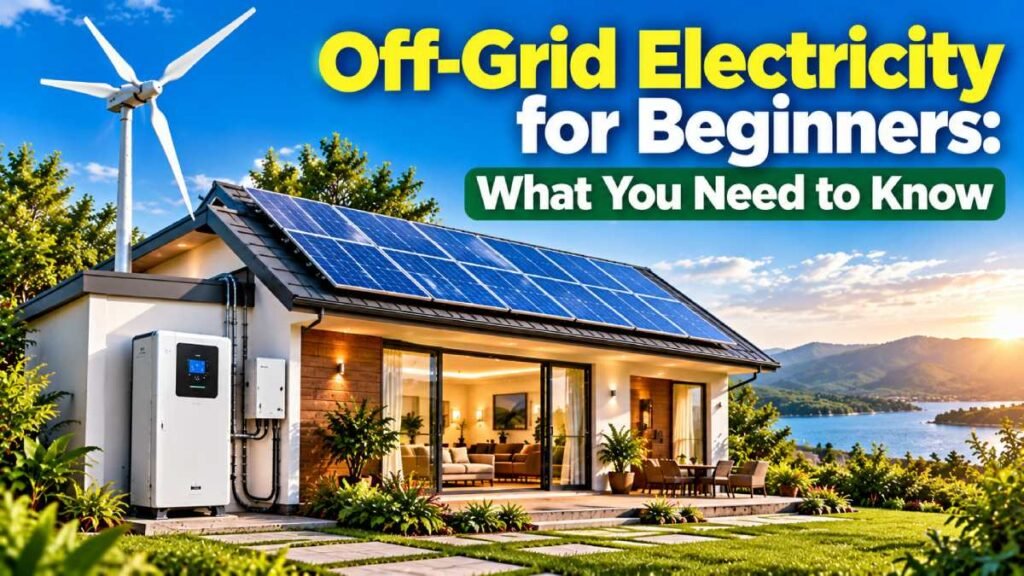
Living completely or partially off the electricity grid can sound complicated, especially if you’ve never designed an energy system before.
You may have questions like:
- How much electricity do I actually need?
- Can solar power run my entire home?
- How many batteries do I need?
- What happens at night?
- Can an off-grid system power an air conditioner?
- Do I need a generator as backup?
- How much does an off-grid electricity system cost?
The good news is that you don’t need to understand every technical detail before getting started.
What you do need is a basic understanding of how electricity generation, batteries, inverters, and household consumption work together.
An off-grid electricity system is essentially a self-contained power system. Instead of depending entirely on electricity supplied by the public grid, your home generates and stores some or all of the electricity it needs.
For many beginners, solar power combined with battery storage is the most obvious starting point. But an off-grid system can also incorporate other energy sources depending on your location and circumstances.
The biggest mistake is thinking that going off-grid simply means buying solar panels.
It is much more than that.
What Does “Off-Grid” Actually Mean?
An off-grid home is a property that is not dependent on the public electricity grid for its normal electricity supply.
Instead, the property has its own electricity-generation and storage system.
A typical setup might look something like this:
Solar panels → Charge controller → Batteries → Inverter → Household appliances
The solar panels generate electricity.
The batteries store excess electricity.
The inverter converts the stored electricity into a form that compatible household appliances can use.
The system therefore needs to do two things:
Generate enough electricity and store enough electricity.
That second part is particularly important.
The sun isn’t available at night, but your home still needs electricity after sunset.
That’s where battery storage becomes critical.
Why Would Someone Go Off-Grid?
There are several reasons people consider off-grid electricity.
1. Energy Independence
The biggest attraction is independence.
Instead of relying entirely on the public electricity supply, you have your own source of power.
This can be especially appealing in locations where grid electricity is unreliable or where outages are frequent.
2. Backup During Outages
You don’t necessarily need to disconnect from the grid to benefit from off-grid-style technology.
A battery and solar system can provide backup electricity when the grid goes down.
This is often a more practical goal for beginners than attempting complete energy independence immediately.
3. Lower Dependence on Fuel Generators
Some households rely heavily on petrol or diesel generators during outages.
Generating electricity from solar energy can reduce the amount of fuel you need to purchase, although the initial equipment cost can be significant.
4. Remote Properties
Off-grid electricity can be particularly useful for homes, farms, cabins, workshops, or other properties where connecting to the public grid is difficult or expensive.
In these situations, creating an independent electricity system may be more practical than waiting for grid infrastructure.
The Four Main Parts of an Off-Grid System
A beginner-friendly way to understand off-grid electricity is to break the system into four major components.
1. Energy Generation
You need something that produces electricity.
For many homes, this means solar panels.
However, depending on the location, an off-grid system could potentially use:
- Solar
- Wind
- Micro-hydro
- Fuel generators
- Other compatible generation systems
Solar is particularly attractive because sunlight is widely available and solar panels don’t require fuel to generate electricity.
But solar output varies throughout the day and disappears at night.
That’s why generation alone isn’t enough.
2. Battery Storage
Batteries store electricity for later use.
This is one of the most important components of an off-grid system.
During periods when your energy source is producing more electricity than your home is consuming, the excess can be stored.
Later, the stored electricity can be used when generation is unavailable or insufficient.
For example:
Daytime: Solar panels generate electricity → appliances use electricity → excess charges batteries.
Night: Solar panels stop producing → batteries supply electricity.
The larger your electricity requirements and the longer you need backup power, the more battery capacity you may need.
3. Inverter
Most household appliances require AC electricity.
Many renewable energy systems and batteries operate using DC electricity.
An inverter bridges that gap.
It converts the electricity into the appropriate form for compatible household loads.
The inverter also needs to be properly sized.
If your appliances can demand more power than the inverter can provide, you may experience overloads or shutdowns.
4. Electrical Protection and Distribution
The system also needs appropriate wiring, fuses, breakers, disconnects, grounding, and other safety equipment.
This part is easy for beginners to overlook because it isn’t as visually impressive as solar panels or batteries.
But it is essential.
An off-grid electricity system involves real electrical power and should be designed and installed safely.
For complex household installations, professional electrical assistance is strongly recommended.
How Much Electricity Does an Off-Grid Home Need?
This is the first major question you should answer before purchasing anything.
There is no universal off-grid system size.
A small home using:
- LED lights
- Fans
- A refrigerator
- A television
- A router
- Phone chargers
will have very different requirements from a large home using:
- Multiple air conditioners
- Electric water heaters
- Electric cooking appliances
- Large water pumps
- Washing machines
- Dryers
- Freezers
- Other high-power equipment
This is why you should calculate your household’s electricity consumption before choosing your equipment.
Start by listing your appliances.
For each one, determine:
- Its wattage
- How many hours it runs each day
- Whether it operates continuously
- Whether it has a starting surge
- Whether it is essential
You can then estimate your daily energy consumption.
Power and Energy Are Not the Same Thing
This distinction is extremely important.
Power is generally measured in watts (W).
Energy is commonly measured in kilowatt-hours (kWh).
Imagine an appliance rated at 1,000 watts.
If it runs for one hour, it uses approximately 1 kWh.
If it runs for five hours, it uses approximately 5 kWh.
This matters because an off-grid system needs to address both:
How much power do you need at one time?
and
How much total energy do you need throughout the day?
Your inverter is particularly concerned with power demand.
Your batteries and generation capacity are heavily influenced by total energy consumption.
Why High-Power Appliances Make Off-Grid Systems More Expensive
Some appliances can dramatically increase the size of the system you need.
Air conditioners are a good example.
An air conditioner can require substantially more power than an LED light or phone charger.
Electric water heaters and cooking appliances can also consume considerable amounts of energy.
If you want to operate several high-power appliances simultaneously, you may need:
- More solar panels
- Larger batteries
- A larger inverter
- More sophisticated electrical protection
- Potentially a backup generator
This is why energy efficiency is such an important part of off-grid living.
Start With Your Essential Loads
You don’t necessarily need to power everything.
Many beginners make the mistake of trying to build a system capable of operating every appliance in the home.
That can make the system unnecessarily expensive.
Instead, identify your essential loads.
For example, during an outage you might prioritize:
- Refrigerator
- A few lights
- Fans
- Internet router
- Phone charging
- Laptop
- Television
High-power appliances such as electric water heaters, ovens, or multiple air conditioners could be used selectively or excluded from the backup system.
Reducing the number of appliances your system must support can significantly reduce its required capacity.
How Solar Fits Into an Off-Grid System
Solar is one of the most common energy sources for off-grid homes.
During daylight hours, solar panels generate electricity.
That electricity can be used by your appliances while the panels are producing power.
If the panels generate more electricity than the home needs, the excess can be directed toward battery storage.
At night, the batteries become the primary electricity source.
The basic cycle is:
Sunlight → Solar panels → Household loads + batteries → Nighttime battery power
However, solar production isn’t constant.
Clouds, rain, shading, panel orientation, temperature, and seasonal conditions can all affect output.
This is why an off-grid solar system should not be sized solely around the theoretical maximum output of the panels.
Real-world conditions matter.
How Many Batteries Do You Need?
There isn’t a universal answer.
Battery requirements depend on:
- Your daily energy consumption
- How many hours you need backup
- Your solar generation
- Battery type
- Usable battery capacity
- Desired reserve capacity
- Whether you have another backup source
For example, someone who only needs overnight backup for lights, a router, fans, and a refrigerator may require considerably less storage than someone trying to operate an entire household overnight.
The goal is to size the battery system around actual consumption rather than guessing.
What Happens During Several Cloudy Days?
This is one of the most important questions for anyone considering off-grid living.
Solar panels may produce less electricity during prolonged periods of poor weather.
If your home continues consuming electricity at the same rate, your batteries can eventually become depleted.
That means a genuinely resilient off-grid system needs a plan for periods when the primary energy source isn’t producing enough power.
Possible strategies include:
- Larger battery storage
- More solar generation capacity
- Reducing electricity consumption
- Adding another renewable energy source
- Keeping a backup generator
- Combining several strategies
The right approach depends on your location and how important uninterrupted electricity is to you.
Do You Need a Generator If You Have Solar?
Not necessarily.
But a backup generator can make an off-grid system more resilient.
Imagine several days of poor weather.
Your solar system isn’t generating enough electricity, and your batteries are running low.
A backup generator could potentially provide electricity while the renewable system recovers.
This is one reason many larger off-grid systems use a combination of technologies rather than depending on a single source.
The generator doesn’t have to operate continuously.
It can be reserved for situations where renewable generation and battery storage aren’t sufficient.
Can You Run an Entire House Off-Grid?
Yes, it is possible.
But the bigger the household’s electricity consumption, the more expensive and complicated the system becomes.
A home that primarily uses efficient appliances and carefully manages its electricity consumption is much easier to operate off-grid than a home that uses several high-power appliances continuously.
The system may need enough capacity to handle:
- Normal daily consumption
- Peak appliance demand
- Overnight usage
- Poor weather
- Battery charging
- Seasonal changes
- Unexpected increases in electricity use
This is why complete energy independence should be treated as an engineering and planning project rather than simply a shopping decision.
What About DIY Off-Grid Electricity Systems?
DIY energy systems can be interesting, particularly if you enjoy learning how electricity generation works.
There are numerous plans and digital products that claim to teach homeowners how to build alternative electricity systems.
Some can be useful educational resources.
But you should distinguish between learning how a system works and having enough electricity to run a house.
A small DIY generator may successfully produce electricity without being powerful enough for major household appliances.
The Energy Revolution System review is a useful example of why beginners should look beyond the headline claim and consider the actual purpose, output, components, and limitations of a DIY energy system.
A low-cost DIY blueprint may be interesting for experimentation, but it should not automatically be treated as a substitute for a properly designed whole-home off-grid system.
The Most Important Beginner Mistake to Avoid
Don’t start by buying equipment.
Start by understanding your electricity requirements.
It can be tempting to see a solar panel, battery, inverter, or DIY generator advertised online and immediately think:
“This could solve my electricity problem.”
But without knowing your energy consumption, you don’t know whether the equipment is appropriately sized.
Instead, follow this sequence:
Step 1: Calculate Your Electricity Consumption
Look at your electricity bills and appliance usage.
Step 2: Identify Essential Loads
Decide what must remain operational during an outage.
Step 3: Determine Peak Demand
Identify which appliances may operate simultaneously.
Step 4: Choose Your Energy Source
Solar will be appropriate for many homes, but not every property has the same requirements.
Step 5: Calculate Battery Requirements
Determine how much electricity needs to be stored for nighttime or backup use.
Step 6: Size Your Inverter
Make sure it can handle your expected simultaneous load and appropriate starting surges.
Step 7: Plan for Poor Generation
Consider what happens during cloudy weather, low wind, or other periods of reduced generation.
Step 8: Build for Safety
Use appropriate electrical protection and professional assistance where necessary.
How to Make an Off-Grid System Smaller and Cheaper
One of the most effective ways to reduce the cost of an off-grid system is to reduce the amount of electricity you need.
That might mean:
- Using LED lighting
- Choosing energy-efficient appliances
- Limiting unnecessary air-conditioning
- Turning off unused equipment
- Avoiding unnecessary standby consumption
- Using appliances strategically
- Reducing simultaneous high-power loads
- Monitoring your biggest electricity consumers
The less electricity your household needs, the smaller your generation and storage system can potentially be.
This can be more effective than simply buying more panels or larger batteries.
Should Beginners Go Completely Off-Grid?
Not necessarily.
For many people, a hybrid system can be more practical.
You can remain connected to the public grid while using solar, batteries, or another generation source to reduce your dependence on it.
This gives you several advantages.
You can use your own generated electricity when available and rely on the grid when your system cannot meet demand.
It can also allow you to learn how your energy system performs before deciding whether complete off-grid living is appropriate.
For homeowners primarily interested in backup electricity, this may be a much more realistic starting point than attempting to disconnect from the grid immediately.
Final Verdict: Is Off-Grid Electricity Worth It?
Off-grid electricity can work extremely well, but it needs to be designed around your actual energy consumption.
The basic concept is straightforward:
Generate electricity → Store electricity → Convert and distribute electricity → Manage household demand.
The difficult part is making sure every component is large enough to meet your needs without spending unnecessarily on capacity you don’t use.
For beginners, solar panels combined with battery storage are often the easiest place to start exploring renewable electricity.
But don’t overlook the importance of energy efficiency.
A household that uses less electricity requires less generation capacity and less battery storage.
And don’t assume that every DIY electricity system advertised online can replace a conventional household power system.
Some DIY projects can produce useful electricity. Others are primarily educational or experimental. What matters is their actual electrical output, energy input, storage requirements, and intended use.
If you’re considering an off-grid system, start with your appliances, calculate your consumption, identify your essential loads, and build from there.
The goal isn’t simply to become “off-grid.”
The goal is to create a reliable electricity system that provides enough usable power for the way you actually live.