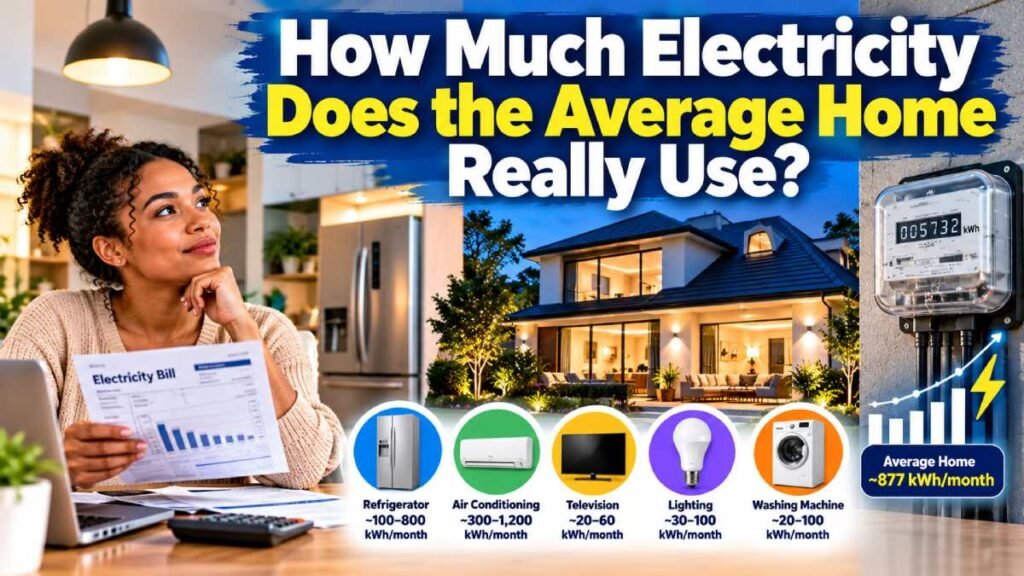
When people start thinking about solar power, backup generators, or DIY electricity generation, one question usually comes first:
How much electricity does the average home actually use?
It sounds like a simple question, but the answer varies considerably from one household to another.
A small apartment with two people who mainly use lights, fans, a refrigerator, and a television can have very different electricity needs from a large family home running air conditioners, electric cooking appliances, water heaters, washing machines, pumps, and multiple electronic devices.
Understanding your electricity consumption is therefore one of the most important steps before buying a generator, installing solar panels, or attempting a DIY electricity project.
After all, there is little point building a system that produces 500 watts if your household regularly needs several thousand watts at the same time.
The good news is that you don’t need to be an electrical engineer to understand your home’s energy consumption.
Once you know which appliances consume the most electricity and how long you use them, you can begin estimating your daily and monthly requirements—and make much smarter decisions about your energy system.
What Does “Average Electricity Use” Actually Mean?
Electricity consumption is usually measured in kilowatt-hours (kWh).
A kilowatt-hour represents the amount of energy consumed when a 1,000-watt appliance operates for one hour.
For example, a 1,000-watt appliance operating for one hour would consume approximately 1 kWh.
But most household appliances don’t operate continuously.
A refrigerator cycles on and off. A television may operate for several hours. A washing machine may run for an hour or two. Lights may only be switched on during the evening.
That means your home’s electricity consumption depends on both:
- How much power an appliance uses
- How long you use it
This is why simply adding up the wattage of your appliances doesn’t tell you how much electricity your home consumes each month.
Which Household Appliances Use the Most Electricity?
Not all appliances have the same impact on your electricity consumption.
Some devices use relatively little electricity, while others can consume substantial amounts of energy.
Typical household electricity users include:
- Air conditioners
- Electric water heaters
- Electric cookers
- Refrigerators and freezers
- Water pumps
- Washing machines
- Clothes dryers
- Electric kettles
- Microwaves
- Irons
- Fans
- Televisions
- Computers
- Lighting
- Phone chargers
- Wi-Fi routers
The biggest energy users are usually appliances that generate heat, cooling, or mechanical power.
For example, heating water requires considerably more energy than charging a smartphone.
This is why replacing a few phone chargers isn’t going to dramatically change a household’s electricity consumption, while reducing air-conditioner usage potentially can.
How to Estimate Your Own Electricity Consumption
The easiest way to understand your home’s electricity needs is to calculate the approximate consumption of each major appliance.
The basic calculation is:
Power in watts × hours of use ÷ 1,000 = kWh consumed
For example, if a 100-watt appliance operates for five hours:
100 × 5 ÷ 1,000 = 0.5 kWh
You can then estimate the consumption of your major appliances and add them together.
The result won’t necessarily be perfectly accurate because appliance power consumption can vary during operation, but it provides a useful starting point.
Your Home’s Electricity Demand Changes Throughout the Day
Another important concept is the difference between energy consumption and instantaneous power demand.
You might consume a certain amount of electricity throughout the entire day, but that doesn’t mean you need that much power at every moment.
For example, imagine your household is using:
- A refrigerator
- Several lights
- A television
- A Wi-Fi router
- Two fans
The total demand might be relatively modest.
But then someone turns on an electric kettle, microwave, iron, water heater, or air conditioner.
Your instantaneous electricity demand can increase dramatically.
This matters when choosing an inverter or generator.
A system needs to be capable of handling the appliances you expect to operate at the same time, not merely your average daily consumption.
Why This Matters for Solar and DIY Electricity
Suppose your home consumes a substantial amount of electricity every day.
You can’t simply purchase a small generator and expect it to handle everything.
You need to consider:
Generation capacity + storage capacity + inverter capacity + appliance demand
For example, solar panels generate electricity during periods of sunlight.
If you want to use that electricity later, you’ll need sufficient battery storage.
Your inverter then needs to be capable of delivering enough power to the appliances you want to operate.
This is why energy planning should start with your household’s actual electricity consumption rather than starting with a particular product.
How Much Electricity Does a Small Home Need?
There is no single number that applies to every small home.
A small, energy-efficient household using mostly LED lighting, fans, a refrigerator, television, router, and small electronics may consume considerably less electricity than a similar-sized home using air conditioning, electric cooking, water heating, and pumping equipment.
The number of people living in the property also matters.
Two people who spend most of the day away from home may consume considerably less electricity than a family of six that spends most of the day at home.
Climate matters too.
In a hot environment, air conditioning and refrigeration can become significant contributors to electricity consumption.
What About Homes With Air Conditioning?
Air conditioning can substantially change a household’s energy requirements.
An air conditioner is not simply another small appliance.
Depending on its size, efficiency, temperature setting, operating time, and environmental conditions, it can become one of the largest electricity consumers in the home.
This has important implications for anyone considering solar or DIY electricity generation.
A system capable of powering lights and charging phones may be perfectly adequate for basic backup electricity.
It is a completely different challenge to run one or more air conditioners for extended periods.
This distinction is especially important when evaluating inexpensive DIY electricity systems.
Can a Small DIY Generator Replace Grid Electricity?
Generally, you should not assume that it can.
A small DIY electricity project may be capable of producing useful low-wattage electricity.
For example, a DIY system may potentially be useful for small electronics, LED lighting, or charging devices.
But that doesn’t make it equivalent to a whole-house power system.
The Energy Revolution System review provides a useful example of why output matters more than marketing claims.
The system is presented as a low-cost DIY electricity project, but it is not designed to replace the electricity supply for major household appliances. Its realistic applications are much more limited, particularly compared with a properly sized solar installation or conventional generator.
The lesson is simple:
Always match the generator’s actual output with the electricity requirements of your appliances.
How Much Electricity Does a Refrigerator Use?
Refrigerators are interesting because they don’t usually operate at their maximum power continuously.
The compressor switches on and off throughout the day.
Consequently, the refrigerator’s rated wattage isn’t necessarily the same as its total daily electricity consumption.
When sizing a backup system, you also need to consider the refrigerator’s starting or surge demand.
This is one reason why a generator that appears large enough based on its continuous wattage may still struggle when an appliance starts.
What About Fans?
Fans generally consume considerably less electricity than air conditioners.
That makes them much easier to include in a small backup system.
For households looking to reduce their electricity requirements, using fans where practical instead of air conditioning can potentially make a meaningful difference in overall consumption.
Of course, comfort, climate, humidity, and individual circumstances matter.
The broader principle is that reducing the power requirements of your essential appliances can make a smaller electricity-generation system much more practical.
Lighting Usually Isn’t the Biggest Problem
Modern LED lighting is relatively efficient.
If you have replaced older incandescent bulbs with LEDs, your lighting requirements may represent a relatively small portion of your household’s total electricity consumption.
This is useful when planning a backup system.
A small system might be able to operate several LED lights for considerably longer than it could operate a high-power heating or cooling appliance.
That doesn’t mean lighting should be ignored.
It simply means you should identify the largest electricity consumers first.
How to Find Your Biggest Energy Users
A useful approach is to divide your appliances into three categories.
Low-Power Devices
These might include:
- Phone chargers
- LED bulbs
- Wi-Fi routers
- Small electronics
- Some laptops
- Small fans
Medium-Power Appliances
Examples can include:
- Televisions
- Refrigerators
- Larger fans
- Washing machines
- Microwaves
- Small pumps
High-Power Appliances
These may include:
- Air conditioners
- Electric water heaters
- Electric cookers
- Clothes dryers
- Large water pumps
- Electric ovens
- Some heating appliances
If you’re designing a backup electricity system, your first priority should generally be determining which appliances are essential and which ones can be switched off during an outage.
You Don’t Have to Power Everything
One of the biggest mistakes homeowners make when planning backup electricity is assuming that the system needs to power the entire house.
It doesn’t.
You can create an essential-load system.
For example, during a power outage, you might prioritize:
- Refrigerator
- A few lights
- Fans
- Wi-Fi router
- Phone charging
- Laptop
- Television
And temporarily avoid:
- Electric water heaters
- Electric ovens
- Clothes dryers
- Heavy-duty pumps
- Multiple air conditioners
- Other high-power appliances
This can dramatically reduce the size of the generator or battery system you need.
Understanding Your Monthly Electricity Bill
Your electricity bill can provide another useful starting point.
If your electricity provider gives you your consumption in kWh, you already have a valuable piece of information.
Instead of guessing how much electricity you use, you can look at your previous bills and identify your consumption patterns.
Compare several months rather than relying on one bill.
Why?
Because electricity consumption can change with:
- Weather
- Number of people at home
- Appliance usage
- Holidays
- Business activities
- Air-conditioning use
- Changes in electricity supply
- Seasonal behavior
A monthly average gives you a much better picture of your normal requirements.
What If You Want to Generate Your Own Electricity?
Once you know your consumption, you can begin asking more useful questions.
Instead of:
“What is the cheapest generator I can buy?”
Ask:
“How much electricity do I need to generate?”
Then ask:
“Which appliances do I want to run?”
Then:
“How long do I need them to run?”
And finally:
“What energy source makes the most sense for my location and budget?”
That process can prevent you from buying a system that is either dramatically undersized or unnecessarily expensive.
Should You Try to Become Completely Energy Independent?
Complete energy independence is possible in some circumstances, but it requires much more planning than simply installing a small generator.
An off-grid home generally needs sufficient generation capacity, battery storage, an appropriate inverter, electrical protection, and careful energy management.
You also need to plan for periods when your primary energy source isn’t producing enough electricity.
For solar, that could mean nighttime or prolonged cloudy conditions.
For wind, it could mean periods with insufficient wind.
For hydroelectricity, water flow can vary.
The more electricity your household consumes, the more generation and storage capacity you’ll need.
The Most Important Number Isn’t Your Average
When designing a backup system, your average monthly consumption is useful—but it isn’t the only number that matters.
You also need to know your peak demand.
Imagine that your household normally uses a moderate amount of electricity.
Then, at the same time, someone switches on:
- An air conditioner
- Electric kettle
- Microwave
- Refrigerator compressor
- Water pump
Your instantaneous demand can suddenly become much higher than your normal average.
This is why a generator or inverter should be sized according to the appliances you intend to operate simultaneously.
What Should You Do Before Buying a Generator?
Start with an appliance inventory.
Write down:
- Every appliance you regularly use.
- Its wattage.
- How many hours you use it each day.
- Whether it has a starting surge.
- Whether it is essential during an outage.
- Whether you can temporarily operate without it.
Then estimate your daily electricity requirement.
This gives you a much more useful foundation for comparing generators, batteries, solar systems, and DIY electricity projects.
Final Thoughts
So, how much electricity does the average home really use?
There isn’t one universal number.
Homes differ dramatically based on their size, location, number of occupants, climate, appliances, lifestyle, and energy habits.
The more important lesson is that you should understand your own household’s electricity consumption rather than relying too heavily on an average.
Start with your appliances.
Identify your biggest electricity users.
Calculate how long you use them.
Determine your essential loads.
Then look at the generation capacity you’ll need.
This is especially important if you’re considering DIY electricity generation. A small system can be useful for low-power applications without being capable of replacing your home’s entire electricity supply.
Understanding that difference can save you from buying the wrong equipment and help you build a much more realistic energy strategy.
Ultimately, the goal isn’t simply to generate electricity.
The goal is to generate enough usable electricity for the things that matter most to you.