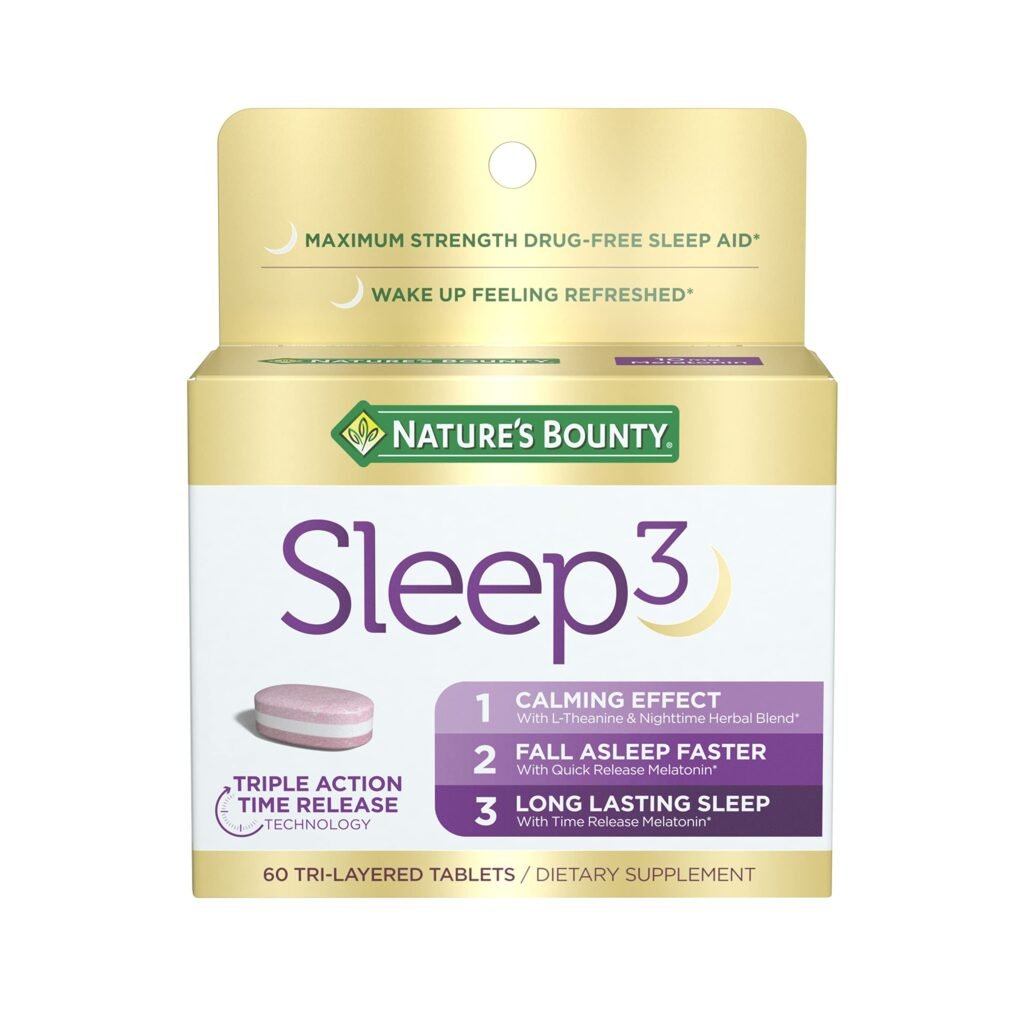
If you’ve typed “sleep 3 supplement” into a search bar, you’re almost certainly looking at Nature’s Bounty Sleep3, a tri-layer sleep tablet that’s sold in most pharmacies and big-box stores. It’s a popular product with thousands of ratings, and it also divides people. Some say it knocks out their 3 AM wake-ups. Others say it leaves them groggy and foggy the next day.
This guide covers what Sleep3 is, what’s in it, how the “triple action” design works, who it suits, who should be careful, and what to consider if you want something gentler.
What Is the Sleep 3 Supplement?
Sleep3 is a product line from Nature’s Bounty. The brand markets it as a triple-action sleep supplement, and its time-release design dissolves each layer at a different time, to help you relax, fall asleep faster, and stay asleep longer. You’ll find it as a tablet and also as gummies.
The idea is simple and genuinely clever. Regular melatonin is released in one burst, so it can help you fall asleep but may wear off before morning. Sleep3 tries to solve that by layering ingredients so they’re released at different points in the night.
For the gummy version, a company executive explained that L-theanine and quick-release melatonin work together to help the body relax and unwind, while a delayed-release melatonin sits inside a protective coating so it dissolves later and keeps a gradual amount of melatonin in the system to support longer sleep.
One thing worth knowing: “Sleep 3” is also used in other markets for similar products. For example, a Spanish brand sells a triple-layer capsule product under the name Dream 3, which combines melatonin with plant ingredients such as passionflower, hawthorn, and lemon balm in its layers. This article focuses on the Nature’s Bounty product, since that’s what most people searching for this keyword are looking at.
Sleep 3 Ingredients: What’s Actually Inside
Formulas change over time, and different versions of Sleep3 are on shelves, so always read the supplement facts panel on the bottle you’re holding. Here’s what the listings show.
The maximum strength tablet lists 200 mg of L-theanine, a 50 mg “nighttime herbal blend” (chamomile, lavender, lemon balm, and valerian root extracts), and 10 mg of melatonin per tablet.
A newer version with stress support is described in retail listings as containing 100 mg of GABA and 60 mg of ashwagandha, with 10 mg of melatonin per serving and quick-release melatonin intended to help you fall asleep fast.
The gummies use the same triple-action concept, with two types of melatonin alongside L-theanine.
The common thread across versions is the 10 mg melatonin dose, which brings us to the key question.
Is 10 mg of Melatonin Too Much?
For many adults, it may be more than necessary. This is the single most important thing to understand about the Sleep 3 supplement.
Melatonin is a hormone your body already makes. Its job is mainly to signal “it’s night,” not to act as a heavy sedative. Many clinicians and researchers suggest that smaller doses are often enough for most people, and that higher doses don’t reliably work better. Higher amounts are more likely to be linked with next-day grogginess, vivid dreams, headaches, or a “hangover” feeling in sensitive people.
That doesn’t mean 10 mg is dangerous for every healthy adult. Plenty of people take it without trouble, and it’s a common over-the-counter strength. But if you’ve ever woken up from a melatonin supplement feeling like your head was packed with cotton, the dose is the first suspect.
The delayed-release layer adds another wrinkle. Extending melatonin deeper into the night may help some people stay asleep, but it can also mean you still have melatonin on board when your alarm goes off. If you wake up groggy, that’s a design trade-off worth knowing about.
Practical tip: If you want to try a product like this, start by taking it at the recommended time and monitor how you feel the next morning. If you’re groggy, a lower-dose formula is a sensible next step.
How the “Triple Action” Design Works
Here’s the logic behind the three layers, in plain English:
- Layer one (fast): quick-release melatonin and calming ingredients such as L-theanine, meant to help you relax and fall asleep sooner.
- Layer two (gradual): a slower-dissolving component intended to keep supporting sleep as the night goes on.
- Layer three (delayed): a later-release component designed to help you stay asleep and reduce early waking.
It’s a smart concept, because sleep problems aren’t all the same. Some people can’t fall asleep, others wake at 3 AM. A formula that covers both at least targets the right problems.
The honest caveat: time-release performance varies from person to person, because digestion speed, food in your stomach, and body chemistry all affect how a tablet breaks down. The marketing describes the intent. Your experience may differ.
What People Say About Sleep 3
Reviews of the Nature’s Bounty product are generally positive. One major retailer listing shows a 4.4 out of 5 average from 346 ratings. Reviewers frequently describe falling asleep more easily and staying asleep through the night, and one shopper wrote that they used to struggle badly with both falling and staying asleep before taking it.
Positive themes you’ll see repeated:
- Falls asleep faster
- Sleeps through the night more often
- Affordable and easy to find
- Convenient once-a-night routine
Common complaints across supplement reviews of this type of product include:
- Morning grogginess or a “hangover” feeling
- Vivid or strange dreams
- Headaches in some users
- Feeling like it stops working after a while
- Frustration that a high dose is the default, with no lower-strength option in the same tablet
None of that is unique to Sleep3. It’s the typical pattern for high-dose melatonin products. Treat reviews as anecdotes, not proof.
Pros and Cons of the Sleep 3 Supplement
What it does well
- Widely available in pharmacies and online
- Reasonably priced compared with many specialty sleep formulas
- The layered design targets both falling asleep and staying asleep
- Combines melatonin with calming ingredients such as L-theanine
- Familiar brand with a long track record in the supplement aisle
Where it falls short
- 10 mg of melatonin is a high dose for many people
- Next-day grogginess is a recurring complaint
- Formulas vary between versions, so labels differ
- Some versions use a “proprietary” herbal blend where the exact amounts of each herb aren’t separated out
- Tablets only, with no faster-absorbing liquid option
- Melatonin-heavy products can lose their edge for people whose problem is stress and a racing mind rather than body-clock timing
Who Is Sleep 3 Best For?
Sleep3 can make sense if you:
- Have occasional sleeplessness, such as travel, schedule shifts, or a rough week
- Want an over-the-counter, drug-free option from a familiar brand
- Have used melatonin before and tolerate higher doses well
- Want a simple tablet and don’t want to fiddle with liquids or multiple products
Who Should Be Cautious or Skip It?
Check with a doctor or pharmacist first, or consider another option, if you:
- Are pregnant or nursing
- Are under 18
- Take antidepressants, sedatives, blood thinners, blood pressure medication, or immunosuppressants (melatonin and some herbal ingredients can interact with certain drugs)
- Have a thyroid condition or autoimmune disease (relevant if the version you buy contains ashwagandha)
- Drive or operate machinery early in the morning and are sensitive to grogginess
- Have chronic insomnia that has lasted for weeks despite good sleep habits
- Suspect sleep apnea (loud snoring, gasping, waking unrefreshed), restless legs, or another medical cause
The manufacturer’s own warning on the label notes that the product is not intended for pregnant or nursing women, and that anyone taking medication or with a medical condition should consult a doctor before use. Take that seriously.
Sleep 3 vs a Lower-Dose, Multi-Ingredient Alternative
If the main thing putting you off is the 10 mg melatonin and the risk of morning fog, there’s a different design philosophy worth comparing: a low-dose melatonin combined with calming and sleep-chemistry ingredients, delivered under the tongue.
That’s the approach taken by Yu Sleep, a liquid sublingual formula. According to the formula details I covered in my full review, it combines GABA, 5-HTP, L-theanine, magnesium glycinate, tart cherry extract, vitamins B6 and B2, and a melatonin dose of roughly 2.3 mg.
Here’s how the two compare at a glance:
| Feature | Nature’s Bounty Sleep3 | Yu Sleep |
|---|---|---|
| Format | Tri-layer tablet (gummies also available) | Liquid drops, taken under the tongue |
| Melatonin dose | 10 mg | Approximately 2.3 mg |
| Calming ingredients | L-theanine; herbs or GABA/ashwagandha depending on version | L-theanine, GABA, magnesium glycinate |
| Release design | Time-release layers | Sublingual absorption |
| Where to buy | Pharmacies, retailers, online | Official website |
| Refund policy | Retailer return policy | 60-day money-back guarantee |
| Best for | Occasional sleeplessness, convenience | Stress-driven sleeplessness, melatonin-sensitive people |
My take: If you tolerate melatonin well and want a cheap, easy tablet, Sleep3 is a reasonable pick. If you’ve been burned by groggy mornings, or your real problem is a mind that won’t switch off, a low-dose, multi-pathway formula is the smarter place to start.
Yu Sleep isn’t perfect. It doesn’t address caffeine, it works gradually over a couple of weeks rather than overnight, it contains 5-HTP (which can interact with antidepressants), and it’s sold through its official site rather than local shelves. I go through the pricing, complaints, and who should skip it in my full Yu Sleep review.
👉 Check Yu Sleep’s current price and 60-day guarantee on the official website
How to Take a Sleep 3 Supplement Safely
If you decide to try Nature’s Bounty Sleep3:
- Follow the label. The directions for the tablet say that adults should take one tablet 30 minutes before bedtime.
- Leave enough time for sleep. Plan for a full 7 to 8 hours so any residual effect has time to fade.
- Skip alcohol. It can fragment sleep and may intensify drowsiness.
- Don’t double up on melatonin. Check other products you take, such as gummies, teas, or “PM” formulas, so you’re not stacking doses.
- Start with the lowest effective routine. If you’re new to melatonin, consider whether a lower dose would work for you before defaulting to the strongest one.
- Track the next morning. Note how alert you feel at 10 AM. That’s the real test of whether the dose suits you.
- Reassess after a couple of weeks. If it’s not helping or you feel foggy, stop and rethink, and talk to a doctor if the problem persists.
Habits That Make Any Sleep Supplement Work Better
No supplement, including Sleep3, can compensate for habits that work against your sleep. These matter more than most people expect:
- Keep a consistent wake time, even on weekends. It anchors your body clock more effectively than almost anything in a bottle.
- Get morning light within an hour of waking, ideally outdoors.
- Move your last caffeine earlier, ideally before early afternoon if you’re sensitive.
- Dim lights and reduce screens in the hour or two before bed.
- Keep the bedroom cool, dark, and quiet.
- Do a short wind-down routine, such as stretching, reading, a warm shower, or breathing exercises.
- Write down worries before bed so your brain doesn’t try to hold them overnight.
- Go easy on alcohol. It can make you drowsy but typically worsens sleep quality.
If you still struggle after a few weeks of consistent effort, speak to a doctor. Persistent insomnia often responds well to structured approaches such as cognitive behavioral therapy for insomnia (CBT-I).
Frequently Asked Questions
What is the Sleep 3 supplement?
It’s most commonly Nature’s Bounty Sleep3, a tri-layer melatonin sleep aid designed to release ingredients at different times of the night to help you fall asleep and stay asleep. It’s available as tablets and gummies.
What’s in Nature’s Bounty Sleep3?
Depending on the version, it combines melatonin (10 mg in the tablet listings) with L-theanine, an herbal blend, or GABA and ashwagandha. Always check the label on your specific bottle, because formulations vary.
Is Sleep 3 safe?
For many healthy adults it’s used without serious problems, but it’s not right for everyone. It’s not intended for pregnant or nursing women, and people on medication or with medical conditions should talk to a doctor first.
Does Sleep 3 cause grogginess?
Some people report it, and it’s a known risk with higher melatonin doses and extended-release designs. If you feel foggy in the morning, a lower-dose formula may suit you better.
How long does Sleep 3 take to work?
The label directs you to take it about 30 minutes before bed. Many people notice an effect the first night, although individual responses vary.
Can I take Sleep 3 every night?
Some people do, but it’s wise to follow label directions and check with a healthcare provider if you plan to use any sleep supplement long-term, or if you have health conditions or take other medicines.
Is Sleep 3 the same as the Dream 3 or other “triple layer” supplements?
No. Other brands, including a European product sold as Dream 3, use similar triple-layer concepts but with different ingredients such as passionflower, hawthorn, and lemon balm. Check the brand and label.
What’s a good alternative to Sleep 3?
If you want a lower melatonin dose with additional calming and magnesium support, a sublingual formula such as Yu Sleep is worth considering. Some people also do well with magnesium glycinate or L-theanine alone.
Where should I buy a sleep supplement?
Buy from the official brand site or an authorized retailer. Counterfeit and mislabeled supplements exist on some marketplaces.
The Bottom Line
The Sleep 3 supplement is a well-known, affordable, easy-to-find option with a thoughtful time-release idea behind it. It can work well for occasional sleeplessness, especially if you tolerate melatonin. The main drawbacks are the high 10 mg melatonin dose, the potential for morning grogginess, and the fact that a melatonin-heavy product doesn’t always fix stress-driven sleep problems.
If you want to compare before you buy, I’d look at a lower-dose, multi-ingredient formula first. Yu Sleep is the one I’d try, and you can read the full breakdown in my Yu Sleep review. If you’re still deciding, my roundup of the 10 best sleep supplements for 2026 lays out more options side by side.
👉 Try Yu Sleep risk-free for 60 days and see how your sleep responds
Medical disclaimer: This article is for informational purposes only and is not medical advice. Dietary supplements are not intended to diagnose, treat, cure, or prevent any disease. Individual results vary. Consult a qualified healthcare provider before starting any supplement, especially if you are pregnant, nursing, under 18, taking medication, or managing a medical condition. Product formulations change, so always read the label on the product you purchase.