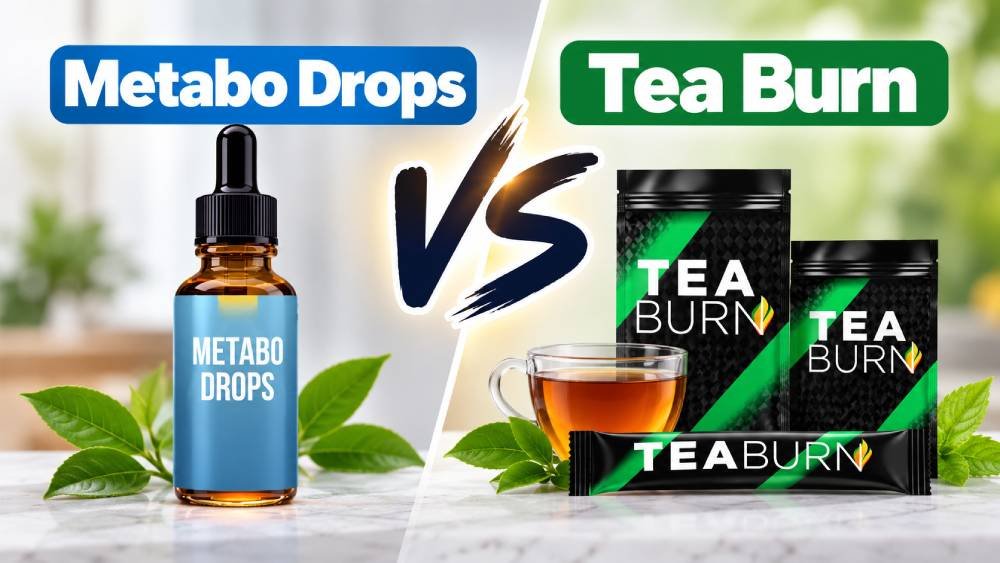
Metabo Drops and Tea Burn are two very similar weight-loss supplements built around two different daily beverages. Metabo Drops is designed to be added to coffee, while Tea Burn is designed to be mixed into tea.
And that’s what makes this comparison more interesting than it first appears.
At first glance, you might expect one product to have a dramatically better formula, a much lower price, or a much stronger guarantee. But after checking the current official offers, the two products are surprisingly close.
Both currently offer 60-, 90- and 180-day packages at the same advertised prices. Both offer a 60-day money-back guarantee. Both say their purchases are one-time payments rather than auto-ship subscriptions. And both promote a very similar group of ingredients, including chlorogenic acid, Camellia sinensis, chromium, L-carnitine, L-theanine and a vitamin complex.
So which one is actually worth buying?
My answer is Metabo Drops for regular coffee drinkers and Tea Burn for regular tea drinkers.
That’s not because I can prove that Metabo Drops burns more fat than Tea Burn. There isn’t enough independent clinical evidence on either finished product to make that claim.
The better argument is practical: the supplement that fits naturally into a habit you already have is the one you’re more likely to use consistently.
👉 Check the Current Metabo Drops Offer
Metabo Drops vs Tea Burn: Quick Comparison
| Feature | Metabo Drops | Tea Burn |
|---|---|---|
| Product format | Liquid drops | Powder/serving format |
| Designed around | Coffee | Tea |
| Core formula | Proprietary formula | Proprietary formula |
| Promoted ingredients | Chlorogenic acid, Camellia sinensis, chromium, L-carnitine, L-theanine, vitamin complex | Chlorogenic acid, Camellia sinensis, chromium, L-carnitine, L-theanine, vitamin complex |
| 60-day supply | $158 + shipping | $158 + shipping |
| 90-day supply | $207 + shipping | $207 + shipping |
| 180-day supply | $294 + free shipping | $294 + free shipping |
| Money-back guarantee | 60 days | 60 days |
| Auto-ship | No, according to official FAQ | No, according to official FAQ |
| Best fit | People who already drink coffee | People who already drink tea |
My Quick Verdict
If you drink coffee every morning, I’d choose Metabo Drops.
If tea is your everyday beverage, I’d choose Tea Burn.
That’s the simplest answer.
The reason is not that Metabo Drops has been proven superior in a head-to-head clinical trial. I could not verify such evidence.
Instead, the two products are so similar in their current offers and ingredient positioning that the delivery format becomes one of the most meaningful differences for an ordinary buyer.
Metabo Drops says to add one drop to hot or iced coffee. Tea Burn says to add one serving to tea. Both products are marketed as tasteless and instantly dissolving.
If you’re already drinking coffee, Metabo Drops requires almost no change to your routine.
If you’re already drinking tea, Tea Burn does the same thing for your routine.
👉 See Metabo Drops Current Pricing & 60-Day Guarantee
What Is Metabo Drops?
Metabo Drops is a liquid dietary supplement marketed as a way to turn ordinary coffee into what the company calls a metabolism-boosting “Super Coffee.”
The official instructions are simple: add one drop to hot or iced coffee, then drink the coffee normally. The company says the drops are tasteless and dissolve quickly.
The current official product page promotes Metabo Drops for:
- Supporting metabolism
- Supporting fat-burning
- Supporting energy
- Reducing cravings or hunger
- Supporting general well-being
Those are manufacturer claims, however, rather than outcomes that have been independently established for the finished product.
The formula currently highlighted on the official website includes:
- Chlorogenic acid
- Camellia sinensis
- Chromium
- L-carnitine
- L-theanine
- Vitamin complex
The company describes the formula as proprietary, so the page does not give readers a complete dose-by-dose breakdown for these ingredients.
That matters when evaluating the science because knowing that an ingredient appears in a supplement is not enough to know whether the product contains the same amount used in a clinical study.
What Is Tea Burn?
Tea Burn takes essentially the same behavioral approach as Metabo Drops but builds it around tea.
The official page describes Tea Burn as a tasteless, instantly dissolving formula intended to work with tea to support metabolism, energy, appetite and overall well-being. It recommends adding one serving to tea each day.
Its current ingredient presentation is remarkably similar to Metabo Drops:
- Chlorogenic acid
- Camellia sinensis
- Chromium
- L-carnitine
- L-theanine
- Vitamin complex
That makes Tea Burn less of a completely different alternative and more of a tea-based counterpart to the Metabo Drops concept.
There is one labeling oddity worth mentioning. The current page describes Tea Burn as a powder/packet product, but later in its FAQ it refers to a “nutritional serum.” Because the official page itself uses both descriptions, I would not make a strong technical claim about the exact physical delivery technology beyond what the current product presentation clearly shows.
👉 Check the Current Tea Burn Offer
The Biggest Difference Between Metabo Drops and Tea Burn
There are plenty of small differences in the marketing language, but the biggest practical difference is extremely simple:
Metabo Drops is built around coffee. Tea Burn is built around tea.
Metabo Drops: coffee routine
The product tells you to add one drop to your coffee. You don’t have to prepare another drink or remember a separate capsule.
For someone who already drinks coffee every morning, that is a genuine convenience advantage.
Tea Burn: tea routine
Tea Burn follows the same basic idea but asks you to add one serving to your tea.
If tea is already part of your daily routine, this may be equally convenient.
That’s why I don’t think it’s useful to declare a universal winner without considering the buyer.
If someone drinks coffee every morning and almost never drinks tea, recommending Tea Burn because of a theoretical ingredient advantage would make little practical sense.
The same is true in reverse.
Metabo Drops vs Tea Burn Ingredients
The two formulas are remarkably similar based on the ingredients currently highlighted by their official websites.
| Ingredient | Why It Is Included | What the Evidence Means |
|---|---|---|
| Chlorogenic acid | Associated with coffee and metabolic processes | Interesting research exists, but it does not prove either finished product causes major weight loss |
| Camellia sinensis | Green tea source associated with catechins and metabolism | Human weight-loss evidence is mixed and generally points to modest effects |
| Chromium | Essential trace mineral involved in macronutrient metabolism | Not established as a powerful standalone fat burner |
| L-carnitine | Involved in fatty-acid transport | Biological role does not automatically translate into substantial weight loss from supplementation |
| L-theanine | Commonly associated with tea and cognitive/relaxation effects | Not strong evidence for major direct fat loss |
| Vitamin complex | General nutritional and energy support | Useful for nutritional adequacy but not proof of a weight-loss effect |
The official websites make stronger claims about these ingredients than the table above does. I have deliberately separated those claims from the evidence because ingredient presence is not the same thing as product efficacy.
What Does the Science Actually Say?
This is probably the most important section of the entire comparison.
Weight-loss supplements frequently use scientifically familiar ingredients. The problem is that research on an individual ingredient can easily be presented as if it were proof of the entire supplement.
That’s not a reliable way to judge a product.
Green tea and Camellia sinensis
Green tea preparations have been studied extensively for weight management.
The evidence is mixed. A Cochrane review found that green tea preparations produced a small, statistically non-significant weight reduction overall, with the authors concluding that the amount was unlikely to be clinically important.
Other meta-analyses have reported statistically significant reductions in body weight with green tea extract, but the size of the effect varies according to the preparation, dose, duration and study population.
So it would be inaccurate to say green tea has “no research.” There is plenty of research.
But it would also be inaccurate to turn that research into a promise of dramatic weight loss.
Chlorogenic acid and green coffee compounds
Chlorogenic acids have attracted interest because of their potential effects on glucose metabolism and other metabolic pathways.
That gives the ingredient a plausible nutritional rationale.
But again, plausible mechanism is not the same thing as proven weight-loss results from Metabo Drops or Tea Burn.
L-carnitine
L-carnitine has a legitimate role in fatty-acid transport and energy metabolism.
However, the fact that the body uses L-carnitine in fat metabolism does not mean taking an L-carnitine-containing supplement automatically produces significant fat loss.
Chromium
Chromium is involved in normal macronutrient metabolism, which explains why it appears in many products positioned around metabolic health.
But it should not be treated as a powerful fat-burning ingredient based solely on that biological role.
The bigger picture
A critical review of natural supplements marketed for weight loss concluded that evidence was insufficient to show significant weight loss for most of the commonly marketed ingredients it evaluated.
The NIH Office of Dietary Supplements also notes that evidence for weight-loss supplements varies substantially by ingredient and that green tea’s observed effects, where present, tend to be modest.
My conclusion: there is enough ingredient research to understand why Metabo Drops and Tea Burn were formulated this way, but not enough product-specific evidence to promise that either supplement will produce dramatic weight loss.
How Are Metabo Drops and Tea Burn Supposed to Work?
Both products are based on a similar idea:
Start with a beverage you already consume, then add a combination of nutrients that the manufacturer says can support metabolism, energy and appetite.
Metabo Drops says coffee provides the foundation for its formula.
Tea Burn makes the same argument about tea.
The manufacturers describe their proprietary combinations as working synergistically with the beverages to create a more favorable environment for fat burning.
That’s the vendor’s proposed mechanism, not an independently established fact about the finished products.
The important buyer takeaway is that these products should be thought of as supplements intended to complement a weight-management routine, rather than replacements for calorie control, physical activity or appropriate medical treatment.
Metabo Drops Pros and Cons
What I Like About Metabo Drops
- Extremely simple: one drop is added to coffee.
- Fits an existing habit: coffee drinkers don’t need to create a new supplement routine.
- Tasteless according to the manufacturer: the company says it dissolves without changing the taste of coffee.
- No capsules: useful for people who don’t like swallowing pills.
- Similar formula to Tea Burn: it contains the same major ingredients highlighted by Tea Burn’s official page.
- 60-day guarantee: buyers have a stated refund period.
- No auto-ship according to the current FAQ: the company states that the purchase is one-time rather than recurring.
What I Don’t Like
- No strong independent clinical trial on the finished product was identified.
- Proprietary formula: the official page doesn’t give consumers a full dose-by-dose breakdown of the highlighted ingredients.
- Marketing claims are aggressive: the sales page uses language about fat burning and metabolism that goes beyond what ingredient-level evidence can establish for the finished product.
- Upfront cost is significant: even the smallest package is $158 before shipping.
Tea Burn Pros and Cons
What I Like About Tea Burn
- Simple tea-based routine: add a serving to your tea.
- Tasteless positioning: the company says it dissolves without changing the taste.
- Very similar ingredient strategy to Metabo Drops.
- 60-day money-back guarantee.
- No auto-ship according to the current official FAQ.
- Useful option for people who genuinely prefer tea.
What I Don’t Like
- There is no obvious ingredient advantage over Metabo Drops.
- The finished product lacks strong independent clinical evidence for major weight loss.
- The official page uses both “powder” and “serum” descriptions, which creates some unnecessary ambiguity about the delivery format.
- The marketing makes strong metabolism and fat-burning claims that should be interpreted cautiously.
Metabo Drops vs Tea Burn Pricing
This is one area where my earlier version was incorrect, so it is worth being precise.
The current official offers show the same advertised package pricing for both products.
| Package | Metabo Drops | Tea Burn |
|---|---|---|
| 2 bottles / 60 days | $158 + shipping | $158 + shipping |
| 3 bottles / 90 days | $207 + shipping | $207 + shipping |
| 6 bottles / 180 days | $294 + free shipping | $294 + free shipping |
The per-bottle figures shown on the current official pages are $79 for the 60-day package, $69 for the 90-day package and $49 for the 180-day package.
That means price is not a useful differentiator between Metabo Drops and Tea Burn at the moment.
If you were hoping one would clearly win on cost, it doesn’t.
The 180-day package gives the lowest advertised per-bottle price for both products, but that also means committing to a larger upfront purchase.
I would not automatically recommend the biggest package simply because the sales page calls it the “best deal.” A larger package only represents better value if you actually intend to use the product consistently.
Metabo Drops vs Tea Burn: Money-Back Guarantee
Another area where the two products are essentially tied is the guarantee.
Both currently advertise a 60-day, 100% money-back guarantee.
Both official pages state that customers can request a refund within 60 days and that even empty bottles can be returned. Both also state that shipping and handling are excluded from the refund.
That is useful because it gives buyers a defined period in which to decide whether the product is suitable for them.
However, a money-back guarantee should not be interpreted as proof that a product works.
A guarantee reduces purchase risk. It does not establish clinical efficacy.
Do Metabo Drops or Tea Burn Have Hidden Subscriptions?
According to the current official FAQs, no.
Metabo Drops says its purchase is a one-time payment and specifically states that it is not an auto-ship program and has no subscription fees.
Tea Burn’s official FAQ makes the same statement: one-time payment, no auto-ship program and no hidden subscription fees.
This is important because some older or third-party supplement reviews can contain outdated billing information. For this comparison, I would give priority to the current first-party checkout and FAQ information.
Are Metabo Drops and Tea Burn Legit?
I would not call either product a scam based on the information currently available.
Both have identifiable product websites, active sales pages, listed ingredients, customer-support information, payment infrastructure and stated refund policies.
But there is an equally important distinction:
Legitimate product does not automatically mean clinically proven product.
That distinction is particularly important with supplements.
A company can sell a genuine product that contains the ingredients it claims to contain while still making marketing statements that are stronger than the independent evidence supports.
That is the category I would put these products in.
I don’t see enough evidence to call them scams.
I also don’t see enough independent product-specific evidence to tell readers that either one is a proven, powerful fat-loss treatment.
Who Is Metabo Drops Best For?
Metabo Drops makes the most sense for you if:
- You already drink coffee regularly.
- You want a liquid supplement rather than capsules.
- You value a very simple morning routine.
- You want to combine supplementation with an existing habit.
- You understand that it is a dietary supplement rather than a medical weight-loss treatment.
- You are comfortable with the current price.
It may not be the best fit if:
- You don’t drink coffee.
- You are highly sensitive to caffeine or other stimulating ingredients in your overall diet.
- You expect the product to produce major weight loss without changes elsewhere.
- You want a completely transparent dose for every active ingredient.
Who Is Tea Burn Best For?
Tea Burn makes the most sense for you if:
- You already drink tea regularly.
- You prefer a tea-based supplement routine.
- You want something that can be added directly to your beverage.
- You don’t want to swallow capsules.
- You understand that supplement results vary.
It may not be the best fit if:
- You rarely drink tea.
- You are expecting dramatic weight loss from the supplement alone.
- You want extensive independent clinical research on the finished product before buying.
- You dislike proprietary formulas with limited dose transparency.
Which One Should You Actually Buy?
| If your situation is… | My pick |
|---|---|
| I drink coffee every morning | Metabo Drops |
| I drink tea every morning | Tea Burn |
| I prefer liquid supplements | Metabo Drops |
| I prefer a tea-based routine | Tea Burn |
| I want the cheaper product | Tie |
| I want the longer guarantee | Tie |
| I don’t want auto-ship | Both currently state no auto-ship |
| I want proven dramatic weight loss | Neither |
This is why my overall recommendation is relatively simple.
Don’t overthink the comparison.
If you’re a coffee drinker, Metabo Drops is the more natural choice.
If you’re a tea drinker, Tea Burn is the more natural choice.
The current pricing doesn’t separate them, the guarantees don’t separate them, and the highlighted ingredients don’t create a dramatic difference.
What Results Should You Expect?
This is where I would be particularly cautious with the sales-page testimonials.
Metabo Drops currently displays testimonials claiming outcomes such as losing 24 pounds and dropping multiple clothing sizes. Tea Burn’s page also refers to thousands of users and makes strong claims about metabolism and fat burning.
Those are vendor-presented testimonials and marketing claims. They should not be interpreted as proof that a typical buyer will achieve the same result.
The scientific literature on ingredients such as green tea is much more modest and variable than the most dramatic supplement advertisements suggest.
So I would approach either product with this expectation:
It may be a useful addition to a broader weight-management routine, but it should not be expected to do the work of that routine.
Your overall food intake, physical activity, sleep, adherence and individual physiology will matter much more than simply adding a few drops or a packet to a drink.
Safety and Who Should Be Careful
Weight-loss supplements deserve some caution even when their ingredients sound natural.
The NIH’s National Center for Complementary and Integrative Health warns that many supplements marketed for weight loss have uncertain safety profiles and that some weight-loss products can contain substantial amounts of caffeine or caffeine-containing herbs.
That doesn’t mean Metabo Drops or Tea Burn is necessarily unsafe. It means consumers should not assume that “natural” automatically means risk-free.
If you are pregnant or breastfeeding, have a medical condition, take prescription medication, have been told to limit caffeine, or have another health concern, speak with a qualified healthcare professional before using a weight-loss supplement.
And if you’re experiencing unexplained weight gain, persistent fatigue, abnormal blood sugar symptoms or another concerning change in health, don’t rely on a supplement to identify or treat the underlying problem.
Metabo Drops vs Tea Burn FAQs
Is Metabo Drops better than Tea Burn?
For a regular coffee drinker, I would choose Metabo Drops because it fits naturally into a coffee routine. For a regular tea drinker, Tea Burn is the more logical choice. There isn’t enough product-specific evidence to claim that one produces substantially greater weight loss than the other.
Which is cheaper, Metabo Drops or Tea Burn?
Currently, neither has a meaningful price advantage. Both advertise $158 for the 60-day package, $207 for the 90-day package and $294 for the 180-day package. The 180-day package includes free shipping according to the current official pages.
Do Metabo Drops and Tea Burn have the same ingredients?
The current official websites highlight essentially the same core ingredients: chlorogenic acid, Camellia sinensis, chromium, L-carnitine, L-theanine and a vitamin complex. Both formulas are described as proprietary.
Does Metabo Drops really burn fat?
The manufacturer claims that Metabo Drops supports fat burning, but that is not the same as independent proof that the finished product produces a specific amount of fat loss. Research on individual ingredients such as green tea suggests effects, when present, tend to be modest and variable.
Does Tea Burn really help with weight loss?
Tea Burn is marketed for metabolism and fat-burning support, but there is not enough independent clinical evidence on the finished product to guarantee a particular weight-loss result. The evidence for individual ingredients is more limited and nuanced than the strongest marketing claims.
Does Metabo Drops have a subscription?
The current official FAQ says no. It states that the purchase is a one-time payment and not an auto-ship program.
Does Tea Burn have a subscription?
The current official FAQ also says no. Tea Burn states that it is a one-time payment and not an auto-ship program.
How long is the Metabo Drops guarantee?
Metabo Drops currently advertises a 60-day money-back guarantee. The official page says customers can request a refund within 60 days and that empty bottles can be returned, with shipping and handling excluded.
How long is the Tea Burn guarantee?
Tea Burn currently advertises the same 60-day money-back guarantee and states that customers can request a refund within that period.
Can Metabo Drops be used with tea?
The manufacturer says the individual nutrients may offer benefits with other beverages, but it specifically positions the proprietary formula around working with coffee. If you primarily drink tea, Tea Burn is the more natural choice.
Can Tea Burn be used with coffee?
The manufacturer says the individual nutrients may offer benefits with other beverages, but its proprietary formula is specifically positioned around working with tea. If coffee is your normal beverage, Metabo Drops is the more logical fit.
Which one would you personally choose?
For a regular coffee drinker, Metabo Drops. The reason is convenience and routine fit rather than a claim that it has been clinically proven superior to Tea Burn.
Final Verdict: Metabo Drops vs Tea Burn
Metabo Drops narrowly wins this comparison for coffee drinkers, while Tea Burn is the better choice for people who naturally prefer tea.
And after checking the current official offers, I don’t think the decision needs to be more complicated than that.
Both products currently have:
- Very similar formulas
- The same advertised package prices
- The same 60-day money-back guarantee
- No stated auto-ship subscription
- A simple beverage-based delivery system
- Strong marketing around metabolism and fat burning
The real differentiator is your existing beverage habit.
Metabo Drops tells coffee drinkers to add one drop to their morning coffee. Tea Burn tells tea drinkers to add one serving to their tea.
That simplicity is actually valuable.
The less friction there is between buying a supplement and remembering to take it, the easier it is to incorporate it into a consistent routine.
But I would not buy either product expecting a miracle.
The scientific evidence surrounding ingredients such as green tea is mixed, and even positive studies generally point toward modest effects rather than dramatic transformations.
So here’s my final recommendation:
Choose Metabo Drops if you’re a coffee drinker who wants a convenient liquid supplement to add to your existing routine.
Choose Tea Burn if you’re a tea drinker who wants the same kind of simple beverage-based approach.
Choose neither if you’re expecting the supplement alone to replace a sustainable diet, physical activity or appropriate medical weight-management care.
For the right buyer, Metabo Drops is a reasonable supplement to consider—but the strongest reason to choose it over Tea Burn is routine fit, not a proven superiority in weight loss.
👉 Check Metabo Drops Current Offer & 60-Day Guarantee
Prefer the tea-based approach?
👉 Check Tea Burn Current Offer & 60-Day Guarantee
Related Weight-Loss Reading
If you’re comparing beverage-based weight-loss supplements, you may also want to read our Citrus Burn review for another perspective on how these supplement formulas are marketed and what buyers should look for before purchasing.
Disclaimer: This article is for informational purposes only and is not medical advice. Dietary supplements are not intended to diagnose, treat, cure or prevent disease. Individual results vary. If you have a medical condition, take prescription medication, are pregnant or breastfeeding, or have concerns about your weight or metabolic health, consult a qualified healthcare professional before using a dietary supplement.
Prices, formulas, package options, shipping charges and refund terms can change. Always verify the current product information and checkout details before purchasing.