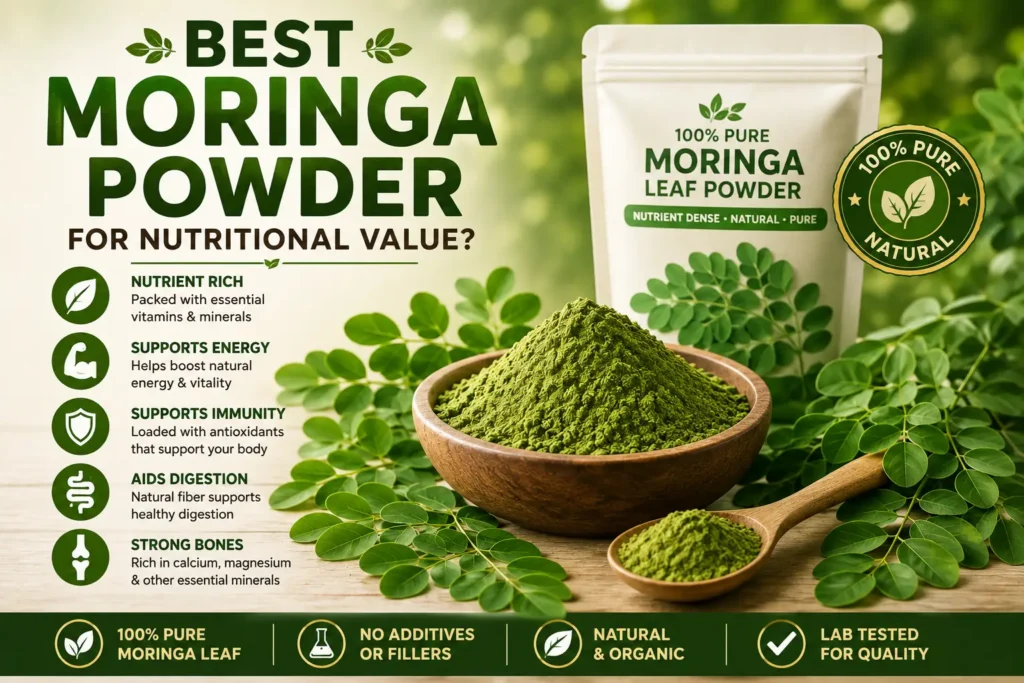
Moringa powder has become a popular way to add more plant-based nutrients to everyday meals and drinks. Made by drying and grinding the leaves of Moringa oleifera, moringa leaf powder contains protein, fibre, minerals, carotenoids and other plant compounds. Research has described moringa leaves as nutrient-dense, although the exact nutritional profile can vary according to growing conditions, processing and the way the product is prepared.
But with so many moringa products available, one question naturally follows:
What is the best moringa powder for nutritional value?
There is no single brand that can automatically be called the “best” for everyone. Nutritional quality depends on factors such as whether the product is made from pure moringa leaf, how the leaves were dried, how they were processed, whether the label provides meaningful nutritional information and whether the manufacturer has appropriate quality controls.
For consumers interested in Moringa Magic, it is also worth noting that the product is presented by its supplier as a capsule supplement made from powdered moringa leaves rather than a loose pouch of powder. The official website describes the product as using moringa leaf powder and currently lists one-, three- and six-bottle options.
This guide looks at what actually makes a moringa powder nutritionally worthwhile, what nutrients moringa can provide, how processing can affect quality, and what to know about Moringa Magic before making a decision.
What Makes a Moringa Powder Nutritionally Valuable?
The first thing to understand is that “best” does not necessarily mean the product with the most impressive marketing claims.
For nutritional value, a good moringa powder should ideally be made primarily from moringa leaves, with a clearly stated ingredient list and a transparent serving size.
Moringa leaves contain protein, fibre, minerals and carotenoid compounds. Scientific reviews have reported substantial protein concentrations in dried leaves, along with calcium, potassium and other nutrients.
The nutritional composition can vary considerably, however. A study examining moringa leaf powder from a Nigerian ecotype found measurable amounts of protein, fat and carbohydrate, illustrating why actual laboratory analysis can be more useful than broad claims about what moringa supposedly contains.
A useful checklist when evaluating a moringa powder is therefore:
Pure or clearly defined ingredients: Look for a product that clearly identifies what is inside.
Transparent serving size: You should be able to tell how much moringa you’re actually consuming.
Good processing practices: Drying and storage can influence nutritional composition.
Reliable manufacturer information: A reputable seller should provide enough information for consumers to understand the product.
Reasonable claims: Be cautious of products promising extraordinary results from a single ingredient.
Moringa Is Naturally Rich in Plant Nutrients
One of the main reasons moringa is often described as a superfood is its concentration of nutrients in the leaves.
Studies have found moringa leaves to contain protein, fibre, calcium, potassium and carotenoids, while other research has examined vitamin and mineral content in both fresh and dried leaves.
This makes moringa particularly interesting as a food ingredient.
However, the nutritional value of moringa should be considered in the context of the overall diet. A teaspoon or two of moringa powder is not going to replace a complete meal, nor should it be treated as a substitute for vegetables, fruits, legumes, grains and other sources of essential nutrients.
Instead, moringa powder can be thought of as a concentrated plant ingredient that can complement an already varied diet.
Protein Content
Moringa leaves contain a meaningful amount of plant protein, particularly when they are dried.
One review reported protein levels in Moringa oleifera leaves ranging from approximately 23% to 29% in proximate analyses.
A Nigerian study analyzing moringa leaf powder reported 28.2 grams of protein per 100 grams of powder.
That sounds impressive, but serving size matters.
People generally consume only a small amount of moringa powder at a time. A 5-gram serving, for example, would provide only a fraction of the protein found in 100 grams.
This is why nutritional comparisons should always consider the actual serving size rather than focusing only on numbers expressed per 100 grams.
Moringa can contribute some plant protein, but it should not be considered a primary protein source for most people.
Fibre and Digestive Nutrition
Moringa leaves also contain dietary fibre.
Fibre contributes to normal digestive function and can form part of a healthy dietary pattern. The amount of fibre found in moringa varies depending on the plant, growing conditions and processing methods.
This is another reason the label matters.
When choosing among different powders, don’t assume that every product has exactly the same nutritional profile simply because they all say “moringa leaf powder” on the front.
Processing can alter the concentration of nutrients and other compounds. A review of moringa leaf powder notes that drying changes the nutritional composition compared with fresh leaves, including changes in energy, protein and fat concentration.
Minerals in Moringa Powder
Moringa has attracted attention as a possible source of several minerals.
Research has identified minerals including calcium, potassium, iron, phosphorus and magnesium in moringa leaves and leaf powder.
Iron is particularly interesting because of the role it plays in oxygen transport and normal physiological function.
However, online claims about moringa sometimes exaggerate how much iron or other nutrients it contains.
For example, one study specifically investigated common claims that moringa contains dramatically more iron than spinach and found that some of those comparisons were misleading. The researchers concluded that moringa’s nutritional value is real, but some popular comparisons relied on inequivalent moisture bases.
This is an important lesson when searching for the “best” moringa powder: look for credible nutritional information rather than dramatic superfood claims.
Carotenoids and Antioxidant Plant Compounds
Moringa leaves contain carotenoids and other phytochemicals that contribute to their nutritional and antioxidant profile.
Provitamin A carotenoids are among the compounds researchers have identified in moringa leaves.
Moringa also contains various polyphenols and glucosinolates that have attracted scientific interest because of their biological activity.
These compounds are one reason researchers continue studying moringa beyond its basic nutritional composition.
Nevertheless, “contains antioxidants” should not be interpreted as meaning that a moringa supplement will prevent disease or produce dramatic health improvements. Antioxidants are found across many fruits, vegetables and plant foods, and overall dietary patterns matter much more than any individual ingredient.
Does Fresh Moringa Have More Nutrients Than Powder?
This is a more complicated question than it first appears.
Fresh leaves naturally contain a large amount of water. When leaves are dried, water is removed, so nutrients become more concentrated by weight.
At the same time, processing can cause some nutrient losses.
A review of moringa leaf powder explains that drying changes the nutritional composition of the leaves and can increase the apparent concentration of some nutrients while potentially reducing certain heat-sensitive compounds.
This means a well-made powder can still be nutritionally valuable, but how the powder is produced matters.
Ideally, manufacturers should use appropriate drying and storage conditions that protect the quality of the leaves.
Does Organic Moringa Mean It Is More Nutritious?
Not necessarily.
Organic certification can tell consumers something about how agricultural inputs are managed, but it does not automatically mean that one moringa powder contains dramatically more protein, minerals or vitamins than another.
For nutritional purposes, ingredient purity, processing, storage and serving size may matter more than the word “organic” by itself.
Organic certification can be an important purchasing preference for some consumers, but it should not be confused with a guarantee of superior nutritional content.
What About Moringa Powder That Contains Other Ingredients?
When nutritional value is the priority, a simple ingredient list can make comparison easier.
A powder labelled as 100% moringa leaf powder allows you to understand more clearly what you’re consuming.
Products containing sweeteners, fillers, flavourings or other botanical ingredients may still have uses, but comparing their nutritional value becomes more complicated.
For consumers who want moringa primarily as a nutrient-dense plant ingredient, a clearly labelled product with straightforward ingredients can make more sense.
The same principle applies to capsules.
Moringa Magic’s official website describes the product as containing pure moringa and explains that the leaves are dried and ground into powder before being placed into capsules. The product therefore offers the convenience of capsules rather than requiring consumers to measure loose powder.
Is Moringa Magic a Good Option for Nutritional Value?
Moringa Magic is worth considering separately from ordinary loose moringa powder because the product is presented in capsule form.
According to its official supplier, the product uses powdered moringa leaves. The website describes the ingredient as 100% pure moringa and provides directions for taking two capsules daily.
That can appeal to people who don’t enjoy the taste of moringa powder or don’t want to mix green powder into food and drinks.
However, anyone comparing products specifically for nutritional value should look at the actual serving amount.
A product can contain a high-quality ingredient but still provide a relatively small quantity per serving. This is one reason it is useful to compare the amount of moringa supplied rather than simply comparing the words used on the label.
For more information about Moringa Magic, including its ingredients, pricing and product claims, read the detailed:
How Much Moringa Powder Should You Take?
There is no universally established “perfect” serving size for everyone.
Research has used different amounts of moringa leaf powder depending on the purpose of the study. One 2025 study involving healthy adults tested approximately 2.4, 4.8 and 7.2 grams per day and found that the powder was generally acceptable across the groups, although gastrointestinal symptoms were more common at the highest dose.
This illustrates why more is not automatically better.
People should follow the serving instructions supplied with the particular product rather than assuming that larger quantities will produce better nutritional results.
The evidence also varies depending on whether the product is whole leaf powder, an extract or another preparation.
Can Moringa Help With Nutritional Gaps?
Research has investigated moringa as a potential food-based strategy for improving nutritional status, particularly in settings where micronutrient deficiencies are common.
A systematic review of moringa supplementation studies found some promising results involving haemoglobin and vitamin A status at higher doses in certain populations, but the authors stressed that the evidence remains limited and that larger, more rigorous studies are needed.
That is encouraging, but it should not be interpreted as evidence that every person with a nutrient deficiency can simply take moringa instead of addressing the underlying issue.
If someone is concerned about iron deficiency, vitamin deficiency or another nutritional problem, appropriate medical assessment is much more useful than guessing with supplements.
What Should You Avoid When Buying Moringa Powder?
Not every product marketed as moringa is necessarily equal.
Be cautious about products making claims such as:
“Contains 25 times more iron than spinach.”
“Provides every nutrient your body needs.”
“Detoxes your entire body.”
“Treats diabetes.”
“Replaces your multivitamin.”
“Cures chronic disease.”
Evidence does not support treating moringa as a miracle cure.
In particular, the research on the plant’s potential health effects remains developing. A 2022 systematic review described the evidence as limited but promising and called for larger, more rigorous human studies.
The most sensible reason to use moringa is as part of a balanced diet rather than as a substitute for proper nutrition or medical care.
Look at the Manufacturing and Quality Information
Nutritional value starts with the raw plant, but product quality also depends on what happens after harvesting.
A good manufacturer should have clear information about the product and how it is made.
Factors worth considering include:
Ingredient transparency: Can you clearly identify what is in the product?
Processing: Is there information about how the leaves are dried and processed?
Storage: Has the product been packaged in a way that protects freshness?
Serving information: Is the amount per serving clearly stated?
Manufacturer details: Can customers find a legitimate company and support channel?
These considerations can be more meaningful than attractive packaging or exaggerated health claims.
Powder Versus Capsules: Which Is Better Nutritionally?
Neither format is automatically superior.
Loose powder has the advantage of being easy to add to smoothies, yoghurt, soups or meals, while capsules provide convenience and avoid the taste of the powdered leaves.
From a nutritional perspective, the important question is what is actually contained in each serving.
Two products can both be called “moringa” but provide very different amounts.
Capsules can also make it easier to take a consistent measured amount, whereas loose powder allows greater flexibility in how much you consume.
For people who want moringa primarily for nutritional supplementation but dislike its earthy or bitter flavour, capsules may be more practical.
So, What Is the Best Moringa Powder for Nutritional Value?
The best choice is not necessarily the brand with the loudest health claims or the highest number of nutrients listed on its marketing page.
A good moringa product should ideally provide:
A clearly identified moringa leaf ingredient.
Transparent serving information.
Minimal unnecessary additives.
Responsible processing and storage.
Credible manufacturer information.
Reasonable, evidence-based health claims.
From a nutritional standpoint, the most important factor is the actual amount and quality of moringa leaf provided.
Research consistently supports the view that moringa leaves contain useful nutrients and bioactive plant compounds. However, nutritional composition can vary between products and studies, so claims should always be interpreted carefully.
Final Thoughts
Moringa powder can be a convenient way to add a range of plant nutrients to the diet. The leaves contain protein, fibre, minerals, carotenoids and other bioactive compounds, making moringa a nutritionally interesting food ingredient.
But the phrase “best moringa powder” needs some qualification.
The best product for nutritional value is generally one with a clear ingredient list, appropriate processing, a transparent serving size and a credible manufacturer. Claims about extraordinary concentrations of nutrients should be checked against actual research rather than accepted at face value.
Moringa Magic is one product consumers may encounter when researching moringa. Its official supplier describes it as a capsule product made from powdered moringa leaves, rather than a conventional loose powder. The official site also currently advertises a 60-day money-back guarantee. For consumers considering this particular product, comparing the supplier’s information with independent information is a sensible way to make a more informed decision.
For a closer look at Moringa Magic, including its ingredients, pricing, claims and overall value, read the full Moringa Magic Review 2026.
Ultimately, moringa works best as part of an already balanced diet. It can complement nutritious foods, but it should not be treated as a replacement for a varied diet, prescribed treatment or professional nutritional advice.