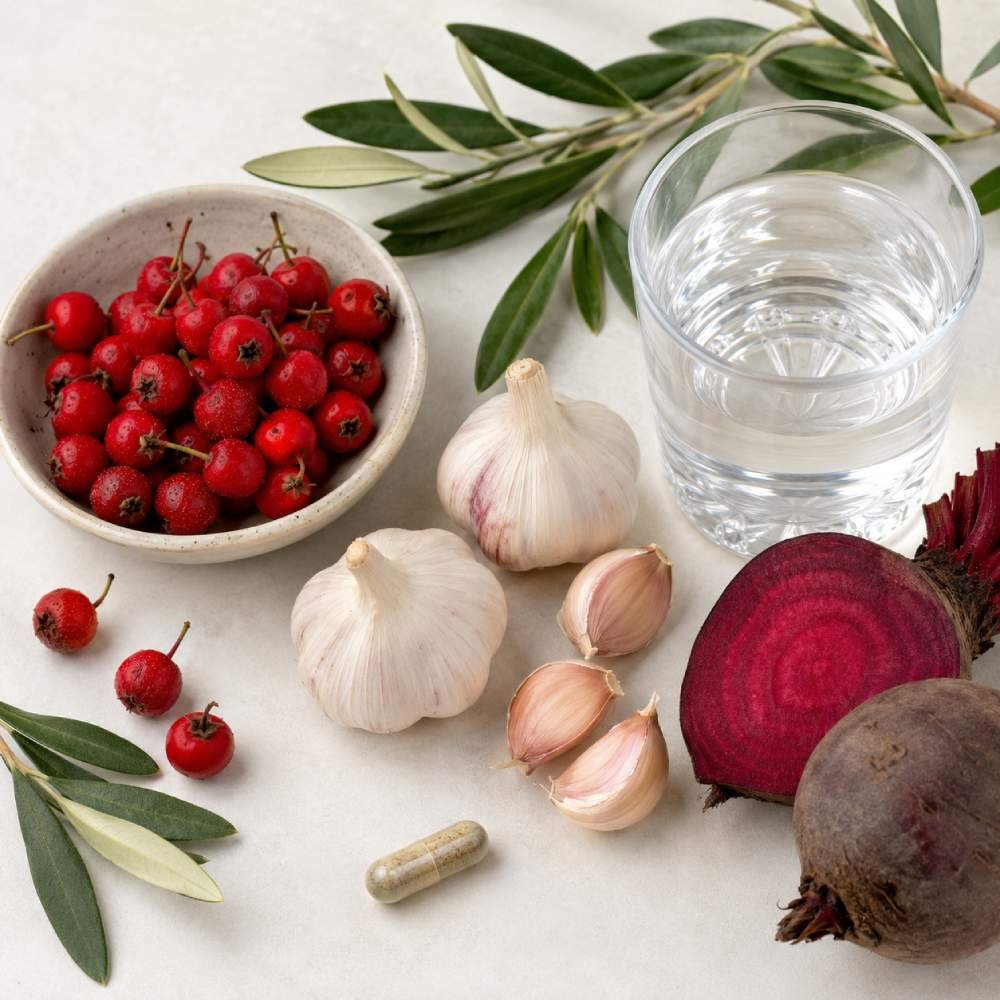
A cardiovascular support supplement is a daily capsule, powder, or drink designed to support healthy blood pressure, circulation, and blood vessel function using natural compounds like nitrates, antioxidants, and vasodilating botanicals.
The primary benefits — in order of how much clinical evidence backs them — are blood pressure support through vasodilation, improved circulation and oxygen delivery, antioxidant protection of blood vessel walls, cholesterol and lipid balance, and increased daily energy tied to better cardiac efficiency.
These supplements work best for adults with mild-to-moderate blood pressure elevation who want a natural adjunct to diet and exercise. They’re not for anyone with Stage 2 hypertension or diagnosed heart disease who needs medical treatment, not a supplement. Below is the full breakdown of each benefit, the mechanism behind it, and what the research actually supports versus what’s just marketing.
Quick-Reference Summary
| Field | Detail |
|---|---|
| Category | Cardiovascular / heart health support supplements |
| Format | Capsule, powder, or tea, depending on brand |
| Price Range | $39–$69 per bottle (monthly supply) |
| Key Mechanism | Vasodilation via nitric oxide support and antioxidant protection of blood vessel walls |
| Best For | Adults with mild-to-moderate blood pressure elevation seeking a natural, lifestyle-compatible adjunct |
| Not For | Anyone with Stage 2 hypertension, diagnosed heart disease, or already on cardiovascular medication without medical supervision |
| Example Pick | Cardio Shield — see full review below |
What a Cardiovascular Support Supplement Actually Is
A cardiovascular support supplement is a category of dietary supplement, not a single product, built around a shared goal: helping the heart and blood vessels function more efficiently through natural ingredients rather than prescription drugs. Most fall into one of three formats — capsules built around botanical extracts like hawthorn, olive leaf, and garlic; powders centered on nitric-oxide precursors like beetroot and L-citrulline; or hybrid formulas combining both approaches with supporting vitamins and CoQ10.
These aren’t a new category. Garlic and hawthorn have centuries of traditional use behind them for heart health, and the nitric oxide pathway — the newer mechanistic angle most modern formulas lean on — has been an active area of cardiovascular research since the 1998 Nobel Prize in Medicine was awarded for discovering nitric oxide’s role as a signaling molecule in the vascular system. What’s changed is that supplement formulators now combine traditional botanicals with nitrate-rich ingredients and antioxidants in a single daily product, aiming to hit multiple mechanisms at once instead of relying on one ingredient alone.
The Science: How These Supplements Work
Nearly every benefit these supplements claim traces back to one of three underlying mechanisms, so it’s worth understanding them before looking at individual benefits.
Vasodilation through nitric oxide. Nitric oxide is a signaling molecule your blood vessels produce naturally, and its job is to tell the smooth muscle in vessel walls to relax and widen. Wider vessels mean lower resistance to blood flow, which translates directly to lower blood pressure. Research on inorganic nitrate supplementation shows it supports cardiovascular health by lowering blood pressure, protecting the endothelium, and slowing processes associated with cardiovascular disease. Ingredients like beetroot and L-citrulline feed this pathway directly, while others like hawthorn support the enzyme responsible for producing nitric oxide in the first place.
Antioxidant protection. Oxidative stress damages the endothelium — the thin inner lining of blood vessels — and that damage is a major driver of both high blood pressure and arterial plaque formation over time. Ingredients like olive leaf, green tea, and vitamin C neutralize the free radicals responsible for this damage, which is less about an immediate blood pressure drop and more about protecting the system long-term.
Cellular energy support. CoQ10 and related compounds support the mitochondria inside heart muscle cells specifically, which is why cardiovascular formulas that include it often tout an energy benefit alongside a blood pressure one — the heart is, after all, a muscle that never stops working, and it has an unusually high mitochondrial density compared to most other tissue.
The clinical evidence behind these mechanisms is genuinely stronger than in most supplement categories. One study on hypertensive patients found a statistically significant 6 mmHg reduction in both systolic and diastolic pressure within 60 minutes of a single nitric oxide supplement dose, and a broader review found that nitrate-rich dietary approaches can meaningfully support blood pressure control alongside standard antihypertensive treatment by improving nitric oxide signaling and reducing oxidative stress. That said, these are supportive, adjunctive effects — not replacements for treatment in anyone already diagnosed with hypertension or cardiovascular disease.
Benefit #1: Healthy Blood Pressure Support
This is the headline benefit, and the one with the deepest research behind it. The mechanism is direct: vasodilating ingredients relax and widen blood vessels, which lowers the resistance the heart has to pump against. Less resistance means lower pressure readings, in the same basic physiological pathway — just gentler and slower — that several prescription antihypertensive drug classes use.
Clinical trials on concentrated beetroot nitrate have shown consistent reductions of roughly 7 to 8 mmHg in systolic blood pressure at doses around 400mg of nitrate daily. Botanical ingredients like hibiscus and olive leaf show similar ranges in their own trials, typically 6 to 11 mmHg systolic. None of these numbers rival what a prescription drug delivers for someone with clinically diagnosed hypertension, but for the mild-to-moderate elevation range — the “borderline high” numbers many adults see at a routine checkup — that’s a meaningful, non-trivial shift, especially stacked on top of dietary sodium reduction and regular movement.
Real-world scenario: A 52-year-old whose annual physical shows 138/88 — elevated but not yet a prescription-level diagnosis — is a textbook candidate for this benefit. A 68-year-old already on two blood pressure medications is not; that’s a conversation for their doctor, not a supplement aisle.
Benefit #2: Improved Circulation and Oxygen Delivery
Wider, more relaxed blood vessels don’t just lower a number on a cuff — they move blood more efficiently throughout the body, which means better oxygen and nutrient delivery to tissue, including the brain and muscles. This is the mechanism behind the “mental clarity” and “less fatigue climbing stairs” anecdotes that show up constantly in cardiovascular supplement reviews, and it has a real physiological basis rather than being pure placebo.
Nitric oxide is the same molecule athletes chase with pre-workout nitrate supplements for a reason: it increases blood flow to muscle tissue during exertion, improving nutrient delivery and oxygen uptake. Cardiovascular formulas aimed at general heart health are using the identical mechanism at a gentler dose, aimed at daily function rather than athletic performance.
Caveat: This benefit is typically the fastest to show up — often within days for nitrate-forward formulas — but it’s also the hardest to measure objectively at home, since most people don’t have a way to track circulation the way they can track a blood pressure number.
Benefit #3: Antioxidant Protection of Blood Vessel Walls
This is the benefit that operates on the longest timeline and gets the least attention, largely because it doesn’t produce an immediate number you can point to. Oxidative stress — the accumulation of free radicals faster than your body can neutralize them — is one of the core drivers of endothelial dysfunction, the technical term for a blood vessel lining that’s lost its ability to relax and constrict properly.
Ingredients like olive leaf extract (rich in oleuropein), green tea catechins, and vitamin C work here, neutralizing free radicals before they damage the endothelium. This matters because a damaged endothelium is where arterial plaque tends to start forming. Protecting it isn’t a benefit you’ll feel next week, but it’s arguably the most important one for long-term cardiovascular risk, since it addresses a root contributor rather than just a downstream symptom.
Honest caveat: Antioxidant supplementation research for cardiovascular outcomes is genuinely mixed in the broader literature — some large trials on isolated antioxidant vitamins haven’t shown the dramatic benefits once hoped for. The ingredients used in cardio-focused formulas (polyphenols from olive leaf, hawthorn, and green tea specifically) have better individual data than generic multivitamin-style antioxidants, but this is a benefit built on a reasonable mechanism more than a slam-dunk outcome trial.
Benefit #4: Cholesterol and Lipid Balance Support
Not every cardiovascular supplement targets this, but many multi-ingredient formulas include something aimed at LDL cholesterol or triglycerides alongside their blood pressure ingredients, since the two conditions frequently show up in the same person and share overlapping risk factors.
Garlic extract has reasonably solid research behind modest LDL reductions, and ingredients like bergamot and red yeast rice (found in more specialized formulas) act on the same enzyme pathway as statin medications, just less potently. Omega-3 fatty acids, when included, have strong evidence specifically for triglyceride reduction.
Real-world scenario: Someone told at a checkup they have “borderline high” cholesterol and blood pressure together — a common pairing — benefits more from a formula that addresses both than one narrowly focused on blood pressure alone.
Benefit #5: Increased Daily Energy and Stamina
This benefit surprises people who assume “heart supplement” only means blood pressure. CoQ10 is the ingredient driving it: it’s a coenzyme your mitochondria need to produce cellular energy, and heart muscle tissue has an especially high concentration of mitochondria because it’s working continuously. Natural CoQ10 production also declines with age and is further reduced by statin medications, which is part of why CoQ10 is specifically recommended by some physicians for patients on long-term statin therapy.
The energy benefit here is genuinely tied to the cardiovascular mechanism rather than being a separate stimulant effect — there’s no caffeine or synthetic stimulant doing the work. That’s also why it tends to build gradually over several weeks rather than producing the immediate jolt a stimulant would.
Benefit #6: Reduced Arterial Stiffness Over Time
Arterial stiffness — the gradual loss of elasticity in blood vessel walls that comes with age — is a distinct issue from blood pressure itself, though the two are related. Stiffer arteries force the heart to work harder with every beat, and stiffness is now recognized as an independent cardiovascular risk marker, not just a symptom of high blood pressure.
The vasodilating and antioxidant mechanisms already discussed both play a role here: better nitric oxide signaling keeps vessel walls more responsive over time, and reduced oxidative damage helps preserve the elastin and collagen structures that give arteries their flexibility. Garlic specifically has research showing measurable improvements in arterial stiffness markers with consistent long-term use, not just isolated blood pressure drops.
Honest caveat: This is a slow-moving benefit, realistically measured in months rather than weeks, and it’s not something most people can track without specialized equipment. It’s a genuine mechanism worth knowing about, but not one to expect a noticeable before-and-after from.
Benefit #7: A Lower-Side-Effect Adjunct to Lifestyle Change
This last benefit is more practical than biochemical, but it’s real: for someone in the mild-to-moderate blood pressure range who isn’t yet a candidate for medication, a well-formulated natural supplement offers a lower-risk starting point than jumping straight to a prescription, while they work on the diet and exercise changes that matter most long-term. Most of the ingredients discussed here — hawthorn, garlic, hibiscus, beetroot — have long safety track records at the doses used in these formulas, with side effects generally limited to mild digestive upset in a small percentage of users.
Important honesty check: This benefit only holds if the supplement is used as intended — alongside lifestyle changes, and with a doctor’s awareness if you’re on any medication. It is not a benefit if someone uses it to avoid a needed medical conversation about numbers in the moderate-to-severe range.
How These Benefits Work Together
None of these seven benefits operate in isolation, and understanding how they stack is more useful than treating them as a checklist. The blood pressure benefit and the circulation benefit come from the same nitric oxide mechanism, just measured differently — one as a number on a cuff, one as how you feel climbing stairs. The antioxidant and arterial stiffness benefits are two sides of the same long-term protective effect, working over months rather than weeks. The energy benefit rides alongside all of it, since a heart working more efficiently, with better circulation and less oxidative stress, is a heart with more capacity for everything else the body needs it to do.
The practical takeaway: don’t expect one dramatic result. Expect a handful of modest, complementary shifts that add up over 8 to 12 weeks of consistent use, layered on top of — not instead of — the basics of sodium reduction, movement, and sleep.
Who Benefits Most
The clearest fit is an adult in their 40s to 60s with a blood pressure reading in the elevated-to-stage-1 range (roughly 120–139 systolic or 80–89 diastolic) who hasn’t been prescribed medication yet and wants a natural first step. It’s also a reasonable fit for someone already managing their numbers well through lifestyle changes who wants additional support, or someone whose family history of heart disease has them looking to be proactive rather than reactive.
It’s a poor fit for anyone with a reading consistently above 140/90 who hasn’t seen a doctor about it, anyone already diagnosed with heart disease, and anyone expecting a supplement to substitute for a prescription they’ve already been given.
What These Supplements Won’t Do
They won’t replace a prescription antihypertensive for someone who’s been diagnosed with hypertension requiring medication — the effect sizes, while real, are smaller than what most blood pressure drugs deliver. They won’t reverse existing arterial plaque or established cardiovascular disease. They won’t work without consistency; nearly every ingredient discussed here needs 4 to 8 weeks of daily use before effects are measurable, and stopping and starting undermines the whole mechanism. And they won’t outrun a genuinely poor diet — an ingredient supporting healthy blood pressure through vasodilation is fighting an uphill battle against a diet consistently high in sodium and processed food.
How to Choose One
Look for full ingredient disclosure with actual doses listed, not a hidden “proprietary blend.” Compare the doses against what’s used in the research — a formula using 50mg of an ingredient studied at 500mg isn’t going to deliver the same effect. Favor formulas manufactured in FDA-registered, GMP-certified US facilities, and check the guarantee window; anything under 60 days doesn’t give you enough time to judge a supplement that needs 4 to 8 weeks to work in the first place.
Cardio Shield is a good example of a formula that checks these boxes: a disclosed 620mg blend of hawthorn, olive leaf, garlic, hibiscus, and supporting vitamins, manufactured in a GMP-certified US facility, backed by a 180-day guarantee. If you want to see how several options compare side by side, our top-rated cardio supplements guide ranks six of them against each other, and our 10 Best Blood Pressure Supplements ranking covers the full category in more depth.
👉 See Cardio Shield’s Full Ingredient List and Pricing →
Unique Insight: Which Ingredient Actually Delivers Which Benefit
Most articles in this category list ingredients in one place and benefits in another, leaving you to guess which ingredient is responsible for which claim. Here’s the direct mapping, so you can evaluate any product’s label against what it’s actually likely to deliver.
| Ingredient | Primary Benefit Delivered | Secondary Benefit | Typical Effective Dose |
|---|---|---|---|
| Beetroot / dietary nitrate | Circulation (fast-acting) | Blood pressure support | ~400mg nitrate daily |
| Hibiscus extract | Blood pressure support | Mild diuretic effect | 2–3g dried extract |
| Olive leaf (oleuropein) | Antioxidant / endothelial protection | Blood pressure support | 500–1000mg standardized extract |
| Garlic (allicin) | Cholesterol support | Arterial stiffness reduction | 600–1200mg aged extract |
| Hawthorn berry | Coronary vasodilation | Nitric oxide enzyme support | 300–900mg standardized extract |
| CoQ10 | Cellular energy | Antioxidant protection | 100–200mg |
| L-citrulline | Circulation (via arginine conversion) | Endothelial function | 3–6g |
| Green tea catechins | Antioxidant protection | Mild lipid support | 300–500mg EGCG |
Use this table as a checklist against any product’s label. If a formula claims “supports blood pressure and cholesterol” but only lists hibiscus and green tea at unlisted amounts, it’s leaning heavily on one ingredient (hibiscus) for the headline claim while the cholesterol benefit is thin at best. A well-built formula will usually show at least one ingredient from each row it claims to address, at a dose that resembles the ones listed here.
Frequently Asked Questions
How long does it take to see the benefits of a cardiovascular support supplement?
Most benefits build over 4 to 8 weeks of consistent daily use. Nitric oxide-driven effects like improved circulation can show up within days, while antioxidant-driven benefits like reduced arterial stiffness take months. Judge any product over a full 8-week window before deciding whether it’s working for you.
Can I take a cardiovascular supplement alongside blood pressure medication?
Only with your doctor’s knowledge. Several common ingredients — garlic, hawthorn, beetroot nitrates — have additive vasodilating effects that can push blood pressure lower than intended when combined with prescription antihypertensives, so this needs medical oversight rather than guesswork.
Are the benefits backed by real research, or is this mostly marketing?
Both, honestly. The underlying mechanisms — nitric oxide-driven vasodilation, antioxidant protection of the endothelium, CoQ10’s role in cellular energy — are legitimate, well-published areas of cardiovascular research. Where marketing overreaches is in implying these effects rival prescription medication or happen overnight. The mechanisms are real; the timelines and magnitude are more modest than most sales pages suggest.
Do I need to change my diet for these supplements to work?
You don’t need a complete overhaul, but the benefits are additive with lifestyle changes, not a replacement for them. A supplement delivering a 7 mmHg reduction on top of reduced sodium intake adds up to something meaningful. The same ingredient fighting against a consistently high-sodium diet will show a much smaller effect.
What’s the difference between a capsule formula and a powder formula?
Capsule formulas typically lean on botanical extracts like hawthorn and olive leaf, working through vasodilation and antioxidant mechanisms over weeks. Powder formulas are usually built around dietary nitrates like beetroot, which convert to nitric oxide faster and can show effects within hours to days. Neither is inherently “better” — they’re different mechanisms with different timelines.
Is there a risk of taking too much and lowering blood pressure too far?
It’s possible, particularly if you stack multiple nitric oxide-boosting products together or combine them with prescription antihypertensives without medical guidance. Stick to one product at the labeled dose, and talk to your doctor before combining with any blood pressure medication.
Do these benefits apply the same way to men and women?
The core mechanisms — vasodilation, antioxidant protection, nitric oxide signaling — work identically regardless of sex, since they’re basic vascular physiology. Where differences show up is in dosing research: most large nitrate and hawthorn trials have skewed toward male participants, and some botanical ingredients marketed toward men’s cardiovascular and performance health (like icariin-based formulas) are specifically studied in male populations and aren’t well-suited for women. Read the label’s intended-use section before assuming a formula applies equally to you.
Final Verdict
The primary benefits of a cardiovascular support supplement — blood pressure support, improved circulation, antioxidant protection, lipid balance, energy, and reduced arterial stiffness — all trace back to legitimate, published mechanisms, not invented marketing claims. What separates a well-formulated product from a weak one is whether the doses match what’s actually been studied, and whether you give it the 8-week window these mechanisms genuinely need to show up. Used that way, alongside basic lifestyle habits, these supplements offer a reasonable, low-risk starting point for anyone in the mild-to-moderate blood pressure range who isn’t ready for or eligible for prescription treatment.
👉 Try Cardio Shield Risk-Free for 180 Days →
Disclaimer: This article is for informational purposes only and does not constitute medical advice. Cardiovascular support supplements are dietary supplements, not treatments for hypertension or heart disease, and have not been evaluated by the FDA. Always consult a qualified healthcare professional before starting any supplement, especially if you are on prescription medication or have a diagnosed cardiovascular condition. Individual results will vary. This article contains affiliate links, and we may earn a commission if you purchase through them at no extra cost to you.