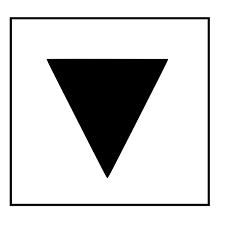
The upside down triangle symbolizes the feminine principle, water element, and descent into the material world across multiple spiritual and cultural traditions. Also known as an inverted triangle or nabla symbol, this geometric shape pointing downward represents concepts ranging from the alchemical element of water to the chalice receiving divine wisdom, from the sacred feminine in Tantric traditions to LGBTQ+ pride in contemporary culture. The meaning shifts dramatically depending on context—whether you’re examining ancient Greek philosophy, modern occult practices, or mathematical notation.
This simple yet profound symbol has captivated human imagination for thousands of years, appearing in everything from ancient temple carvings to modern jewelry designs. Let’s explore the rich tapestry of meanings behind this powerful geometric form.
The Basic Geometry and Visual Properties
An upside down triangle consists of three points forming a shape with the apex pointing downward and the base positioned at the top. This orientation creates an immediate visual contrast with the standard upright triangle, which points upward toward the heavens.
The geometric properties of the inverted triangle create a sense of grounding and descent. While upright triangles suggest aspiration, ascension, and reaching upward, the inverted form implies receptivity, grounding, and movement toward earth.
In sacred geometry, triangles represent the number three, which appears throughout spiritual traditions as a symbol of completion and divine manifestation. The Christian trinity, the Hindu trimurti, and countless other three-fold concepts find expression in triangular symbolism.
The inverted orientation specifically emphasizes the receptive, passive, or yin qualities associated with downward movement. This stands in deliberate contrast to the active, projective, or yang qualities of upward-pointing triangles.
Visually, the inverted triangle also resembles a funnel or vessel, which connects to its symbolic associations with receptivity and containment. This shape naturally collects and channels energy or substance downward.
Water Element in Alchemy and Western Esoteric Traditions
In Western alchemy, the upside down triangle serves as the primary symbol for the water element. This association dates back at least to medieval European alchemical texts and likely has roots in ancient Greek philosophy.
The alchemical water symbol represents more than just physical H2O. It embodies qualities of fluidity, emotion, intuition, and the subconscious mind. Water in alchemical thought dissolves, cleanses, and transforms.
Aristotle and earlier Greek philosophers associated water with coldness and moisture. These qualities made the downward-pointing triangle an appropriate symbol, as water naturally flows downward and seeks the lowest point.
In contrast, the fire element was represented by an upright triangle in alchemical symbolism. Fire rises, while water falls—a perfect visual representation through opposing triangle orientations.
The alchemical tradition influenced later Western esoteric systems including Hermeticism, Rosicrucianism, and various ceremonial magic traditions. All of these retained the inverted triangle as the water symbol.
Modern Wicca and neo-pagan practices also use the inverted triangle to represent water in ritual contexts. Practitioners might draw or visualize this symbol when invoking water’s qualities during ceremonies or magical workings.
The Feminine Principle and Sacred Feminine
The upside down triangle has strong associations with feminine energy, particularly in Tantric and Hindu traditions. In this context, it’s known as the Shakti symbol or yoni yantra, representing the divine feminine creative force.
Shakti in Hindu philosophy is the dynamic, creative power of the universe. She’s often depicted as the consort of Shiva, who represents consciousness. Together, they form the complete cosmic principle.
The inverted triangle specifically symbolizes the yoni, or female generative organ, in Tantric iconography. This isn’t merely anatomical symbolism but represents the cosmic womb from which all creation emerges.
In the Sri Yantra, one of Hinduism’s most sacred geometric diagrams, multiple inverted triangles interlock with upright triangles. The downward-pointing triangles represent Shakti, while upward triangles represent Shiva. Their union creates the entire cosmos.
Western feminist spirituality movements have also embraced the inverted triangle as a symbol of feminine power. This adoption connects to both ancient goddess worship traditions and modern reclamations of feminine symbolism.
The association between inverted triangles and femininity extends to the pubic triangle, which naturally forms an inverted triangular shape. Many ancient Venus figurines emphasize this triangular pubic region, suggesting awareness of this symbolism dates to prehistoric times.
Mathematical and Scientific Uses
In mathematics, the upside down triangle symbol is called nabla or del, represented as ∇. This symbol has specific technical meanings in vector calculus and differential geometry.
The nabla symbol was introduced in the late 19th century by William Rowan Hamilton and later popularized by Peter Guthrie Tait. The name “nabla” comes from a Greek harp that had a similar triangular shape.
In vector calculus, ∇ represents the gradient operator, which describes how a scalar field changes in space. It’s fundamental to physics, engineering, and applied mathematics.
The symbol also appears in divergence and curl operations, which are crucial for understanding fluid dynamics, electromagnetism, and many other physical phenomena. Maxwell’s equations, which govern all classical electromagnetic phenomena, use the nabla extensively.
This mathematical usage has no direct connection to the spiritual or symbolic meanings of inverted triangles. However, the coincidence of using a downward triangle for operations involving rates of change and gradients creates an interesting parallel with the spiritual concept of descent or grounding.
In chemistry, an inverted triangle sometimes indicates a decrease or reduction, continuing the theme of downward movement that connects various uses of this symbol.
LGBT Pride and Pink Triangle History
The pink triangle has powerful significance in LGBTQ+ history and modern pride movements. This symbol’s journey from Nazi persecution to pride emblem represents reclamation and resilience.
During the Holocaust, Nazi Germany forced gay men to wear pink triangles as identifying markers in concentration camps. This classification system marked approximately 5,000-15,000 gay men who were imprisoned and often killed.
The pink triangle pointed downward in the Nazi classification system, distinguishing it from other prisoner categories. This symbol represented one of history’s darkest periods of persecution based on sexual orientation.
In the 1970s and 1980s, LGBTQ+ activists began reclaiming the pink triangle as a symbol of pride and remembrance. The AIDS Coalition to Unleash Power (ACT UP) famously used a pink triangle with the slogan “Silence = Death.”
Some activists inverted the pink triangle to point upward, symbolizing resistance and empowerment. This upward orientation represented fighting back against oppression rather than accepting persecution.
Today, the pink triangle appears in pride contexts, Holocaust memorials, and LGBTQ+ rights advocacy. Museums like the United States Holocaust Memorial Museum document this history, ensuring the persecution isn’t forgotten.
The reclamation of the pink triangle demonstrates how oppressed communities can transform symbols of hate into emblems of pride and solidarity. This transformation adds another layer to the inverted triangle’s symbolic richness.
Religious and Spiritual Contexts
Christianity occasionally uses the inverted triangle, though less commonly than other traditions. When it appears, it typically represents the Trinity with emphasis on the Holy Spirit’s descent to humanity.
Some Christian mystics interpreted the downward triangle as Christ descending to Earth, or divine grace flowing down to humanity. This interpretation emphasizes God’s movement toward creation rather than humanity’s aspiration toward God.
In Kabbalah, the Jewish mystical tradition, triangles appear in the Tree of Life diagram. While not typically inverted, the concept of divine emanation flowing downward from Ein Sof (the infinite) through the sephirot parallels the descent symbolism of inverted triangles.
Buddhism and Eastern traditions less commonly use triangle symbolism compared to circles and other shapes. However, when triangles appear, downward orientation can represent the Buddha’s compassion descending to suffering beings.
Theosophy, a late 19th-century spiritual movement founded by Helena Blavatsky, incorporated extensive geometric symbolism including inverted triangles. The Theosophical Society’s seal contains multiple triangular forms representing spiritual principles.
Modern New Age practices often employ the inverted triangle in meditation, energy work, and chakra balancing. Practitioners might visualize inverted triangles to ground energy or connect with earth elements.
Comparing Upright vs. Inverted Triangle Symbolism
The contrast between upright and inverted triangles reveals fundamental dualities in symbolic thinking. This table summarizes the key differences:
| Aspect | Upright Triangle (△) | Inverted Triangle (▽) |
|---|---|---|
| Direction | Upward, ascending | Downward, descending |
| Element (Alchemy) | Fire, Air | Water, Earth |
| Gender Association | Masculine, Yang | Feminine, Yin |
| Energy Type | Projective, Active | Receptive, Passive |
| Spiritual Movement | Aspiration to divine | Divine descent to material |
| Symbolic Quality | Expansion, reaching | Contraction, receiving |
| Physical Metaphor | Mountain, flame | Chalice, womb |
| Consciousness | Rational mind | Subconscious, intuition |
This comparison demonstrates how a simple geometric inversion creates opposite symbolic meanings. The upright triangle reaches toward the heavens, while the inverted triangle receives from above or descends into matter.
In many traditions, the combination or intersection of upright and inverted triangles creates even more powerful symbols. The Star of David, for instance, consists of overlapping upright and inverted triangles, representing the union of opposites.
The hexagram formed by these intersecting triangles appears in Jewish mysticism but also in Hindu tantric traditions, where it symbolizes the union of Shiva and Shakti. This universal appearance suggests deep archetypal resonance with the human psyche.
Occult and Esoteric Meanings
In Western occultism, the inverted triangle carries complex and sometimes controversial meanings. Different magical traditions interpret this symbol through their unique philosophical frameworks.
Ceremonial magic systems like the Hermetic Order of the Golden Dawn use elemental triangles extensively in ritual work. The water triangle (inverted) appears in invocations, talismans, and temple layouts.
Some occult traditions associate the inverted triangle with darker or “left-hand path” practices. This association stems partly from the symbol’s connection to earthward movement and material manifestation rather than spiritual ascension.
However, this negative interpretation is often misunderstood. In balanced esoteric systems, descent into matter is necessary and complementary to spiritual ascent. The alchemical maxim “as above, so below” requires movement in both directions.
Aleister Crowley’s Thelemic system uses triangular symbolism extensively, though the meanings are complex and context-dependent. Crowley emphasized that no symbol has inherently “good” or “evil” meanings—context and intention determine significance.
The inverted pentagram (five-pointed star) sometimes confused with inverted triangles, carries different symbolism. The inverted pentagram became associated with Satanism in the 20th century, but this is distinct from triangle symbolism.
Modern chaos magic practitioners often use geometric symbols including inverted triangles pragmatically, focusing on personal association and ritual effectiveness rather than fixed traditional meanings.
Psychological and Archetypal Interpretations
Carl Jung’s analytical psychology provides fascinating insights into why triangular symbols resonate across cultures. Jung identified triangles as archetypal forms appearing in the collective unconscious.
The inverted triangle specifically might represent what Jung called the descent into the unconscious or the individuation process’s downward movement. Before ascending to integrated wholeness, one must descend into shadow material.
From a Jungian perspective, the inverted triangle’s association with femininity connects to the anima archetype—the feminine principle within the male psyche and the collective feminine archetype more broadly.
The triangle’s three points also resonate with the concept of the triple goddess (maiden, mother, crone) found in many cultures. When inverted, this trinity emphasizes the chthonic or earth-bound aspects of the goddess.
Gestalt psychology notes that inverted triangles create visual instability compared to upright triangles. This instability might contribute to the symbol’s association with transformation, change, and dynamic processes rather than stable structures.
Color psychology adds another dimension when the triangle is rendered in specific colors. A pink inverted triangle carries different psychological associations than a blue one, layering color symbolism onto geometric form.
Tattoo Culture and Personal Meaning
Inverted triangle tattoos have surged in popularity, particularly over the past decade. These tattoos carry deeply personal meanings that often blend traditional symbolism with individual interpretation.
Many people choose inverted triangle tattoos to represent feminine energy or their connection to divine feminine principles. Women particularly embrace this symbol as an affirmation of feminine power and identity.
LGBTQ+ individuals often get pink triangle tattoos as symbols of pride, remembrance, and solidarity with those who suffered persecution. These tattoos transform a symbol of oppression into personal empowerment.
Minimalist design trends in tattoo culture have made simple geometric shapes like inverted triangles increasingly popular. Their clean lines and clear form translate well to various body placements and sizes.
Some people combine inverted triangles with other elements—flowers, moons, waves—to create personalized symbolic compositions. An inverted triangle with water waves reinforces the water element association, for example.
Three inverted triangles tattooed together create the valknut symbol from Norse mythology, representing Odin and the interconnection of the nine worlds. This demonstrates how multiple triangles create new symbolic meanings.
The placement of triangle tattoos also carries meaning. An inverted triangle on the wrist might serve as a daily reminder of personal values, while one near the heart emphasizes emotional or spiritual significance.
Modern Design and Branding
Contemporary graphic design frequently employs inverted triangles for their visual impact and symbolic resonance. Designers appreciate both the form’s aesthetic qualities and its layered meanings.
The downward point creates a natural focal point that draws the eye, making inverted triangles effective in logos and brand marks. The shape suggests innovation and thinking differently from conventional upright orientations.
Tech companies occasionally use inverted triangle motifs in their branding, though less commonly than other geometric shapes. When employed, it often suggests downloading, descending into data, or user-friendly accessibility.
Fashion brands sometimes incorporate inverted triangles into patterns and designs, playing with the symbol’s associations with femininity, elemental forces, or geometric modernism.
In user interface design, downward-pointing triangles commonly indicate dropdown menus or expanding content. This functional use connects to the symbol’s broader association with descent and revelation of hidden content.
Architecture sometimes employs inverted triangular forms for dramatic visual effect. Buildings with inverted triangular elements create dynamic, modern aesthetics that challenge traditional upright construction.
The symbol’s versatility allows designers to layer multiple associations—a wellness brand might use an inverted triangle to suggest water and emotional healing, while a feminist organization might emphasize feminine empowerment.
Cultural Variations Around the World
While Western traditions provide much of the documented inverted triangle symbolism, other cultures have their own interpretations and uses of this geometric form.
In some Native American traditions, triangular shapes represent mountains, tipis, or directional markers. While specific inverted triangle symbolism is less documented, downward-pointing forms might represent valleys, caves, or receptive earth energy.
African symbolic systems vary tremendously across the continent’s diverse cultures. Some West African traditions use triangular patterns in textiles and art, though specific meanings of orientation aren’t always clearly documented in accessible sources.
Chinese philosophy’s yin-yang system doesn’t traditionally emphasize triangles as primary symbols, preferring circles and curved forms. However, modern interpretations sometimes map triangular symbolism onto yin (inverted) and yang (upright) principles.
Japanese culture occasionally employs triangular forms in family crests (mon) and religious contexts. The orientation’s significance varies by context, with Buddhist and Shinto traditions having different symbolic languages.
Maori and Polynesian cultures use extensive geometric symbolism in their traditional art and tattoos. While triangular forms appear frequently, the specific symbolism of inverted versus upright triangles differs from Western interpretations.
Contemporary global culture increasingly shares symbols across borders through internet communication. This creates both deeper understanding of diverse meanings and sometimes simplified or appropriated interpretations that lose cultural context.
Practical Applications in Meditation and Energy Work
Many spiritual practitioners use the inverted triangle as a meditation focus or visualization tool. These practices harness the symbol’s archetypal power for personal transformation and healing.
Grounding meditations often incorporate visualizing an inverted triangle extending from the base of the spine downward into the earth. This practice helps practitioners feel more stable, present, and connected to physical reality.
Chakra work sometimes employs inverted triangles when focusing on lower chakras—the root and sacral chakras particularly benefit from downward-flowing energy visualizations that inverted triangles facilitate.
Water element meditations naturally incorporate inverted triangle symbolism. Practitioners might visualize this shape while contemplating emotional flow, intuitive wisdom, or the cleansing properties of water.
Some energy healers use inverted triangle hand positions (mudras) to channel healing energy downward into clients’ bodies or to ground excessive mental or spiritual energy into the earth.
Tantric practices involving the Shakti triangle include complex visualizations of inverted triangles combined with mantra recitation, breath work, and sometimes physical postures. These practices aim to awaken kundalini energy and achieve spiritual realization.
Modern eclectic spiritual practitioners create personal rituals combining various traditional uses. Someone might draw an inverted triangle on paper while setting intentions related to receiving abundance or grounding creative ideas into material reality.
The Inverted Triangle in Art History
Art history reveals fascinating uses of inverted triangular composition and symbolism. Artists across centuries have employed this form for both aesthetic and symbolic purposes.
Renaissance paintings sometimes used inverted triangular composition to create visual stability with the base at the top of the canvas. This technique draws the eye downward and creates a sense of weight and grounding.
Religious art occasionally features inverted triangles in symbolic contexts. The dove representing the Holy Spirit sometimes appears within or surrounded by inverted triangular forms, symbolizing divine descent.
Modern and contemporary artists have explored geometric abstraction including triangular forms. Artists like Wassily Kandinsky and Piet Mondrian used triangles to explore pure form, color relationships, and spiritual expression through geometry.
Feminist artists beginning in the 1970s deliberately incorporated inverted triangles and vulvar forms into their work. Judy Chicago’s “The Dinner Party” and other feminist artworks reclaimed feminine symbolism including triangular forms.
Street art and graffiti culture sometimes employs inverted triangles in compositions. These uses range from purely aesthetic geometry to conscious incorporation of LGBTQ+ pride symbolism.
Contemporary digital art and generative art often features algorithmic explorations of triangular forms. These works investigate how orientation, color, and arrangement create psychological and aesthetic effects.
Scientific and Natural Occurrences
While much triangle symbolism is human-created, inverted triangular forms appear naturally in the physical world, possibly contributing to the symbol’s archetypal power.
Water droplets form roughly triangular shapes when hanging from surfaces before falling. This natural phenomenon creates a visual link between inverted triangles and water, reinforcing alchemical associations.
Certain crystal formations grow in triangular patterns. Minerals like fluorite sometimes form triangular faces on their crystal structures, and when oriented point-downward, create natural inverted triangles.
The female pubic triangle naturally forms an inverted triangular shape, creating an obvious anatomical connection that ancient peoples would have observed. This biological reality grounds abstract symbolism in physical form.
Mountain valleys and river deltas often create inverted triangular landscape patterns when viewed from above. These geological formations demonstrate how earth and water naturally create this shape.
Some plant leaves and flower structures display triangular symmetry. When these point downward, as in certain hanging flowers, they create natural inverted triangular forms.
The shadow cast by an upright pyramid or cone creates an inverted triangular shape on the ground, suggesting how ancient peoples might have connected geometric forms with their shadows and reflections.
Common Misconceptions and Clarifications
Several misconceptions about inverted triangle symbolism persist. Clarifying these helps develop more accurate understanding of the symbol’s meanings.
The inverted triangle is not inherently Satanic or evil. This misconception confuses inverted triangles with inverted pentagrams, which are distinct symbols. Even inverted pentagrams have complex meanings beyond popular cultural associations with Satanism.
Not all inverted triangles represent the same thing. Context determines meaning—an inverted triangle in a chemistry textbook means something entirely different from one in a Tantric mandala or on a pride flag.
The pink triangle specifically relates to LGBTQ+ history and pride. Using this symbol without awareness of its connection to Holocaust persecution and subsequent reclamation can be insensitive or appropriative.
Sacred geometry practitioners sometimes claim precise mathematical properties for symbolic triangles, but spiritual meanings shouldn’t be confused with mathematical properties. A symbol’s power comes from archetypal and cultural associations, not from mathematical ratios.
The symbol’s association with femininity doesn’t mean only women should use it or that it represents all women. Symbolic associations aren’t prescriptive rules about who can engage with symbols.
New Age claims that inverted triangles channel specific “frequencies” or “vibrations” lack scientific support. While symbols clearly affect human psychology and have spiritual significance, pseudoscientific explanations aren’t necessary to validate their importance.
How to Use Inverted Triangle Symbolism Personally
Individuals interested in working with inverted triangle symbolism can incorporate it into their lives in various meaningful ways.
Start by reflecting on which aspects of the symbol’s meanings resonate most personally. Are you drawn to its water associations, feminine qualities, grounding properties, or another dimension?
Create simple visual reminders by drawing inverted triangles in journals, on sticky notes, or as phone backgrounds. This keeps the symbol present in daily life and reinforces your chosen associations.
Incorporate the symbol into meditation practice by visualizing an inverted triangle during sessions focused on grounding, emotional awareness, or connecting with feminine energy.
Some people create personal altars or sacred spaces featuring inverted triangle imagery. This might include drawings, carved or painted triangles, or objects naturally forming this shape.
Wear jewelry featuring inverted triangles as a daily reminder of your intentions or values. This makes the symbol’s energy accessible throughout the day.
If considering a tattoo, research the various meanings and ensure you’re comfortable with the specific associations your chosen design might convey to others who recognize the symbol.
Study traditions that use this symbol to deepen understanding. Reading about alchemy, Tantra, sacred geometry, or other systems provides richer context for personal practice.
Conclusion: The Enduring Power of the Inverted Triangle
The upside down triangle carries remarkable symbolic density—from ancient alchemical water symbols to modern LGBTQ+ pride emblems, from Tantric representations of cosmic feminine power to mathematical operators describing change and flow.
This simple geometric form demonstrates how humans across cultures and centuries have found profound meaning in basic shapes. The inverted triangle’s associations with descent, receptivity, femininity, and elemental water create a coherent symbolic cluster that resonates with deep psychological and spiritual truths.
Whether you encounter this symbol in a medieval alchemical text, a contemporary pride march, a sacred Tantric artwork, or a mathematical equation, it carries layers of meaning accumulated through millennia of human symbolic thinking.
The inverted triangle reminds us that descent is as sacred as ascent. Receiving is as powerful as projecting. The feminine principle complements rather than opposes the masculine. Water’s flowing, adaptive nature holds wisdom that fire’s intensity cannot provide.
In our upward-focused culture that values ascension, achievement, and rising above, the inverted triangle offers an important counterbalance. It suggests that sometimes we must descend—into our bodies, our emotions, our intuitions, and the material world—to find wholeness.
As symbols continue evolving in our interconnected global culture, the inverted triangle will undoubtedly acquire new meanings while retaining its ancient associations. Its geometric simplicity ensures it will remain accessible, while its symbolic depth guarantees continued fascination for those who explore its meanings.
Understanding this symbol’s rich history and varied meanings allows us to engage with it more consciously, whether we encounter it in art, use it in spiritual practice, or simply notice its recurring presence in the visual landscape of human culture.
