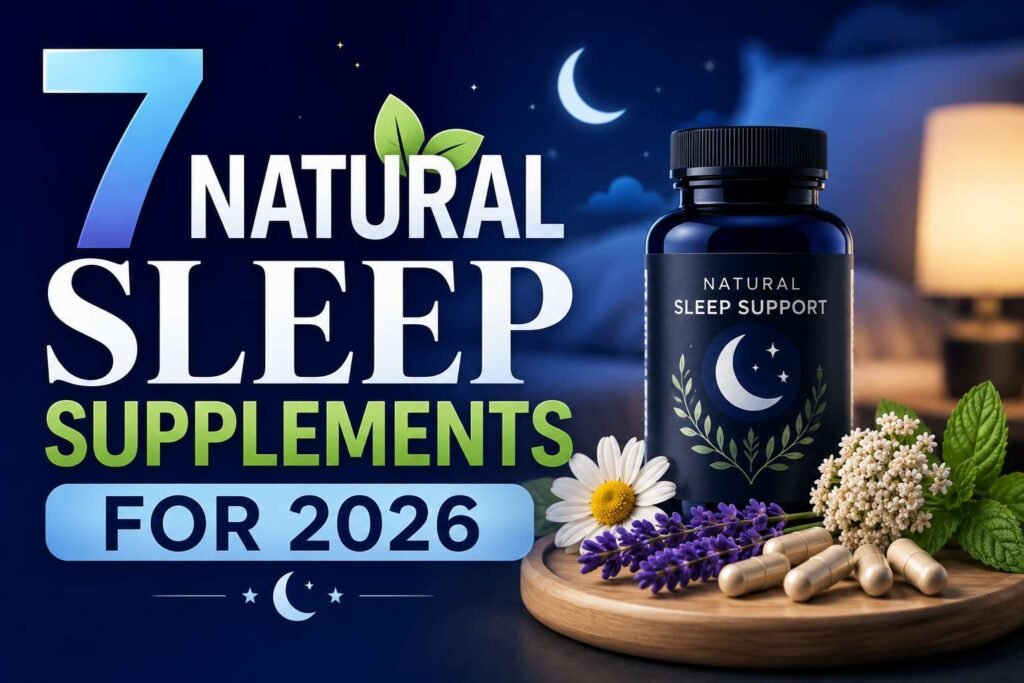
If you’d rather not reach for a synthetic sleep aid, the good news is that 2026’s research on natural sleep support is more solid than it’s ever been.
“Natural” here means plant-based, amino acid, mineral, or vitamin ingredients — things your body already knows how to use, rather than synthesized sedatives. None of these will knock you out like a prescription sleep aid, and that’s actually the point. The goal is to support systems your body already has:
- Nervous system arousal level
- Core body temperature
- Stress hormones
…rather than override them.
Before you dive in: supplements work best alongside good sleep habits, not instead of them. A consistent bedtime, a dark and cool room, and less screen time before bed will outperform any pill on this list if those basics aren’t already in place. If you’re dealing with chronic insomnia, it’s worth looping in a doctor — the American Academy of Sleep Medicine specifically advises against relying on over-the-counter sleep aids as a long-term fix for ongoing sleep problems.
A note on ordering: the first entry below is an Editor’s Pick, based on the author’s personal experience rather than a claim that it out-evidences the others. The remaining six are ordered roughly by strength of clinical evidence.
1. Yu sleep — Editor’s Pick
This is my number 1 recommended pick for better sleep.
I’ve used Yusleep myself and found it genuinely effective — noticeably easier to fall asleep and fewer middle-of-the-night wakeups. It’s placed first because it’s the product I personally reach for,
What it is
Yusleep is a liquid, sublingual sleep supplement that takes a “kitchen sink” approach compared to most single- or dual-ingredient products on this list. One dose combines ten plant-based and amino-acid ingredients:
- Tart cherry extract
- Magnesium glycinate
- GABA
- L-theanine
- 5-HTP
- Lemon balm extract
- Apigenin
- Vitamin B6
- Vitamin B2
- Melatonin (0.9 mg — a comparatively low dose)
Why the formulation makes sense
A few of these pairings aren’t random:
- B6 + 5-HTP: B6 is a cofactor that helps convert 5-HTP into serotonin, so the pairing is functional, not filler.
- Low-dose melatonin: 0.9 mg lines up with the “less is more” guidance that’s become standard in 2026 sleep research, rather than the inflated 5–10 mg doses common on drugstore shelves.
- Sublingual delivery: delivered as a liquid rather than a capsule, which the company markets as enabling faster absorption — though independent, product-specific absorption data isn’t publicly available.
What to know before you buy
- It’s sold direct-to-consumer, not through major retailers like Amazon or Walmart. Search for it directly, verify you’re on a legitimate ordering page, and read the return policy before purchasing. Don’t feel pressured by “limited time” discount countdowns — that’s a standard marketing tactic across this entire product category, not something specific to this brand.
- 5-HTP + melatonin is generally considered redundant rather than harmful for most healthy adults, since both act on the same serotonin-melatonin pathway. But 5-HTP has a hard contraindication with SSRIs, SNRIs, MAOIs, and triptans due to serotonin syndrome risk. Talk to your doctor first if you take any of those.
- Treat marketing claims about dramatic before/after results, weight loss, or anti-aging effects with healthy skepticism, here and with any sleep brand. A sleep formula’s job is to help you sleep — claims that go well beyond that are worth scrutinizing.
Bottom line: If you want a multi-ingredient, all-in-one product rather than building your own stack, this is one of the more thoughtfully formulated combination products available in 2026. Individual results vary based on your baseline sleep issues and sensitivity to each ingredient.
👉 Try Yu Sleep Risk Free for 60 Days
2. Magnesium Glycinate
Magnesium is the closest thing 2026 has to a consensus pick among natural sleep aids — a good starting point if you’re new to sleep supplementation.
How it works
Magnesium is a cofactor in hundreds of enzymatic reactions, including ones that:
- Regulate the NMDA receptor pathway
- Support the conversion of tryptophan into serotonin (an upstream step in melatonin production)
- Calm the nervous system and relax muscle tissue
A 2025 randomized trial published in Nature and Science of Sleep found magnesium bisglycinate improved sleep quality in adults who reported poor sleep, helping them fall asleep faster and wake up feeling more rested.
The catch
The evidence is genuinely mixed. A 2026 study in the European Journal of Nutrition found no notable effect on sleep quality overall. The likely explanation: magnesium mainly helps people who are actually deficient, and roughly half of American adults fall short of the recommended intake. If your levels are already fine, extra magnesium probably won’t move the needle much.
Dosage
Glycinate or bisglycinate forms are best absorbed and gentlest on the stomach. Skip magnesium oxide — it’s cheap but poorly absorbed. A typical effective dose is 200–400 mg, taken 30–60 minutes before bed.
3. L-Theanine
L-theanine is an amino acid found naturally in green tea, and it’s become a staple of natural sleep stacks because it does something most sedating ingredients don’t: it quiets a racing mind without acting as a sedative.
How it works
It works primarily by promoting alpha brain wave activity — the same relaxed-but-awake state associated with meditation — while modestly increasing GABA and serotonin levels. Research published in the journal Nutrients has specifically highlighted L-theanine as a safe option worth investigating for sleep support. It’s also been studied in combination with GABA, where the pairing appears to shorten the time it takes to fall asleep more effectively than either ingredient alone.
Because it isn’t sedating on its own, L-theanine is well suited to people whose main problem is a busy brain at bedtime rather than difficulty feeling physically tired.
Dosage
100–200 mg, about 30–60 minutes before bed. It combines well with magnesium and apigenin, and it’s one of the few natural sleep ingredients considered safe for regular nightly use.
4. Glycine
Glycine is an amino acid that’s quietly become one of the better-supported natural sleep ingredients, despite getting far less attention than melatonin or magnesium.
How it works
Its main mechanism is thermoregulatory: glycine appears to help lower core body temperature, which is one of the physiological triggers for sleep onset.
Paired with magnesium glycinate, it’s frequently cited as the highest-evidence two-ingredient combination for both sleep onset and sleep quality — and it’s considered a solid starting stack for people who are new to sleep supplements and want to keep things simple and natural.
Dosage
Around 3 grams before bed, ideally paired with magnesium glycinate. Side-effect risk is low, which makes it a reasonable everyday option.
5. Ashwagandha (KSM-66)
Ashwagandha is an adaptogen, not a direct sedative. It’s best suited to a specific kind of sleep problem: stress-driven insomnia, where cortisol and a wired nervous system are the main barrier to rest rather than an inability to physically relax.
How it works
Research on the KSM-66 extract specifically has shown it can lower evening cortisol levels, which is the proposed mechanism for its sleep benefit. It’s often stacked with apigenin — ashwagandha handles the stress-hormone side, apigenin manages residual mental arousal.
The catch
There’s an ongoing conversation in the research community about ashwagandha and liver safety at higher doses or with prolonged daily use. It’s generally recommended as a cycled supplement (commonly 8 weeks on, 2 weeks off) rather than something you take indefinitely every night.
Dosage
300–600 mg of KSM-66 extract, sometimes taken in the morning rather than at night since its effect is on cumulative stress load rather than immediate sedation. Check with a doctor if you have any liver conditions or take medications metabolized by the liver.
6. Tart Cherry Extract
Tart cherry is one of the few food-based sleep aids with actual clinical backing, largely because it’s one of the small number of natural sources of dietary melatonin, alongside antioxidant compounds that may support sleep indirectly.
How it works
A pilot study on tart cherry juice specifically looked at insomnia in older adults and found benefits for sleep duration and quality. It’s generally considered most useful for older adults and athletes, where recovery and nighttime awakenings tend to be bigger issues than sleep onset itself.
Dosage
Around 480 mg of concentrated extract, taken 1–2 hours before bed. It’s often used as an optional add-on to a core stack rather than a standalone solution.
7. Apigenin
Apigenin is a plant flavonoid found in chamomile, parsley, and celery. It went from niche to mainstream fast after appearing on several popular health podcasts, most notably Andrew Huberman’s.
How it works
Apigenin binds to GABA-A receptors and has anti-anxiety effects, which is the theory behind calling it “nature’s gentle sedative.” Paired with magnesium, it forms what’s now commonly referred to as the “alpha stack” — magnesium handles NMDA receptor activity and direct sleep pathways, apigenin handles arousal reduction.
The catch
Apigenin’s popularity has significantly outpaced its clinical evidence. As of 2026, there are no published human trials at the doses typically used in supplements — most of what we know comes from chamomile tea studies and animal research, not isolated apigenin capsules at scale. That doesn’t mean it doesn’t work, but the “gentle sedative” reputation is running ahead of the data — which is why it’s last on this particular list despite the buzz around it.
Dosage
Around 50 mg, 30–60 minutes before bed. There’s no established standard dose since regulators haven’t set one, so start low and see how you respond.
How to Choose
With seven natural options on the table, here’s a simple way to narrow it down based on what’s actually keeping you up:
| If your problem is… | Try… |
|---|---|
| Trouble falling asleep because your mind won’t shut off | L-theanine or apigenin, alone or stacked with magnesium |
| Waking up in the middle of the night | Magnesium glycinate, glycine, or tart cherry extract |
| Stress is the root cause | Ashwagandha, ideally cycled rather than taken indefinitely |
| You want one product instead of a stack | A multi-ingredient formula like Yusleep — check the medication interactions above first |
A few last things to keep in mind
Introduce one at a time. Space new supplements a couple of weeks apart so you can actually tell what’s helping. Stack five new ingredients at once and, if something goes wrong — an upset stomach, grogginess, vivid dreams — you won’t know which one caused it.
Set realistic timelines. L-theanine can have a noticeable effect the very first night, since it acts on a system (nervous-system arousal) that responds quickly. Magnesium and ashwagandha work more cumulatively — they’re correcting a deficiency or gradually lowering a stress-hormone baseline, which tends to show up as a trend over a couple of weeks rather than an overnight change. Two or three nights without a dramatic difference doesn’t necessarily mean it isn’t working.
Fix the basics first. Supplements sit downstream of your actual sleep habits, not upstream of them. If your room is too warm, your schedule is inconsistent, or you’re scrolling your phone in bed until midnight, no ingredient on this list — however well-researched — will fully compensate for that.
👉 Try Yu Sleep Risk Free for 60 Days
Used alongside good sleep hygiene, the options above represent some of the most credible, natural, evidence-informed choices available in 2026. If sleep problems are frequent, severe, or affecting your daily functioning, a supplement is worth trying, but it’s not a substitute for talking to a doctor about what’s actually going on.